Articles
of Interest & News
|
Rottweilers owner
Target of proposed law limiting pets in Mendham Township
Observer Tribune by PHIL
GARBER, Managing Editor
Friday, December 9, 2011
|
MENDHAM TWP. - A proposed law that would bar any resident from having more than six dogs is apparently aimed at a 5 Thakery Lane homeowner who raises champion Rottweilers.
The property owner, Vincent Carraba, said he will sue if the law is approved by the Township Committee.
“I’m devastated,” said Carrabba. “My whole life is my dogs.”
Animal protection representatives opposed the proposal and said it would punish responsible pet owners and that current laws can be applied to stop loud or threatening animals.
The law was introduced on Nov. 29 and is scheduled for a public hearing and final vote on Monday, Dec. 12. The proposal was previously introduced in October but was delayed until it was reviewed by the township attorney. It was unanimously introduced Nov. 28.
The proposal would be retroactive and if passed, would require Carraba to either give away or have most of his Rottweilers put down.
“Telling people right before Christmas that they have to get rid of their dogs or have them put down is unconscionable,” said Carraba’s lawyer, Scott L. Carlson of Riker Danzig of Morristown.
The impetus for the proposal was not clear because neither Mayor Frank Cioppettini nor Vice Mayor Samuel Tolley would comment. Cioppettini declined to comment until after the public hearing while Tolley said he was not familiar enough with the plan to speak.
Long History
The issue goes back about seven years when a neighbor first complained to the township and threatened a lawsuit if action was not taken against Carrabba.
Public records showed that Carrabba’s home was inspected and that the animals were deemed to be not threatening, were well cared for and the home was clean. Carrabba was given a summons for illegally operating a kennel, although he said he raises the dogs to show around the world and any sales are made through facilities in Staten Island, N.Y. and Syracuse, N.Y.
The proposal would allow three dogs per property, with one for each added acre, up to a maximum of six.
Carraba, 37, owns a security company and has lived in town for seven years.
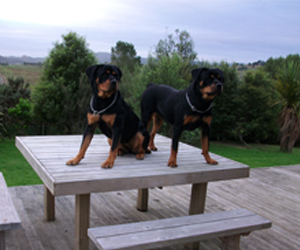
He and his wife, Lisa Landi, are currently raising 12 Rottweilers on his three-acre property. He said no one has ever complained that his dogs are aggressive and that he pays walkers to regularly walk the pets in the neighborhood.
He gets regular deliveries of high quality meat to feed his pets which he shows around the world, most recently placing high in events in Italy and Germany. Carraba said he breeds one dog a year and sells an average of five pups each year from his facility in Syracuse, N.Y.
He said he fell in love with Rottweilers after he got his first one when he was 16 and living with his family in Staten Island. He moved to the township, in part, so he could raise many of the animals.
“I always wanted to have my own land,” Carraba said. “I left Staten Island because I wanted to live my dream.”
No one answered the door at the Carraba home but a large Rottweiler with the signature large head and powerful body was in an outdoor cage and true to the breed, barked loudly and aggressively at the approach of a visitor.
Carraba’s lawyer said the Carrabas take good care of their animals.
“We’re trying to put the brakes on this ordinance,” Carlson said. “You shouldn’t penalize responsible people. They’re probably the most responsible animal owners you would meet.”
After receiving a complaint from a resident in April 2010, Nora Jacobs, the town’s animal control officer, inspected the Carraba property. She determined that the Carrabas were not operating an illegal kennel but were “hobby breeders.”
“There are no state statutes that prohibit dog owners from breeding their pets,” Jacobs reported.
She also said the premises were “immaculate” and the 12 dogs and two puppies were “well cared for” and that there was “little barking” by any of the dogs.
Jacobs inspected the property again on June 21, 2010. At the time, Carrera had 14 dogs and Jacobs again found they were well cared for and that there were no violations.
Russ Heiney, the township zoning official, reported on April 16, 2010, that the first inspection was conducted about four or five years earlier after a complaint by a neighbor and that no violations were found.
The Animal Protection League of N.J. has joined on the side of the Carrabas. The league’s programs director, Janine Motta, wrote in a letter to residents that ordinances limiting the number of dogs would have unexpected and unfortunate results.
“Dog limit ordinances do not recognize that many dog lovers can care for many dogs and by doing so prevent the unnecessary impoundment and killing of healthy dogs,” Motta wrote. “The Animal Protection League of N.J. upholds the right of homeowners to be free from nuisances caused by others and existing ordinances can adequately address such issues.”
Motta wrote that laws limiting the number of pets unfairly penalize responsible pet-owners.
The Humane Society of the U.S. also recommends against setting pet limits. Nora Parker of St. Hubert Animal Welfare Center in Madison also said laws limiting animals do not stop pet hoarders and that existing laws are adequate to address noise and other animal complaints.
Animal organizations meanwhile said that the powerful mastiff-like Rottweiler has an unwarranted reputation for being aggressive. A spokeswoman for the American Kennel Club said the behavior of Rottweilers like all animals, is a result of training and not breed. She said that breeds that are used as show dogs have extensive socialization and are even less likely to be aggressive.
According to the Official Rottweiler Guide, the Rottweiler was used in Roman times to herd cattle and protect property from wolves, thieves and other dangers.
“The ferocity of the Rottweiler is owed to its origins and its initial occupation and history shows that unless they were strong and ferocious during their herding time, they would not have lasted against the natural and human predators,” the guide said. “It takes a lot to control and master this animal, and you will need to have an active and assertive personality so it can respect you as its leader. Obedience training is of paramount importance for this dog breed, and this has to be done before it becomes full grown.”
The guide said Rottweilers are intelligent and can be great companions.
According to the American Rottweiler Club, through the 1970’s, the Rottweiler was a fairly uncommon dog in the United States. In the early 1980’s the breed grew in popularity, and has been the second most popular AKC breed since 1992.
|
|
Top of page
|
MORE THAN MEETS THE EYE Proximity and Knowledge - Keys to
Observation
By Carmen L. Battaglia, PhD
- Breeding Better Dogs
|
Did you ever wonder why people disagree about the winners at a dog show? We all have at one time or
another, but we know from our experiences that what we think we observed usually depends on many things.
At most shows its a matter of where you sit or stand during the judging and what you know about the breed
standard, structure and movement. Each of these elements tends to influence what we see and think. For
example, when a dog is standing, much of its anatomy can be noticed, but when it is gaiting, its movement is
often quicker then the eye. In the confined space and limited time allowed in the show ring, even the educated
eye that knows what to look for can be misled. In the ring, many things are happening at the same time. Since
dogs can move in different ways, where we position ourselves will determine which part of the judging we will
see. It might only be the sidegate or perhaps the down and back, or maybe just the individual examination.
....more
|
|
Top of page
|
Rottweiler study links ovaries with exceptional longevity
AVMA
Journals
|
New
research on the biology of aging in dogs suggests a
link between shortened life expectancy and ovary
removal.
The
study, published in the December 2009 issue of the
journal Aging Cell, found that Rottweilers that were
spayed after they were 6 years old were 4.6 times as
likely to reach 13 years of age as were Rottweilers
that were spayed at a younger age.
The
finding is important because the average life
expectancy of Rottweiler dogs is 9.4 years, observed
research team leader Dr. David J. Waters. "Our
results support the notion that how long females
keep their ovaries influences how long they
live," he said.
Dr.
Waters is the executive director of the Gerald P.
Murphy Cancer Foundation at the Purdue Research Park
in West Lafayette, Ind. The foundation is home to
the Center for Exceptional Longevity Studies, which
tracks the oldest living pet dogs in the country.
Although
the findings may challenge long-held notions about
pet neutering, Dr. Waters believes veterinarians
shouldn't dismiss the research outright but,
instead, see it as an exciting development in pet
longevity research.
"It
was once considered a fact the earth was flat, and
then somebody's data said otherwise. That's what
scientific discoveries dothey reshape the
intellectual terrain," said Dr. Waters, who is
also associate director of Purdue University's
Center on Aging and the Life Course and a professor
in the Department of Veterinary Clinical Sciences.
Dogs
are a good model for cancer studies in humans, and
now there's growing support for using pet dogs in
research aimed at helping people live longer lives.
The National Institute on Aging, for instance,
issued a call in November for information on the
feasibility of studying pet dogs to advance the
study of human aging.
Dr.
Waters' team spent a decade collecting and analyzing
medical histories, longevity, and causes of death
for 119 Rottweilers in the United States and Canada
that survived to 13 years of age. These dogs were
compared with a group of 186 Rottweilers with more
typical longevity.
Researchers
found that female Rottweilers have a distinct
survival advantage over malesa trend also
documented in humans. That advantage appears to be
determined by whether the female dog is sexually
intact, however. "Taking away ovaries during
the first four years of life completely erased the
female survival advantage," Dr. Waters said.
The
Rottweiler research mirrors the findings of the
Nurses' Health Study published in May 2009 in
Obstetrics & Gynecology by William Parker, MD,
and colleagues from the John Wayne Cancer Institute
in Santa Monica, Calif.
Dr.
Parker's group studied more than 29,000 women who
underwent a hysterectomy for benign uterine disease.
The findings showed that the benefits of ovary
removalprotection against ovarian, uterine, and
breast cancerwere outweighed by an increased
mortality rate from other causes. As a result,
longevity was cut short in women who lost their
ovaries before the age of 50, compared with those
who kept their ovaries for at least 50 years.
How
ovaries affect longevity in Rottweilers is not
understood, but Dr. Waters' research points to a new
set of research questions, recalibrating the
conversation about removing ovaries.
"We
liken this to an ecosystem," Dr. Waters
explained. "If you take the caterpillars out of
an environment, what are you left with? I'm betting
that like removing all the caterpillars, removing
ovaries has unanticipated, unforeseen consequences.
An adverse effect on longevity might just be one of
those consequences."
Does
Dr. Waters recommend that every dog owner delay
their pet's ovariohysterectomy? Not at all. In fact,
he cautioned against overgeneralizing the study
findings, saying much more research is needed.
"We
studied purebred dogs living with responsible
owners. You could say our results aren't pertinent
to stray dogs or mongrel dogs. I don't believe every
Rottweiler or every woman will benefit from keeping
ovaries. That's an all-or-none stipulation, and
that's not how biology works," he said, adding
that tomorrow's challenge will be to identify which
individuals benefit from retaining or removing
ovaries.
To
meet the needs of veterinarians who want to better
understand the biology of aging, Dr. Waters
developed a Gerontology Training Program for DVMs at
Gerald P. Murphy Cancer Foundation, based on his
experience teaching biogerontology to graduate
students for more than a decade at Purdue. As
longevity research advances, veterinarians need to
be prepared. "We make the surest progress when
cutting-edge research and cutting-edge education go
hand in hand," Dr. Waters said.
R.
Scott Nolen
|
|
Top of page
|
Renaming Your Rescue Dog
by Darlene Arden
(Subscribe to Darlene Arden's
posts)
Aug 25th 2011 @ 1:00PM Filed Under: Dogs,
Pet Adoption
There are few things in life as rewarding as giving a homeless animal a second chance at life. Some have never had a proper home, many have never had a good home and some have lost their home because of their owner's life circumstances, often the death of the owner or the birth of a child who is dangerous allergic to pets.
One question that often arises is whether or not to give your new dog a new name. This may sound frivolous to some but it's a serious question and a real consideration. Here's my "rule of thumb" for renaming a dog.
If the dog has been in a loving home and has only positive associations with his name, I advise keeping the name. He has already lost so much in life, why subject him to losing the last familiar thing? It will help make the transition easier if he knows that you're talking specifically to him. Acknowledge who he is and always use his name in a loving tone of voice.
On the other hand, there are certainly times when changing your dog's name is advisable, when he needs a fresh start in every possible way, including a new name. In some cases, the dog may have been brought into a shelter off the street and has no name. In that case, the shelter volunteers have named him but his only real association with the name is a loud, cold, noisy shelter environment and what little affection the volunteers can spare when it has to be spread among so many animals. In other cases, the dog has a bad association with his name. These are often the dogs that have been relinquished to shelters. In Breed Rescue Groups, volunteers foster the dogs to help them make the transition to a new home so, for our purposes, we'll be concentrating on shelter dogs or those off the street who have appeared in your life.
Usually, dogs who have been relinquished by their owners have come with some sort of history or their reaction to volunteers can tell part of the story just by watching their body language. While most small dogs are given up because of housetraining issues, many people get a dog and get tired of it so they stick the dog in the backyard, totally ignoring this living, breathing, sentient being. Or they get bored. Or they no longer want the responsibility, or it grew bigger than they thought. The human-animal bond means nothing to these people and it is the dog that suffers. Other people take out their hostilities on the dog, hitting it, screaming at it, kicking it , etc. Not one of these dogs will have a positive association with his or her name. These dogs have often been called by name only to be punished, they've been screamed at, they've been abused.
Along with the tender, loving care you provide a new name will help set the tone for a new life.
Naming your adopted dog will give you both a fresh start. You may want to start with something close to the dog's previous name and use the old name first, quickly followed by the new name. Then switch to new first and then old name, and then phase out the old name entirely.
If the dog's background has been so horrible that quakes when he hears his name, just change it immediately and remember to associate it with only good things. Use his name and toss a treat his way but not directly at him. Don't frighten him because he's had a lifetime of fear. Always call him to you to pat and praise him and give him a small treat. You never want to call any dog to you for punishment or to yell at him. Always make the association positive and loving.
Remember to be patient with your new family member. It takes time to adjust to a new home, a new name, and feel secure. Positive training will help him make positive associations with his new home, his new family and his new life. Speak softly to him, tell him he's a good boy (or good girl) and set your dog up to do things that you can encourage. Mistakes happen. Don't yell at him, especially be careful to use the new name in positive, loving ways and don't rush your newcomer. Allow him to have some time get acquainted. He's going to expect to be yelled at for no reason that he understands, or punished, or left alone in the yard, or returned to the shelter. It takes time to build trust and that wonderful human-animal bond. A slow, steady start and a brand-new name will lead to a lifetime of wonderful experiences and a deep and satisfying human-animal bond for you and your dog.
Darlene Arden is a Certified Animal Behavior Consultant, a speaker, a learning facilitator, an award-winning writer, and the author of more than half a dozen pet books, including her dog behavior book
Rover, Get Off Her Leg! You can find her online at
www.darlenearden.com and on
Red
Room.
|
Top of page
|
American Kennel Club - AKC Breeder
What's in a Name Can Hurt You
Canine Legislation, and What You and AKC Can Do About It
Summer
2011
Its hard to be a breeder or an AKC club member without hearing warnings at least occasionally about the vast amount of canine legislation introduced throughout the country each year. So far in 2011, the AKC Government Relations team (AKC GR) is tracking over 1,000 legislative proposals, and over one-third of them directly impact those who breed dogs.
For hobby breeders, one of the most significant new trends and threats are bills that define all breeders as commercial enterprises. For many, the concept of being a commercial or high-volume breeder sounds so foreign that its hard to imagine such legislation could impact them. But the truth is, commercial breeder legislation can impact anyone who keeps intact dogs, and especially anyone who has ever bred or may breed a dog.
Even when the stated purpose of legislation is to regulate commercial breeding operations, its important to look at how the term commercial breeder is defined, as many bills seek to heavily regulate so-called commercial breeders based on the number of dogs owned, not on the commerce actually conducted.
The AKC respects the important role high-quality professional breeders play in meeting the demand for quality pets. These breeders provide beloved pets and they deserve recognition for the good job they do. Far too often, the creation of restrictive new laws rather than the enforcement of existing negligence/cruelty laws to crack down on a few bad actors ends up missing the intended mark. Instead, it targets small hobby breeders who hand-raise puppies and requires them to obtain new commercial licenses, be subject to inappropriate inspections, or comply with facilities requirements designed for large commercial kennels.
One of the most significant and easily overlooked issues is the impact that changing the official categorization of a home-based/hobby enterprise to a commercial operation can have. In many cases, this may actually jeopardize a persons home! Someone who has lived their entire lives in a residential community may suddenly find they are in violation of local zoning laws, even though nothing they do has changed.
Legislation requiring small breeders to comply with regulations designed for large commercial operations can result in unintended consequences, including:
Placing so many demands on breeders that they can no longer breed at all
Forcing breeders to change from a small home-based model to a larger commercial-style model that they dont have the resources or the desire to operate, or worst of all
Forcing breeders into a situation where they may be violating the letter of the law merely by providing the best possible care for their dogs.
For any hobby breeder who has ever thought that commercial-breeder legislation does not impact you, consider this:
The current definition of commercial breeder in Nebraska includes anyone who owns four or more intact females intended for breeding. This definition illustrates several common issues. Even if there is no intention to breed the dog, the burden of proof is on the owner to prove a negative. Under this lawregardless of whether you have actually bred a dog you are technically considered to be a commercial breeder. And once you are designated by the state to be commercial, you can then easily run afoul of local zoning or other ordinances.
Legislation currently before Congress (S. 707/H.R. 835, known as PUPS) would require anyone who owns or co-owns dogs that produce more than 50 puppies that are sold in a single year to be regulated in the same manner as a USDA puppy dealer (wholesaler). Legislation sounds benevolent enough, but consider this: If you co-own several dogs bred just a few times in a single year, this could include you. Even if you never whelp a single litter, or see a single puppy, you could be subject to licensing and inspection as a commercial breeder.
What is AKC doing about it?
With so many purebred dog owners and breeders under legislative attack, its not surprising, that one of the most common questions we hear is, Whats the AKC doing about canine legislation?
AKC GR is charged with addressing issues on a daily basis that impact the rights of responsible dog breeders and all dog owners. Advocacy works best when those directly affected by it take the lead in working with legislators. For this reason, AKC GR does not regularly send staffers out to legislative trouble spots, but instead provides educational, informational, and training resources that enable the residents of a community those most affected by the laws to take the lead in working for policies that best address their needs.
Some of the departments work is conducted outside the public eye. While it may sometimes appear that the AKC is not actively involved in the legislative process, this is not the case. Some of AKC GRs greatest successes are the bills you never hear about those that have never been formally introduced or have never made it past committee hearings.
Other times, legislation and legislative issues are best addressed by public input. This is when AKC GR issues Legislative Alerts or news items and provides constituents with sample letters and talking points. In some cases, staff may conduct legislative training sessions or lobby days.
AKC GR provides a wide variety of resources to support clubs, federations, breeders and individuals in protecting their rights, including:
AKC GR staff ready to work with you one-on-one and address your concerns
A growing list of AKC state federations coalitions of breeders and fanciers on the ground at state capitols and local communities working together on legislative issues
A contracted federal lobbying team in Washington, D.C.
The ability to send targeted e-mails to specific states or communities facing legislative battles
AKC GRs online toolbox a one-stop shop for data, talking points and other resources to help fight bad legislation
An online legislation tracking system, providing up-to-date information on state-level bills in all 50 states
In 2011, AKC GR has already made thousands of contacts with legislators and posted scores of Legislative Alerts both online and to targeted areas. With our federations, AKC has been on the front lines of successful legislative battles in 2011 from Hawaii to Mississippi, Virginia, Colorado, and Wyoming, just to name a few.
What You Can Do
As an AKC breeder, you are an acknowledged expert in your breed, and dogs in general. You have a unique opportunity and responsibility to make your voice heardespecially when faced with issues that may adversely impact responsible dog owners in your community.
Most politicians know very little about dogs and even less about breeding and showing.
Educating your legislatorsespecially before an issue ever comes up is one of the most important things you can do to ensure dog owners and breeders interests are served when canine legislation is introduced. Consider scheduling a 10-minute appointment with your local representatives. Introduce yourself and offer to provide insight on dog issues. This will give you access if canine legislation is introduced in the future.
Here are a few suggestions on other ways to get involved:
Make sure your clubs have Legislative Liaisons and work within a state federation. AKC GR depends on liaisons and federations as two-way information channels to learn about possible local ordinances and to get the word out about new legislation. If we dont hear about an issue, we cant help. Likewise, if clubs and individuals do not get our information, they cant respond to it.
Support and encourage your club to support the AKC Canine Legislative Support Fund (CLSF). These donations support advocacy efforts around the country, including legislative empowerment seminars at national specialties and all-breed shows, statewide lobby days, and the development of advocacy training programs.
Support the AKC Political Action Committee (PAC). The AKC PAC accepts contributions from individual AKC club members and uses 100 percent of those funds to support the campaigns of breeder-friendly candidates for political office. For more information, visit
akc.org/pac
|
Top of page
|
Past
Articles
|
|