Past Articles
|
Judging The Norsk Rottweiler Klubb
National Specialty Show June 22, 2013
By Steve Wolfson
On June 20, 2013, I traveled to Norway to conduct my seminar on the Rottweiler and judge for the Norsk RottweilerKlubb. Dirk Vandercasteele of Belgium was also invited to judge; he adjudicated bitches and I dogs. It was a small show of 55 entries, yet big on enthusiasm and energy. This assignment would be my first time in Norway and meet Dirk Vandercasteele who was accompanied by his wife Kathleen Vos. The date of the show was special since it was the summer solstice. At that time in Norway, the sun sets at 11PM and rises at 3:45AM!
I would like to extend my thanks and appreciation to Rita Rosberg,
the driving force of the show - and her husband Thomas for their hospitality and efforts concerning my seminar and arrangements while in Norway. My appreciation and thanks is also extended to Espen Pedersen and Lisa Iversen for their hospitality and time shuttling me to and from the airport. And a �thank
you to all exhibitors and show secretaries - the unsung heroes of all shows - for supporting and working the event. The Norsk Rottweilerklubb hosts a well-organized and efficiently managed specialty.
I conducted my seminar "The Rottweiler In Type: Discussions on Breed Type, Structure and their Correlation to
Locomotion", the day prior to the show. It was attended by 15 enthusiasts. The seminar is a Power Point presentation that attempts to simplify the parts of the standard facilitating a more thorough understanding. It is a valuable teaching tool. When the seminar concluded, we progressed to a
hands on application of what was discussed via several demonstration dogs. I had a few brave volunteers critique the demo dogs. The
hands on segment is an essential way to learn the standard by applying its information through the
"critique". For a brief time, the volunteers shared a
judge's perspective.
Since I judged only dogs, my comments are limited to the males. The ring size for the show was good and large enough to adequately assess movement - one cannot completely evaluate canine gait in a small ring. Most dog exhibits were excellent in type, construction and movement. Head type was generally strong with good skull to muzzle ratios, good pronunciation of the zygomatic arch and stop and good width of the muzzle at the base. One exhibit possessed a slight dome shaped top-skull and slightly shorter than correct length of the muzzle. This trend
the dome shape top-skull accompanied by an unusually short muzzle, which we are seeing in many dogs
interestingly not in bitches is the head of Boxer, not correct and very dangerous! Despite this exhibit demonstrating a slight exaggeration in the arch of the top-skull and borderline short muzzle, both traits were within the limit of acceptability.
Eye color was dark and the shape of the eyes were generally excellent. Gum pigmentation was dark. Most had good bone substance and good markings. Some had sooty markings and a couple possessed the preferred rich mahogany. Exhibit�s coats were good with their texture ranging from coarse to fine. Dentition was generally good with scissors bites and correct alignment of the teeth. In construction, the front and rear assemblies were moderately angulated. Many exhibits could use improvement in this area with more shoulder layback, more angulation and turn of stifle in the rear. Most stood correct in the front feet and none were hocky. Construction problems encountered were twofold. First, was turning out of the left and right front feet
east/west feet- on several exhibits. This problem varied from slight to noticeable. Second, was body length. Too many were long in body with most male exhibits possessing this trait. It is a problem not particular to Norway, but observable worldwide. The standard requires a body length to height ratio of 10 to 9, compact in appearance. Many exhibits exceeded this correct ratio.
In movement, I ask that all exhibits move up and back in a straight line. Many judges do not require this. However, it is necessary to assess their lateral gait and render a more complete assessment. With the up and back, I observed some exhibits with soft pasterns and
turning out at the elbows. In the side gait, all dog exhibits gaited with sufficient to good front reach and rear drive. Certainly, some gaited better than others with a more harmonious aggressive action in the front and rear. This is why I ask for a large ring and require the exhibits to go around enough times for me to make a complete judgment on their locomotion.
Additional Comments and Observations
Despite not judging bitches, I have some observations that I hope the club will apply in a constructive manner. A noticeable construction fault observed on several bitch exhibits was
"sickle hocks". They demonstrated this while standing and gaiting. Its cause is usually an undersized muscle, which controls the Achilles tendon. This fault prohibits the exhibit from fully extending its rear feet and driving its body forward. Perhaps these exhibits have a common ancestor? Another locomotion problem that I observed on a bitch exhibit was �pounding� of the front feet while gaiting. It is an imbalance between the front and rear angulations causing the exhibit to appear as it were running downhill. Construction problems like these are issues that breeders in Norway should address.
I enjoyed my short stay in Norway. The Norsk Rottweilerklubb members are very passionate about the Rottweiler and conveyed this enthusiasm throughout the show. I hope to be invited back in the future.
Steve Wolfson
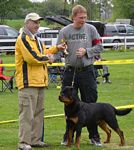
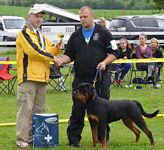
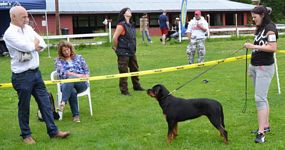
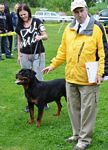
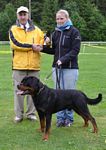
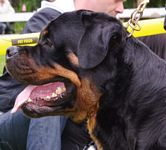
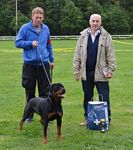
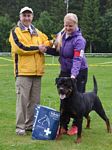
PHOTOS FROM THE SHOW


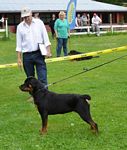

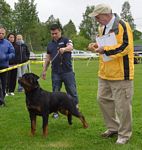
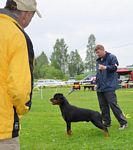

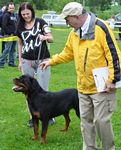

|
Top of page
|
Rottweiler caricature or is it evolution
By Ian
Geddes-Cook
Hardrada Rottweilers
Over time I have heard people say how much our breed has changed, in some instances for the better, in others for the worse. You may hear people say, where is the size or bone or what�s happening to the head, or clearly formed markings? The question I would ask is, are the dogs changing? Is this process natural evolution or a man made evolutionary process pumped up by people�s view of the breed rather then the actual standard?
I remember in the 1980�s seeing a Rottweiler being billed as the biggest Rottweiler
in the country (United Kingdom) and available for stud work. The dog indeed looked like a rotty, correct shape and markings with a somewhat houndy looking head, however, it must have been the size of a great Dane, certainly not within standard but people still used the dog at stud.
The simple answer to my question is that the standards and dogs have been changing for generations. We see judges from overseas checking our dogs for full dentition, yet our standard in New Zealand does not ask for full dentition it states quite simply
Mouth:
"The teeth are strong and the incisors of the lower jaw must touch the inner surface of the upper incisors. The flews are black and firm; they fall gradually away towards the corners of the mouth, which do not protrude excessively".
Is this variance in standards part of the problem? We have many countries with different standards, but ultimately we all have in our own minds what a
Rottweiler should look like. At the confirmation shows a major influence on what determines a great dog or not so good dog is one person judging on the day. In the end one dog will come away with top honours, with the judges decision indicating that his/ her pick is the best specimen on the day. But does it conform to relevant breed standards of the day. In some respects I�m sure it will, but which standard was the dog judged by? Was it the written standard from where the judge came from, or from the country in which they judge is judging in or is it a formulation of what they perceive a good quality
Rottweiler should look like?
In 1901 the first Rottweiler standard was published. In fact it was the Rottweiler and Leonberger breed standard of 1901. If you compare that standard with the one we have today, you would see a very different dog including brindle
Rottweilers, and dogs lacking bone and substance, with white on chest, legs and neck, with long coats and weaker heads. The intention then and now is to have a breed standard to maintain the breed type. What is breed type you my say, well in my opinion it is the sum total of the individual characteristics which help maintain the breeds individuality and uniqueness.
The question we should all ask is what best conforms to the breed standard. What is a great dog and what is not so great. Judges, breeders, pet owners, exhibitors etc all have a view on this, and interpret this in one way or another. Accordingly in the show world the qualities of our dogs are measured against the breed standard, the aim and expectation is to maintain a breed type, which will typify the unique qualities and individualities of our breed including the both the physical and psychological traits. I must say I've not seen many
Rottweilers pulling carts or rounding up cattle these days, but essentially that was the job they were bred for, as we all know when you loose one job you have to find another, ultimately the
Rottweiler was used in various roles including the police, army etc and later as the breed became popular in the 1970's onwards, as a family protector and friendly pet.
The breed standard is said to ensure breed type is maintained by assessing and maintaining function, soundness, confirmation, movement, attitude, colour, weight etc .. People talk about Breed Type vs. Soundness, but essentially breed type is the sum total of all these things.
I think the breed is essentially still evolving in two ways, one to match with the standard view given by breed clubs by way of a breed standard, the other is for the breed to fit in with what society expects of the breed. Certainly there is a balancing act , with anti dog laws and anti
Rottweiler view, would it be prudent that some traits will have to go, is this a wrong assumption.? I for one see some of my dogs with the original working attitude, but more and more my focus has been to have a dog that is acceptable in society and is well behaved, maybe I am wrong to say this but essentially for the longevity of the breed to continue it needs to evolve into what people want, essentially a loving family pet, there will be those that say that it has become just a caricature of the breed, I can live with that because I don�t feel I'm fooling myself when I breed, I know what my aims and objects are when I breed.
Essentially the breed has made some significant changes in the last 100 years, originally we had two types of
Rottweilers, the large big boned butchers dog, who pulled carts for a living and the smaller more agile dog that trotted around rounding up cattle. We can still see both types today as they have not gone away. I still have new pet owners contacting me asking for the biggest dog or biggest head out of a litter, the one they choose is not in my opinion necessarily the best dog, but it conforms to an individuals preference based not upon a standard but upon each persons own interpretation of what fits for them.
|
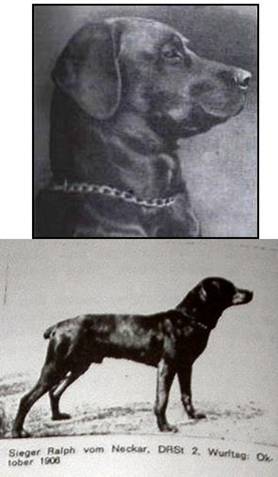
1906
Rottweilers Ralph Vom Necker
 |
Present day Rottweiler
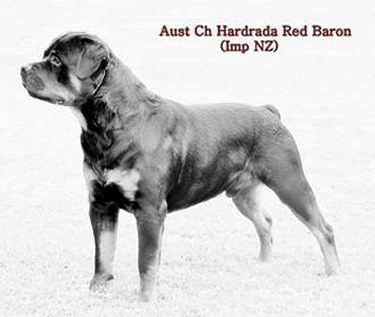 |
The pictures above show two dogs both distantly related, yet the size of bone, heads are so different when comparing the two. It would be interesting to see who of the two dogs would be able to function and work best.
I think change is inevitable, based upon peoples own individual ideas and thoughts on how the breed should be, ultimately it is the role of the breeder to maintain those traits that we think make our breed stand out and gives it that uniqueness that we see and love.
The breed I am sure will continue to alter, their may be slight changes in the wording in the breed standard, but with slight variation I feel dramatic changes tends to occur. Take the head for instance, the head looked many years ago finer with slight stop, little zygoma development and conical muzzle, the head today in many dogs have shorter muzzles and well developed zygoma's, ok but the forehead is starting to become more domed with the general head becoming mastiff like in appearance. Maybe I'm interpreting what I see incorrectly but everybody will have there own interpretation. I think it will be fascinating if we could see what the breed will evolve into in another 100 yrs time, will we
recognize it or will it have evolved into something different, may be a caricature of the breed. Only time will tell.
Below is a comparison of the breed, taken from the first original breed standard and the current NZKC
Rottweiler standard. The information listed below is split into two columns listing some notable
differences. The 1901 standard, or documentation about what a rotty looked like 100 yrs, the second column shows today's standard or what we would expect to see today, I have listed some key differences from then and now, it is not a definitive list.
|
Breed standards
or documented evidence noted in the breed
|
Rottweiler
* denotes as per 1901 Rottweiler and Leonberger
standard
|
Dogs today
# NZKC standard
|
|
Size
|
Bitches 21.5 in #
# Data based on dog measurements taken in 1st
world war size not stated in 1901 standard
|
Bitches # 23-25
|
|
Weight
|
Dogs 30 kg*
|
Dogs 50 kg
|
|
|
Bitches 25 kg*
|
Bitches 42 kg
|
|
Colour
|
1901 standard
Black and russet markings
Black stripes on ash grey background with
yellow markings
Dark wolf grey with black head and saddle
|
The colour is black with clearly
defined markings on the cheeks, muzzle, chest and legs, as
well as over both eyes and the area beneath the tail.
Colour of markings ranges from rich tan to mahogany brown.
|
|
White markings
|
1901 standard
White markings on legs and chest occur
frequently and are admissible if not too excessive
|
Under
faults:
Any white
markings..
|
|
Coat
|
Unusually thick with strong undercoat, the
hairs firm, straight and reasonably long, wiry hard, the
whole coat very abundant, thick and weatherproof, and
having black velvety sheen
|
The coat, which consists of top
coat and undercoat, should be of medium length, coarse and
flat. The undercoat, which is essential on the neck and
thighs, should not show through the outer coat. The hair
may also be a little longer on the back of the forelegs
and breechings.
|
|
Head
|
Skull broad ,well arched with well marked
frontal depression, short muzzle bridge of nose broad,
ample flews with corners of mouth moderatley prominent,
cheeks full and round.
Broad nose with wide nostrils, invariably
black. The whole head quite dry without any surplus skin
|
Head
and Skull:
The head is of medium length, the skull between the ears
is broad. The forehead line is moderately arched as seen
from the side. Occipital bone well developed but not
conspicuous. Cheeks well muscled but not prominent, with
the zygomatic arch well formed. The skin on the head
should not be loose although it is allowed to form
moderate wrinkle when the dog is attentive. Muzzle fairly
deep with topline level and length not longer than the
length from stop to occiput.
|
|
Tail
|
1901 standard
Dog is often born with a stumpy tail, and this
is always preferred Natural bob docked short
|
Docked to first joint
I have had occasional litters with a few of
the pups being born with a naturally short tail, but this
is a rare event
|
|
Top of page
|
Extinct Show Dog Breeders
January 2013 - Barbara J. Andrews, Editor-In-Chief, TheDogPress.com
Forced into hiding by animal control, handcuffed by zoning regulations, local and state laws, most of which are lobbied into fruition by animal rights groups, �responsible dog breeders� are facing extinction....
more
|
Top of page
|
Skin problems Part I - Allergies or Food Intolerances
Originally printed in the B-Naturals Newsletter
Reprinted with permission by Lew
Olson, PhD Natural Health
B-Naturals / Holistic Products For Dogs and Cats
Itchy skin, redness, weepy eyes, head shaking, foot licking and gunky ears! Sound familiar? These issues seem to plague our dogs and despite the fact the issues are so common, the problems are both difficult to diagnose and cure.
Dog owners frequently search for solutions to these problems, yet they do not always know where to start. This two-part newsletter will hopefully provide you with a tips that to help you better approach these issues and steps and ideas on how to successfully resolve these problems.
This is a large topic, so it will come to you in two parts. This month's newsletter helps define the differences between allergies and food tolerances, their symptoms and their effects on the immune system. Part II offers more information on the immune system and steps you can take to stabilize and maintain your dog's immune system health to ward off some of the effects of the allergy and food intolerance issues discussed this month.
Once your dog starts itching and scratching, it can create irritation and sores. Continued scratching can cause both bacteria and yeast to grow. If this is happening to your dog, I encourage the technique of tests to not only rule out what the problem might be, but to also rule out what the problem is not! Therefore, the first step is to schedule a visit to see your veterinarian.
A good rule of thumb with these issues is to start with a skin scraping and culture of the affected areas on the skin and a culture of the ears if they are affected. This means having your veterinarian take samples and send them off to a laboratory. These tests will determine if yeast and/or bacteria are present. If bacteria are present, the specific bacteria can be identified. Once identified, your veterinarian can determine which antibiotic will best treat the symptoms. A skin culture will eliminate any guessing and avoid the possibility of overusing antibiotics.
Proper treatment of bacteria and/or yeast issues is the best place to start, however treating the symptoms does not determine the actual cause of the problem. However, treating the symptoms helps eliminate some of your dog's discomfort, pain and irritation.
Bathing your dog weekly in a good oatmeal-based shampoo (or a special preparation for yeast conditions) can help keep the skin and coat clean to prevent further development. Rinsing with a solution of � white vinegar and � water can also help to kill yeast and cleanse any remaining shampoo from the skin and coat.
There are some good ear washes for dogs, but you need to know if you are treating your dog's ears for yeast or bacteria, as each requires a different approach! Again, a visit to your veterinarian will determine this! Most importantly, when treating the ears, never flood them with liquid. This can cause deafness! Use a small amount and carefully wipe out any excess!
Whether your dog's issue is yeast or bacteria related, you could either repeatedly treat the symptoms or choose to get to the root of the problem so you do not have to treat the symptoms any longer.
When we read about skin and coat issues in books and magazines, and explore the different health conditions on the internet, we find a lot of information that defines the symptoms as allergy issues or food intolerance issues. In many cases, you will find information that discusses allergies vs. food intolerances. While you may find allergy vs. food intolerances on both human and canine sites, you will see there is a specific difference between the two. I find these ideas interesting, but they really do not quite describe the problems I have seen in dogs.
Allergies are defined as allergens that cause the dog to itch and scratch, cause redness of the skin and may cause ear problems. Occasionally vomiting and diarrhea may occur, but these are less common side effects.
While allergies indeed can cause redness, welts on the skin, redness in the eyes and more, food allergies are rare in dogs, and for the most part occur after the dog is over two years old. I see food allergies when dogs have been fed the same commercial food or fixed diet, day in and day out. When the body is repeatedly exposed to the same allergens (same proteins/ingredients) for prolonged periods of time, the body can develop an immune response where the body no longer recognizes these foods as 'normal. The allergic reaction is an autoimmune system response.
Food intolerances are described as only affecting the digestive tract and the symptoms only include vomiting and/or diarrhea. These issues are NOT about the immune system as food intolerances are not immune mediated. They are a reaction to a substance or toxin in the food that the body reacts to. For example, some dogs, such as Miniature Schnauzers, commonly have lipid problems and therefore have trouble with high fat diets. Dogs that have gluten intolerance suffer from gas and diarrhea issues. Many dogs get diarrhea and intestinal discomfort when fed uncultured milk products because they are lactose intolerant. Additionally, foods contaminated with bacteria or other toxins can also cause diarrhea and vomiting.
Prolonged use of these foods can eventually cause the digestive tract lining to become inflamed and a chronic digestive condition can develop. These problems can include Inflammatory Bowel Disease or Colitis. However, if these problems develop and go untreated, it can lead to a suppressed immune system, which can lead to other health issues.
Based on what I've said, one might guess that if their dog is suffering from chronic itching and scratching and the diet is varied, they may be dealing with an environmental allergy issue as opposed to an allergy issue they thought might be food related. Allergy testing for environmental issues is more reliable than testing for food allergies and can be helpful in determining the root cause of your dog's condition. Of course, you can also get disheartening news like I did when I did allergy testing on my horse last summer. The test results showed that my horse was allergic to grass and pine trees! Disappointed, I opted for allergy shots. However, you may find that the allergy is caused by something you can easily remove from your home or yard and the issue can be cleared up in no time.
If you are feeding a varied fresh food diet with at least four different proteins, which I hope you are, the chances of your dog having a food allergy is slim, especially if your dog is young. However, there are many different types of allergy issues. If you are dealing with allergies, it could be that the symptoms are the result of an autoimmune system issue. You can treat the symptoms and make your dog comfortable for a while, but if you don't find the root cause of the problem and work to fix it, you will end up treating the same problem over and over. When you know the root cause and work to fix the issue, you may find you no longer have to treat the symptoms!
It is worth investigating the issue further to see if the problem is either causing an over-active or suppressed immune system, what you might be able to do to help regulate your dog's immune system, and determine what is 'normal' and what is not.
If your dog is diagnosed as having food intolerance, your veterinarian may suggest a prescription diet or suggest trying a dog food with a different protein source. Oftentimes, trying these diet changes brings short-term results but within a few weeks, you may see the symptoms reappear. This oftentimes sends people on a frenzy trying different foods to see if they will fix the problem.
What often happens is the dog seems to improve at the start of the food change, as switching the diet and the ingredients oftentimes helps. If the dog is suffering from diarrhea, the veterinarian may prescribe a high fiber diet, which may also make the dog's symptoms appear to improve. This is because the high fiber in the diet will absorb more moisture in the large intestine, which creates a firmer appearing stool. However, the intestinal lining continues to be irritated. This condition will eventually worsen and the problem will return. Further, if the dog remains on a 'fixed' diet without variety, there is a higher chance a real food allergy may occur.
If the cycle persists, dog owners tend to change the food again and see a short-term improvement again. However, in no time at all, the diarrhea and vomiting start to occur again. At this point, the veterinarian may prescribe antibiotics and oftentimes prescribes steroids. As the months and years go by, the problem continues. What many do not realize is the issue actually worsens internally. An endoscopy is often done at this point and commonly, the dog is diagnosed with Inflammatory Bowel Disease (IBD) and a lifetime of prescription foods and drugs.
While much of this is labeled 'Food Intolerance', I see it as an irritated and inflamed digestive tract lining that is never given the chance to heal. Continued rounds of antibiotics continually strip the digestive tract of good flora and fauna intestinal bacteria that helps with digestion AND supports the immune system. Lacking this, the dog may show further symptoms, such as bad breath, thinning hair coat, weight loss, and anxiety or nervousness. Long-term use of steroids can also have harmful side effects, such as hair loss, behavioral changes, harsh effects on the liver and kidneys as well as increased appetite, increased thirst and can depleted the immune system.
We will continue next month by looking at some of the things that can compromise and negatively affect your dog's immune system and steps you can take to help stabilize your dog's immune system and maintain good immune system health. We will have some good diet and supplement tips that address the issues we have talked about this month. We will see you again next month with more information on how to deal with the allergies and food intolerances.
Copyright Lew Olson 2012
|
Top of page
Top of page
|
Dog
owners face written and practical tests
Published: March 21, 2012
Dog owners in Germany are bracing themselves for the introduction of a license which would require passing written and practical tests and could cost hundreds of euros.
Authorities in Lower Saxony passed a law last year requiring owners to prove their basic knowledge about dogs and for the pets to pass a
behavior test. Berlin may follow suit.
The Lower Saxony measure takes effect in 2013, although people who can prove they have owned a dog for at least two years since 2003 will be exempt.
Owners will be tested on their knowledge of dog owner rules and of dogs' needs in general. A practical test of the animal, which can be completed by a veterinarian, will also be required to show that the pet is socialized and not dangerous.
The rule also requires dog owners to have liability insurance for their pets and that dogs have an identification chip inserted under their skin.
Lower Saxony's agricultural ministry expects dog owners will have to pay around �350 to �550, depending on how much the vet charges, ministry spokesperson Natascha Manski told The Local.
Now Berlin�s authorities, having recorded significant increases in dog bites over the past few years, are working out how to introduce similar licensing rules.
The number of dog bites reported to authorities rose by 44 to 704 last year, compared to 2010 � a six percent increase. That follows a 30 percent rise in 2010 over 2009.
"That is clearly an alarm signal," Claudia H�mmerling, the animal rights spokeswoman for Berlin's Green party, told the Tagessppiegel newspaper. She noted that of the 704 bites reported, just 32 were attributable to �attack� dog breeds.
H�mmerling, herself the owner of a Staffordshire Bull Terrier, is working to get a licensing rule similar to that in Lower Saxony through the Berlin state government.
Under the bill being discussed dogs would be divided into three categories based on size and breed. Attack, hunting and herding dogs would be required to pass additional tests based on the breed's character.
There has been much discussion about the costs, the paper noted. Prices for the written exam would be around �25 and between �50 and �75 for the practical test.
H�mmerling, who met dog owners on Tuesday evening, said cooperation among the interested parties had been "superb." She did say that many were worried their beloved pet might be taken away if they fail to pass the test.
The Green party politician said she assured owners that the aim of the law was not to separate dog owners from their pets but to make sure people who own canines are responsible.
Asked whether someone would fail if their dog did not come on command, H�mmerling giggled and said: "Whose dog comes on command?" The idea is to show that the dogs are socialized and not a danger to people.
The Local/Germany's News in English
|
Top of page
|
MORE THAN MEETS THE EYE
Proximity and Knowledge - Keys to
Observation
By Carmen L. Battaglia, PhD
- Breeding Better Dogs
|
Did you ever wonder why people disagree about the winners at a dog show? We all have at one time or
another, but we know from our experiences that what we think we observed usually depends on many things.
At most shows its a matter of where you sit or stand during the judging and what you know about the breed
standard, structure and movement. Each of these elements tends to influence what we see and think. For
example, when a dog is standing, much of its anatomy can be noticed, but when it is gaiting, its movement is
often quicker then the eye. In the confined space and limited time allowed in the show ring, even the educated
eye that knows what to look for can be misled. In the ring, many things are happening at the same time. Since
dogs can move in different ways, where we position ourselves will determine which part of the judging we will
see. It might only be the sidegate or perhaps the down and back, or maybe just the individual examination.
....more
|
|
Top of page
|
THE FUTURE OF DOG SHOWS
E. Katie
Gammill, AKC Judge/Exhibition Editor,TheDogPlace.org
Friday, December 9, 2011
Do
breeders and owner handlers no longer understand the sport
of dogs? �Show and go� doesn�t get the job done. You
are either in, or you are out.
Examples:
People bump a dog up to Specials class without first
asking the competitors if they would prefer that the dog
stay in the classes and hold the major. People
double-enter and don�t show up. Owner handlers drive
miles to get to that major only to find someone else
�slept in� or didn�t go. Time and again, we hear
�the major broke� but sometimes exhibitors come to
ringside to get a number and they see a few numbers
aren�t picked up and so, assume there is no major. Then
due to late pick ups, find it is THEIR FAULT the major
didn�t hold because they didn�t compete and the rest
of the armbands were picked up at the last minute.
Do
breeders still count the �Specials�, especially now
with �Awards of Merit� entries, when it comes to
possibly winning over the Specials and picking up a major?
Sure Groups are tough but a judge gave you the honor of
representing your breed and you skip Group competition?
And did you know when if ANY breed in the Group has a
major, and your dog wins the Group, it counts as a major
for your entry?
Breeders
Discourage Future Breeders
Breeders
are, and will always be, the backbone of the sport and the
future of dog shows. When I read we must do things to
attract newcomers to our sport, and then hear the
complaints from buyers who speak of contracts, breeding
restrictions, exorbitant prices, and in some cases
rudeness, is it any wonder buyers run to the nearest
shelter for their pet? Between our actions, the lack of
breeding litters, and restrictions, we don�t have to
worry about Animal Activists. We are shooting ourselves in
our own proverbial foot!
I
have attempted to teach new breeders or owner handlers
only to have them disregard my effort. The future of the
sport depends on them but I suppose it is the times. I can
say �What was� worked a lot better that �What is�.
If we refuse to honor the sport of dogs and play by the
rules, we defeat our purpose. If we all breed what we like
and disregard the standard, we will join the ranks of the
�doodle dogs�.
Breeding
To The Breed Standard
Another
example: Why won�t the breeders and handlers stand up
for the Standards? I love breed type, the look of eagles,
the virtues that separate one breed from another. I love
�cropped ears and docked tails�. A big, substantial
Great Dane one can �look in the eye� represents the
Apollo of the breed. Nobility is a look; I love the keen
presence of each individual breed, be it large or small. I
grieve the loss of these attributes, but they can be
preserved IF breeders take breeding to standard seriously
and evaluate their dogs honestly.
When
evaluating dogs, does one keep a dog for a single
attribute, or does one choose the overall dog? It starts
there. IF you breed for eye improvement and it shows up on
the worst puppy in the litter, and you choose to keep that
�eye�, the next generation will take you backwards. IF
you choose the best overall puppy, keeping your positive
virtues intact, your reward comes when you later breed
that dog. In the next litter will be a choice of an
overall puppy that incorporates the desired eye. This
requires patience, but �socks in� your virtues and
moves your program forward.
There
are breeders, and then there are BREEDERS! True breeders
know how to incorporate a virtue into their program
without losing their own �look�. Meeting a breeder
with four generations of �OFA excellent� hips in her
dogs, she asked me how it could be that all puppies in the
last litter were dysplastic? I�m no expert in genetics,
but I am an expert regarding �You plan, Nature
laughs�, keeping us on our toes. It�s always been that
way. But the sport and a good breeding program will
survive if we just carry on.
Present
and Future Breeder Tools
With
frozen semen, opportunities are abound. Hesitant at first
regarding Award of Merits, I look at it now as an
opportunity for newcomers to view many �greats� of
many breeds. Frozen semen and Award of Merits allow access
to studs long forgotten affords a fresh approach to
possibly getting �back on track�.
Many
dogs age well and are still breathtaking. Even those who
don�t age as well  have
a certain dignity and presence that is undeniable. It�s
regrettable only one dog and one bitch can be recognized
when so many are so deserving. Take advantage of this
opportunity to improve your breeding program. have
a certain dignity and presence that is undeniable. It�s
regrettable only one dog and one bitch can be recognized
when so many are so deserving. Take advantage of this
opportunity to improve your breeding program.
The
future of dog shows and that of your breed is in your
hands. It�s a worthwhile responsibility. Don�t sit
back and think others are fighting the battle to preserve
either one just for you. Get involved before it�s too
late and the privilege of owning a dog is taken from us
all. BREEDERS ARE THE FUTURE OF THE SPORT.
http://www.thedogplace.org/SHOWDOG/Future-of-dog-shows_Gammill-1203.asp
|
Top of page
|
Rottweiler study links ovaries with exceptional longevity
AVMA
Journals
|
 New
research on the biology of aging in dogs suggests a
link between shortened life expectancy and ovary
removal.
New
research on the biology of aging in dogs suggests a
link between shortened life expectancy and ovary
removal.
The
study, published in the December 2009 issue of the
journal Aging Cell, found that Rottweilers that were
spayed after they were 6 years old were 4.6 times as
likely to reach 13 years of age as were Rottweilers
that were spayed at a younger age.
The
finding is important because the average life
expectancy of Rottweiler dogs is 9.4 years, observed
research team leader Dr. David J. Waters. "Our
results support the notion that how long females
keep their ovaries influences how long they
live," he said.
Dr.
Waters is the executive director of the Gerald P.
Murphy Cancer Foundation at the Purdue Research Park
in West Lafayette, Ind. The foundation is home to
the Center for Exceptional Longevity Studies, which
tracks the oldest living pet dogs in the country.
Although
the findings may challenge long-held notions about
pet neutering, Dr. Waters believes veterinarians
shouldn't dismiss the research outright but,
instead, see it as an exciting development in pet
longevity research.
"It
was once considered a fact the earth was flat, and
then somebody's data said otherwise. That's what
scientific discoveries dothey reshape the
intellectual terrain," said Dr. Waters, who is
also associate director of Purdue University's
Center on Aging and the Life Course and a professor
in the Department of Veterinary Clinical Sciences.
Dogs
are a good model for cancer studies in humans, and
now there's growing support for using pet dogs in
research aimed at helping people live longer lives.
The National Institute on Aging, for instance,
issued a call in November for information on the
feasibility of studying pet dogs to advance the
study of human aging.
Dr.
Waters' team spent a decade collecting and analyzing
medical histories, longevity, and causes of death
for 119 Rottweilers in the United States and Canada
that survived to 13 years of age. These dogs were
compared with a group of 186 Rottweilers with more
typical longevity.
Researchers
found that female Rottweilers have a distinct
survival advantage over malesa trend also
documented in humans. That advantage appears to be
determined by whether the female dog is sexually
intact, however. "Taking away ovaries during
the first four years of life completely erased the
female survival advantage," Dr. Waters said.
The
Rottweiler research mirrors the findings of the
Nurses' Health Study published in May 2009 in
Obstetrics & Gynecology by William Parker, MD,
and colleagues from the John Wayne Cancer Institute
in Santa Monica, Calif.
Dr.
Parker's group studied more than 29,000 women who
underwent a hysterectomy for benign uterine disease.
The findings showed that the benefits of ovary
removalprotection against ovarian, uterine, and
breast cancerwere outweighed by an increased
mortality rate from other causes. As a result,
longevity was cut short in women who lost their
ovaries before the age of 50, compared with those
who kept their ovaries for at least 50 years.
How
ovaries affect longevity in Rottweilers is not
understood, but Dr. Waters' research points to a new
set of research questions, recalibrating the
conversation about removing ovaries.
"We
liken this to an ecosystem," Dr. Waters
explained. "If you take the caterpillars out of
an environment, what are you left with? I'm betting
that like removing all the caterpillars, removing
ovaries has unanticipated, unforeseen consequences.
An adverse effect on longevity might just be one of
those consequences."
Does
Dr. Waters recommend that every dog owner delay
their pet's ovariohysterectomy? Not at all. In fact,
he cautioned against overgeneralizing the study
findings, saying much more research is needed.
"We
studied purebred dogs living with responsible
owners. You could say our results aren't pertinent
to stray dogs or mongrel dogs. I don't believe every
Rottweiler or every woman will benefit from keeping
ovaries. That's an all-or-none stipulation, and
that's not how biology works," he said, adding
that tomorrow's challenge will be to identify which
individuals benefit from retaining or removing
ovaries.
To
meet the needs of veterinarians who want to better
understand the biology of aging, Dr. Waters
developed a Gerontology Training Program for DVMs at
Gerald P. Murphy Cancer Foundation, based on his
experience teaching biogerontology to graduate
students for more than a decade at Purdue. As
longevity research advances, veterinarians need to
be prepared. "We make the surest progress when
cutting-edge research and cutting-edge education go
hand in hand," Dr. Waters said.
R.
Scott Nolen
|
|
Top of page
|
Renaming Your Rescue Dog
by Darlene Arden
(Subscribe to Darlene Arden's
posts)
Aug 25th 2011 @ 1:00PM Filed Under: Dogs,
Pet Adoption
There are few things in life as rewarding as giving a homeless animal a second chance at life. Some have never had a proper home, many have never had a good home and some have lost their home because of their owner's life circumstances, often the death of the owner or the birth of a child who is dangerous allergic to pets.
One question that often arises is whether or not to give your new dog a new name. This may sound frivolous to some but it's a serious question and a real consideration. Here's my "rule of thumb" for renaming a dog.
If the dog has been in a loving home and has only positive associations with his name, I advise keeping the name. He has already lost so much in life, why subject him to losing the last familiar thing? It will help make the transition easier if he knows that you're talking specifically to him. Acknowledge who he is and always use his name in a loving tone of voice.
On the other hand, there are certainly times when changing your dog's name is advisable, when he needs a fresh start in every possible way, including a new name. In some cases, the dog may have been brought into a shelter off the street and has no name. In that case, the shelter volunteers have named him but his only real association with the name is a loud, cold, noisy shelter environment and what little affection the volunteers can spare when it has to be spread among so many animals. In other cases, the dog has a bad association with his name. These are often the dogs that have been relinquished to shelters. In Breed Rescue Groups, volunteers foster the dogs to help them make the transition to a new home so, for our purposes, we'll be concentrating on shelter dogs or those off the street who have appeared in your life.
Usually, dogs who have been relinquished by their owners have come with some sort of history or their reaction to volunteers can tell part of the story just by watching their body language. While most small dogs are given up because of housetraining issues, many people get a dog and get tired of it so they stick the dog in the backyard, totally ignoring this living, breathing, sentient being. Or they get bored. Or they no longer want the responsibility, or it grew bigger than they thought. The human-animal bond means nothing to these people and it is the dog that suffers. Other people take out their hostilities on the dog, hitting it, screaming at it, kicking it , etc. Not one of these dogs will have a positive association with his or her name. These dogs have often been called by name only to be punished, they've been screamed at, they've been abused.
Along with the tender, loving care you provide a new name will help set the tone for a new life.
Naming your adopted dog will give you both a fresh start. You may want to start with something close to the dog's previous name and use the old name first, quickly followed by the new name. Then switch to new first and then old name, and then phase out the old name entirely.
If the dog's background has been so horrible that quakes when he hears his name, just change it immediately and remember to associate it with only good things. Use his name and toss a treat his way but not directly at him. Don't frighten him because he's had a lifetime of fear. Always call him to you to pat and praise him and give him a small treat. You never want to call any dog to you for punishment or to yell at him. Always make the association positive and loving.
Remember to be patient with your new family member. It takes time to adjust to a new home, a new name, and feel secure. Positive training will help him make positive associations with his new home, his new family and his new life. Speak softly to him, tell him he's a good boy (or good girl) and set your dog up to do things that you can encourage. Mistakes happen. Don't yell at him, especially be careful to use the new name in positive, loving ways and don't rush your newcomer. Allow him to have some time get acquainted. He's going to expect to be yelled at for no reason that he understands, or punished, or left alone in the yard, or returned to the shelter. It takes time to build trust and that wonderful human-animal bond. A slow, steady start and a brand-new name will lead to a lifetime of wonderful experiences and a deep and satisfying human-animal bond for you and your dog.
Darlene Arden is a Certified Animal Behavior Consultant, a speaker, a learning facilitator, an award-winning writer, and the author of more than half a dozen pet books, including her dog behavior book
Rover, Get Off Her Leg! You can find her online at
www.darlenearden.com and on
Red
Room.
|
Top of page
|
American Kennel Club - AKC Breeder
What's in a Name Can Hurt You
Canine Legislation, and What You and AKC Can Do About It
Summer
2011
Its hard to be a breeder or an AKC club member without hearing warnings at least occasionally about the vast amount of canine legislation introduced throughout the country each year. So far in 2011, the AKC Government Relations team (AKC GR) is tracking over 1,000 legislative proposals, and over one-third of them directly impact those who breed dogs.
For hobby breeders, one of the most significant new trends and threats are bills that define all breeders as commercial enterprises. For many, the concept of being a commercial or high-volume breeder sounds so foreign that its hard to imagine such legislation could impact them. But the truth is, commercial breeder legislation can impact anyone who keeps intact dogs, and especially anyone who has ever bred or may breed a dog.
Even when the stated purpose of legislation is to regulate commercial breeding operations, its important to look at how the term commercial breeder is defined, as many bills seek to heavily regulate so-called commercial breeders based on the number of dogs owned, not on the commerce actually conducted.
The AKC respects the important role high-quality professional breeders play in meeting the demand for quality pets. These breeders provide beloved pets and they deserve recognition for the good job they do. Far too often, the creation of restrictive new laws rather than the enforcement of existing negligence/cruelty laws to crack down on a few bad actors ends up missing the intended mark. Instead, it targets small hobby breeders who hand-raise puppies and requires them to obtain new commercial licenses, be subject to inappropriate inspections, or comply with facilities requirements designed for large commercial kennels.
One of the most significant and easily overlooked issues is the impact that changing the official categorization of a home-based/hobby enterprise to a commercial operation can have. In many cases, this may actually jeopardize a persons home! Someone who has lived their entire lives in a residential community may suddenly find they are in violation of local zoning laws, even though nothing they do has changed.
Legislation requiring small breeders to comply with regulations designed for large commercial operations can result in unintended consequences, including:
Placing so many demands on breeders that they can no longer breed at all
Forcing breeders to change from a small home-based model to a larger commercial-style model that they dont have the resources or the desire to operate, or worst of all
Forcing breeders into a situation where they may be violating the letter of the law merely by providing the best possible care for their dogs.
For any hobby breeder who has ever thought that commercial-breeder legislation does not impact you, consider this:
The current definition of commercial breeder in Nebraska includes anyone who owns four or more intact females intended for breeding. This definition illustrates several common issues. Even if there is no intention to breed the dog, the burden of proof is on the owner to prove a negative. Under this lawregardless of whether you have actually bred a dog you are technically considered to be a commercial breeder. And once you are designated by the state to be commercial, you can then easily run afoul of local zoning or other ordinances.
Legislation currently before Congress (S. 707/H.R. 835, known as PUPS) would require anyone who owns or co-owns dogs that produce more than 50 puppies that are sold in a single year to be regulated in the same manner as a USDA puppy dealer (wholesaler). Legislation sounds benevolent enough, but consider this: If you co-own several dogs bred just a few times in a single year, this could include you. Even if you never whelp a single litter, or see a single puppy, you could be subject to licensing and inspection as a commercial breeder.
What is AKC doing about it?
With so many purebred dog owners and breeders under legislative attack, its not surprising, that one of the most common questions we hear is, Whats the AKC doing about canine legislation?
AKC GR is charged with addressing issues on a daily basis that impact the rights of responsible dog breeders and all dog owners. Advocacy works best when those directly affected by it take the lead in working with legislators. For this reason, AKC GR does not regularly send staffers out to legislative trouble spots, but instead provides educational, informational, and training resources that enable the residents of a community those most affected by the laws to take the lead in working for policies that best address their needs.
Some of the departments work is conducted outside the public eye. While it may sometimes appear that the AKC is not actively involved in the legislative process, this is not the case. Some of AKC GRs greatest successes are the bills you never hear about those that have never been formally introduced or have never made it past committee hearings.
Other times, legislation and legislative issues are best addressed by public input. This is when AKC GR issues Legislative Alerts or news items and provides constituents with sample letters and talking points. In some cases, staff may conduct legislative training sessions or lobby days.
AKC GR provides a wide variety of resources to support clubs, federations, breeders and individuals in protecting their rights, including:
AKC GR staff ready to work with you one-on-one and address your concerns
A growing list of AKC state federations coalitions of breeders and fanciers on the ground at state capitols and local communities working together on legislative issues
A contracted federal lobbying team in Washington, D.C.
The ability to send targeted e-mails to specific states or communities facing legislative battles
AKC GRs online toolbox a one-stop shop for data, talking points and other resources to help fight bad legislation
An online legislation tracking system, providing up-to-date information on state-level bills in all 50 states
In 2011, AKC GR has already made thousands of contacts with legislators and posted scores of Legislative Alerts both online and to targeted areas. With our federations, AKC has been on the front lines of successful legislative battles in 2011 from Hawaii to Mississippi, Virginia, Colorado, and Wyoming, just to name a few.
What You Can Do
As an AKC breeder, you are an acknowledged expert in your breed, and dogs in general. You have a unique opportunity and responsibility to make your voice heardespecially when faced with issues that may adversely impact responsible dog owners in your community.
Most politicians know very little about dogs and even less about breeding and showing.
Educating your legislatorsespecially before an issue ever comes up is one of the most important things you can do to ensure dog owners and breeders interests are served when canine legislation is introduced. Consider scheduling a 10-minute appointment with your local representatives. Introduce yourself and offer to provide insight on dog issues. This will give you access if canine legislation is introduced in the future.
Here are a few suggestions on other ways to get involved:
Make sure your clubs have Legislative Liaisons and work within a state federation. AKC GR depends on liaisons and federations as two-way information channels to learn about possible local ordinances and to get the word out about new legislation. If we dont hear about an issue, we cant help. Likewise, if clubs and individuals do not get our information, they cant respond to it.
Support and encourage your club to support the AKC Canine Legislative Support Fund (CLSF). These donations support advocacy efforts around the country, including legislative empowerment seminars at national specialties and all-breed shows, statewide lobby days, and the development of advocacy training programs.
Support the AKC Political Action Committee (PAC). The AKC PAC accepts contributions from individual AKC club members and uses 100 percent of those funds to support the campaigns of breeder-friendly candidates for political office. For more information, visit
akc.org/pac
|
Top of page
|
BACKBONE
GONE?
|
HOW
LONG WILL SHOW BREEDERS SUPPORT THE SPORT?
Show
and hobby breeders preserve the breed standards,
protect the health and welfare of dogs, and are
the backbone support for all dog clubs.
April
2011 - Barbara J. Andrews, Editor-In-Chief,
TheDogPress.com
 In
fact, show/hobby breeders have been the backbone
of the entire dog sport. We project pride,
dignity and dedication whether on TV or at the
vets office. We are kind and generous
with our dogs and dog friends but speak ill of our
breeding program and we are as fiercely defensive
as a mama Chihuahua. In
fact, show/hobby breeders have been the backbone
of the entire dog sport. We project pride,
dignity and dedication whether on TV or at the
vets office. We are kind and generous
with our dogs and dog friends but speak ill of our
breeding program and we are as fiercely defensive
as a mama Chihuahua.
Dog
shows and dog breeding were once a gentlemans
sport. The men stood ramrod proud as their new
birding dog was shown off by the kennel manager
and structure and gait discussed. Wives posed and
paraded in high fashion, accented by the newest
little toy and it was more than corsets that
held their backbones rigidly strong.
As America recovered from two wars, the sport of
dogs attracted commoners with working class dogs
which included herding and flock guardians, hounds
that treed and trailed, and police and military
dogs. Suddenly the Marine Corps Devil Dogs,
a Rin Tin Tin German Shepherd or a Lassie dog were
within reach of the average family. The Upper
Crust kept a stiff upper lip (and backbone) as the
public invaded the dog show scene. The new
generation dog lovers were affable, outgoing.
Those who were a little put off by the stuffiness
of it all found their niche in the new sport of
Obedience.
AKC Registered became the epitome of dog
ownership. One had bragging rights if they had
papers but even without an AKC registration
certificate, a purebred had value and the owner
achieved a certain degree of status simply by
owning such a dog. It was a sign of good taste
which somehow reflected on the humans pedigree.
America returned to the affluence of the 20s and
30s and demand for purebred dogs was so great that
Sears Roebuck sold puppies on premises. Pet shops
were born. AKC became a multi-million dollar
corporation because for the first time in history,
everyone could own an AKC registered dog.
In the 50s and 60s, a new industry took shape.
Veterans secured VA loans to set up puppy breeding
farms and hardscrabble farmers discovered a new
money crop. Puppy mills prospered and AKC gobbled
up the gold but hobby breeders shrugged it off and
the collective backbone of American dog breeders
flexed with the times.
Puppy mill mixups resulted in Peekapoos and
Cockapoos which were cleverly marketed to a
gullible public. Whereas dog breeders, like other
stockmen, had once taken pride in a long
line of practical characteristics for
herding and hunting, pedigrees became secondary to
cuteness and salability.
No one cared, life was good. Purebreds still made
sense if you had children, a shop to be protected,
or aspired to become a hunter. The public realized
that the best way to get the right dog for their
purpose was to find a purebred dog. The most
popular breeds from the late 50s to the mid-70s
were Collies, German Shepherds, Poodles, Cocker
Spaniels, and Chihuahuas.
By the early 80s sportsmen were looking at Labs,
Goldens and intriguing new breeds like the Grey
Ghost, reputed to be uniquely suited for both fur
and feather. Humane Society had not yet
become a curse word and shelters were still called
dog pounds. You could own a Rottie and Pit  Bulls
werent on the Most Wanted list. But then dogs
didnt seem to bite people as much back then. Bulls
werent on the Most Wanted list. But then dogs
didnt seem to bite people as much back then.
By
the 90s, big bucks and high society were in
control of the sport again. Puppy farms that had
once provided income for disabled vets were
swallowed up by the Hunte Corporation, which by
the way, also collected over $12 million in
federal funding. AKC and Andrew Hunte had secret
meetings and board members went to puppy mill
auctions. AKC renamed puppy mills as High Volume
Breeders. Hobby breeders were out-produced and
vastly outnumbered, no longer AKCs Cash
Cow. As the Millennium ticked over, AKC
instituted the Frequently Used Sires program, the
puppy mills deserted, AKC pursued, and PETA and
HSUS took control.
Fast forward to today. Zoning, regulations, fees,
and land costs portend the end of all but
commercial puppy mills that can afford the
aforementioned. The American Kennel Club told us
to shut up about puppy mills because after all, it
was our fault! AKC actually postulated that puppy
mills were necessary because we show and hobby
breeders could no longer meet public demand. That
damming insult put many breeders into terminal
osteoporosis.
Loss of backbone must have also affected our
ability to reason. Show breeders sold their souls
for a few ribbons and whatever sales crumbs could
still be picked up. In all fairness, we were a bit
distracted as the animal rights movement,
UNIMPEDED by AKC, tightened the screws. Joint by
joint, our resolve crumbled until bent and broken,
most of us left the Sport of Dogs to the wealthy
socialites who first formed it. We cant afford
legal battles, we cant fight an Animal Control
permeated by HSUS moles, and any viable breeding
program is zoned, taxed, or regulated out of
existence. Without pet insurance, another of
AKCs hugely profitable side deals, we cant
afford the vet bills.
And on top of all that, we have no puppy sales!
How are we to produce the next generation of
healthy, true-to-the-standard, predictable
purebreds with no market for our pet puppies? Do
we bend over, holding our crippled spines, and
just slink away from that which we love? Or do we
stand up straight and fight for our right to
engage in a traditional American hobby? Do we take
the American Kennel Club to task for deserting
show and hobby breeders - the foundation upon
which it was built?
Is there anything we can do to counter PETAs
incredibly effective campaign that makes people
want to save a life by adopting someone
elses reject instead of buying a healthy,
socialized, gorgeous purebred from a breeder?
 How
can we overcome the image HSUS projects of
genetically defective purebred dogs? Since AKC
absolutely refuses to market the concept of
well-bred purebreds, is there any reason to stand
up for what we believe in? Are we too crippled,
too browbeaten, and too alone to change the
direction of purebred dogs? How
can we overcome the image HSUS projects of
genetically defective purebred dogs? Since AKC
absolutely refuses to market the concept of
well-bred purebreds, is there any reason to stand
up for what we believe in? Are we too crippled,
too browbeaten, and too alone to change the
direction of purebred dogs?
I dont have any answers but if you have a plan
or comment, email Editor@TheDogPress.com.
Lets all put our heads together and see where
we are, and whether we have any control over where
were going. We will run the best suggestions
and comments next month.
Barbara
J. Andrews, Editor-In-Chief
|
|
Top of page
|
The Invisible Threat: How Pet Imports Are Undermining Animal Health and Welfare
By Dr. Patty Khuly
Pet MD
Over the past ten years the business of overseas pet importation has seen some pretty impressive growth. Which is a very, very bad thing. That is, if you care at all about animal welfare and public health.
According to a March 1st article in DVM Newsmagazine online,
At last count, in 2006, 287,000 dogs crossed the United States' borders, and veterinary officials fear the problem is getting worse.
Consumer demand for pure-bred and cross-bred puppies coupled with strict new domestic breeding laws is believed to be driving importation numbers even higher than four years ago. To exacerbate the problem, federal regulators have no real way of tracking exactly how many dogs are brought in the country, where they come from, where they are going and whether importers are following up on vaccination requirements for underage puppies.
So it is that our domestic successes have translated yet again into (a) worse conditions for others elsewhere (Latin American and Eastern European puppy mills cannot be a nice place to come from if the health of the imports I've seen is any guide); and (b) a huge potential health hazard to humans, I mean.
It's this latter point that's usually glossed over, but not in this article, where CDC researchers are looking hard for a solution on the basis of the importation of serious zoonotic diseases along with these puppies:
Based on import trends suggesting that the annual number of unvaccinated puppies being imported into the United States increased substantially from 2001 to 2006, imported dogs pose a risk for introducing zoonotic pathogens such as rabies into the United States
But it's not just rabies. There are other scary bugs out there, too, bugs that haven't seen our soils for decades due to better health screening of more traditional agricultural species (like hogs and beef cattle). The dog as ag species is still novel enough that we can't even properly track their numbers at our borders:
No definitive data is available on the number of dogs and puppies imported to the United States each year since no single agency is required to keep track of those numbers. The United States Department of Agriculture (USDA) monitors only commercial breeders who sell animals through pet stores, brokers and research facilities. The CDC monitors rabies vaccinations in imported pets, but its regulations neither require a health screen for dogs prior to arrival to the United States, nor an evaluation for specific zoonoses of concern. Enforcement of regulations are "problematic, because there is no federal requirement mechanism, or capacity for documenting compliance," according to a 2008 article in the journal Zoonosis and Public Health by Marano and fellow CDC veterinarian G. Gale Galland, DVM.
Plus, CDC can't man all the nation's ports of entry, leaving Customs and Border Protection, whose officers have no veterinary training, as the first line of defense to ensure all imported animals meet federal agency requirements.
Scary, right? The fact that there is a huge loophole in our war on animal welfare is one thing, the yawning gap in our nation's biological defenses is quite another.
To be sure, it's already a big problem where I live. In South Florida, I guesstimate that over 50 percent of the French bulldog and French bulldog crosses (yes, these are popular here, too) are imported from Eastern Europe, where it must cost next to nothing to C-section a bitch.
How do I know? These pups are arriving as four- to six-weekers, I've been informed (and I've seen some terribly young ones, too), which is partly why morbidity and mortality rates in these pups in the days immediately post-arrival are sky-high.
Federal regulators, who are so new to the problem that they lack the capacity to handle this burgeoning new breed of animal import may be asking, but what are we to do?
Well, for starters, I suggest we consider treating these dogs like any kind of agricultural import. But then, that's just a veterinarian's opinion. And what do we know? Animal welfare and public health are obviously someone else's purview when it comes to commerce.
Dr. Patty Khuly
Dr. Khuly is a veterinarian based in the "Sunshine State" that's Florida to the rest of you where she learns and grows with an eclectic range of domestic and exotic pets. She shares her professional and personal experiences here on PetMD's blog, the Fully Vetted. Log in Monday through Friday for her insight and humor.
|
Top of page
|
DOGS FILL KEY ROLES
IN OUR SOCIETY
Suzanne
Sparhawk.
Sunday, October 31, 2010 - Fosters.com
Pentagon study confirms value of dogs: Recently the Pentagon announced the end of a costly study aimed at discovering a replacement for the talents of a dog's nose.
For the past 10 years the U.S. military has attempted to develop a
"sniffer" robot that would be able to successfully warn soldiers of the presence of explosive devices to no avail. It seems that no matter how technically advanced the device, nothing can take the place of a dog's nose at seeking out those bombs before they cause mutilation and death.
There are costs for the dogs: sniffer dogs require extensive training, and each has a military handler. But soldiers in Afghanistan have declared their dogs the most valuable and reliable asset they have for detecting and avoiding dangers like hidden bombs. Dogs do not go through these battles unscathed; many are wounded and some are killed. But each of the dogs on patrol with military handlers can save lives, and they work day after day, in terrible conditions. And they don't even get a pension when they retire.
Japanese study finds dogs influence hormone levels: Researchers at Azabu University in Japan have found that when a dog gazes at his owner, the owner's oxytocin level will actually increase. Oxytocin is a social bonding hormone, usually associated with the response humans experience when viewing their own infant or a loved one. The contention based on this finding is that this ability of a dog to stimulate our bonding hormone has probably contributed to the evolution of a dog as a valued member of the human's family.
Our dogs do not sit with us around a campsite, ready to warn us of approaching predators as in prehistoric times, but they are equally valuable in our society today.
Dog and handler teams from Tampa, Flal, were used in Haiti to locate victims of last summer's earthquake. Anyone who flies regularly has probably noticed the sniffer dogs at airports, checking among passengers, sniffing for explosives in luggage, and reinforcing the security systems. Busy little Beagles are used by the U.S. Department of Agriculture to check for particular insects or fungi in food shipments to this country, helping to keep our food supplies safe.
Other dogs help children learn to read (yes some appear regularly at many nearby libraries), service dogs can assist epileptics by warning of impending seizures, and now dogs are being used to detect certain cancers by their scent. These uses of our dogs are a far stretch from those canids that lived with our prehistoric ancestors, acting both as early warning systems and as hunting assistants.
The roles of dogs in our modern culture are many and varied; dogs are generally valued as companions and helpers. Yet we still have those whose stated goal is the elimination of the domestic dog.
Mandatory spay/neuter laws' inevitable effects: Commenting on the current vogue of legislatively mandating that all dogs and cats be surgically neutered, James
Serpell, professor at the University of Pennsylvania, has said "The thing about mandatory spay-neuter [laws] is that those who are most willing to have their dogs spayed or neutered tend to be responsible people. And often, their dogs also happen to be nice animals in temperament. So what you're doing essentially is taking those dogs out of the breeding population."
Serpell leaves us with one logical question: what will become of dog ownership if only ill-tempered puppies from disreputable breeding programs are available as pets?
Good question, that.
Given that in this state over 98 percent of owned cats and over 95 percent of dogs are neutered that leaves a very small population available to create the next generation. Already some people seeking a family pet are having to travel a distance or take an animal that is not what they seek because of the limited pool of available animals.
Those seeking pets are advised to study the available animals in relation to their own lifestyle, with a goal of matching the best home with the best pet. A good match insures that the animal will be a permanent and valued member of that family. A poor match usually means the animal will have or cause problems, and leave this family for a doubtful future.
This option is becoming ever more difficult to accomplish as the supply of animals decreases.
Yes, people will often accept an animal that does not meet their needs, and for whom they do not offer the best home option. The best way to ensure that a pet stays in a family, and has a successful relationship with those people, is to work to make the best match.
When that option is not available, those placements tend not to be long-term successful. This does not help the animal, nor the people.
|
Top
of page
|
AKC
FINES, SUSPENDS VICTIM, NOT PERPETRATOR!
Barbara J. Andrews, Editor-In-Chief
TheDogPress
10|26|2010
Palmer Collier made a reasoned appeal to get AKC to stop what he describes as long-standing harassment of his wife by handler Andrew Green. Had Collier been as well known in dogs as he is to television, perhaps AKC would have handled it differently.
Collier chose not to take time from his business to travel to NJ to AKCs Trial Board. Like anyone else outside the sport, he trusted that a detailed letter to the AKC board would be sufficient to elicit an apology from Andrew Green. Easy-going Collier made a logical assumption that appears to have allowed AKC to once again shield Andrew Green, a man many believe should be permanently suspended for verbal abuse and foul language.
Colliers involvement in dogs is limited to his beloved 14 year old Dalmatian. He is a well known fitness and nutrition expert who rarely has time for dog shows. His wife Carrie is a successful professional handler who regularly competes against Green in the Samoyed ring.
A subscriber sent us a link to a sports-related website [1] that covers Westminster each year, pointing out the WKC report which included a sidebar entitled a crazy dog show feud. The reporter, Barry
Petchesky, characterized Andrew Green as hes way too intense for someone who gets to play with a Samoyed all day. I first noticed him when he yelled at a small child who dared to try to pet his dog. Green is the son of master handler Peter Green, who is now an equally popular and respected AKC judge.
Intrigued by the sports-site coverage and Palmer Collier, who is billed as a "Television Media Health and Fitness Expert", we went to his website
and viewed the TV broadcast videos. He came across as sincere, professional, and more than capable of taking matters into his own hands. Thankfully for Green, Palmer Colliers psyche is as fit as his physique.
Greens bad behavior has been frequently discussed and swept under the AKC carpet. TheDogPress carried a report on Andrew Greens blowup at a prominent AKC judge, his resulting short term suspension and the timing with which it was finally published. After
Crufts, after Louisville, etc.
We called Mr. Collier and learned that in April 2010 he had sent a detailed letter to the entire AKC Board and several related departments including Human Resources. What follows are condensed quotes from Colliers letter.
I am not registered with AKC, nor have any dogs AKC registered. I am a simple fan who occasionally stands outside the ring to support his wife who shows and breeds Samoyeds. [4] I understand that all the AKC reps and judges are frightened of (Andrew Green) that he is untouchable and no one in the AKC wants to ruffle his feathers. I do not understand how this can be so.
Colliers complaint: Andrew Green has been sexually harassing, embarrassing, taunting, verbally abusing and just plain hostile to my wife for many years now. Enough is Enough! ... Four years ago at the Saratoga Springs Dog Shows in Saratoga NY the week before Westminster Dog Show he called my wife Carrie Parma Collier a whore, a slut and a cunt! He called her this in the dog show ring!... Carrie was so intimidated she was afraid to tell the AKC rep I should have pressed charges right then and there with local police authorities and the AKC when Carrie called me on the phone very upset. (but) that would have looked pretty messy on AKC show grounds
He makes an important point: Can this get worse? Yes, my step daughter who was fourteen at the time heard about this despicable event (also) a very confusing message to up and coming handlers of the future. What kind of message is this for a fourteen year old girl when a guy like Andrew Green who is a supposed "GOD" in the dog game can speak vulgarities to a woman my step daughter was invited to Andrew Green's wedding and gracefully declined shortly after this incident.
AKC, you have a real problem on your hand! Andrew Green is eroding the fine reputation of what his father Peter built...Is this the NBA where trash talk is allowed by a bunch of thugs?
Demands apology: I called Andrew immediately at the time of this incident. I left a message on his kennel voice mail and told him I expected an apology from him. My wife Carrie actually got an in-person apology from Peter Green. Mr. Peter Green did not have to do that but out of respect to a woman and more than likely his disgust from his son's actions, he felt an obligation.
Andrew sent a letter with one word on it. "Sorry". Unfortunately on the envelope he addressed it to "Mrs. Carrie Parma Dinger Collier". Let me help you out with that, my wife was married to someone before me. I did not appreciate his sick twisted sarcasm! If he would have addressed the envelope in a respectful manner and written a true apology I would have been fine and moved on. But the abuse continues.
Summary: So tell me AKC, how would any of you feel in my shoes? What if Mr. Green called your wife a slut, a whore and a Cnt? And if you have a young impressionable teenager at home, would you like them to see a man treat a woman like that? This type of incident makes a woman a victim later in life! Well when some one calls your wife these vulgar names and teenagers and junior handlers are hearing that Andrew Green gets away with it, AKC no longer becomes a family sport.
He wrote to AKC several times but says the response he received was that he would have to file formal charges and then go to a Trial Board in NJ. His schedule did not permit that and he trusted AKC to investigate.
When nothing happened, Collier decided to go to a show where Green was competing to personally compel an apology to his wife. He describes the incident for which he was fined $1,000 and suspended from show privileges for 90 days.
I approached Mr. Green this weekend at Syracuse and told him in an angry tone that I was tired of his antics and that he would have to apologize to my wife. I'm angry and livid that he feels he can treat my family like this. I told Mr. Green's wife I wanted to speak with her husband and she should let him know this. I thought maybe Andrew would be courteous enough to come over and say the simple words "I am sorry". Before Mr. Green entered the ring I approached him and told him it was time to take care of unfinished business and requested an apology. Was I angry at the time? You bet I was! Four years this has been simmering and during those four years he continued the harassment to my wife!
A woman jumped forward into my space shoving her phone in my face and threatened me and told me she was going to call 911. At the time my exchange was toward Andrew in a very passionate manner. I had no clue who she was, to me she was sticking up for Andrew. She was in no way helping matters. In fact the anger intensified due to her not introducing herself; she just plain jumped in my face with a very harsh attitude. I told her to stick the phone up her ass!
This artless confession was followed by the unfounded belief that AKC would take an unbiased position. The AKC rep was Patty Proctor who from what I understand has a reputation of having a short fuse and lack of control over her venues based on what handlers say behind the scene. You may want to have a closer look at Ms Proctor.
In fact please take a closer look at me Just go to palmercollier.com (or) to
mindyourbody.com.
Polite logic: The solution for an easy resolve would either be a written apology from Mr. Green to AKC for his insubordinate behavior and also a legitimate letter to my wife. I also feel a long term suspension of Andrew Green by AKC would force him to reflect on his argumentative, confrontational, belligerent personality traits. He is in serious need of behavior modification.
If Andrew is going to insist on threatening my wife then I will have to be at every show just to make sure he does not physically assault her Maybe a restraining order will need to be made? In fact the very next day after my testy incident with Andrew Green he glared continuously at my wife and spit his bait onto the ground at her while in the ring! Exactly twenty four hours later! His behavior is just plain reckless any way you cut it!
I understand that he has had a behavior record in the past and many past transgressions with handlers and judges. I am under the impression that he has been what AKC calls benched because of behavioral issues. Today in the national news media there was a story about nine high school girls that were arrested for "taunting" a fellow class mate that ultimately led to her suicide. Andrew Green is the king of TAUNTING my wife. THIS NEEDS TO STOP!
In closing I feel confident that a fine organization like AKC will not let this matter escalate any further. I look forward to a quick resolution to this matter.
Sincerely,
Palmer Fisk Collier III
Collier explained that he went to the Syracuse show table and asked them to do something about Andrew Green but was told the AKC Rep Patti Proctor was the one with the authority. Unfortunately, he failed to seek out Ms. Proctor before bracing Green at ringside. He said Proctor called the sheriff and he waited for the deputy to arrive, then went outside and chatted amicably with him while waiting for his ride.
Was he benched? No. Experienced exhibitors will wonder why. Collier said he received a call from Jack Norton, Director of Compliance, in which Norton threatened him about what could happen if he showed his dog. Collier said he explained that he had no dog to show, etc. and laughed it off. We could not confirm that with Mr. Norton.
He has received notification of a $1,000 fine and 90 day suspension.
Somehow we dont think that bothers Palmer Collier.
Collier summed things up this way. I feel justice was not done. I could very well hold a grudge over an unresolved issue. Yes, I did the right thing and took the high road. I expected a positive outcome. The sad news did not favor my family. Think about it - AKC has now added insult to injury! No, I'm not satisfied with AKC's verdict.
AKC had a responsibility to mend this situation and did not.
We called Jack Norton for verification and/or clarification on facts as represented in this coverage. He politely refused, saying I cant talk to the press.. all press inquiries must go through the communications department. I reminded Jack that TheDogPress is always fair but beyond that, I personally make every effort to present AKC in a good light. He could not dispute that. When I said that AKC makes it difficult to balance coverage from AKCs perspective, there was only silence. I observed that this one looks bad for AKC, to which he repeated that he could not comment but he offered to transfer my call to Lacy Peterson, Communications. As expected, she was unavailable so I left a message and as has been the case since TheDogPress became the #1 news source, no one has called.
Unlike Palmer Collier, we don't expect much from today's AKC. Glenn Beck fans will understand if I allude to the red phone that never rings.
See AKC's ironic reason for suspending Palmer
Collier!
|
Top of page
|
Rottweiler
honored for stopping Coventry sex attacker
BBC
News
26 September 2010
|
Jake, pictured with owners Ian and Liz Maxted-Bluck, was honoured in Shrewsbury
|
A two-year-old Rottweiler has been
recognized for his bravery after he saved a woman from a sex attacker.
The dog, named Jake, chased off the man as he molested a woman on Hearsall Common, Coventry, in July 2009.
Jake, who stood guard over the victim until police arrived, received his honour at an RSPCA event in Shrewsbury.
The attacker was convicted of serious sexual assault and jailed for four years.
Jake, who was honoured at the Prostar Stadium at an RSPCA conference on Saturday, was nominated by police for the bravery award and medallion after the incident.
Det Con Clive Leftwich, from Coventry police station, said: "From our point of view Jake the Rottweiler stopped a serious sexual assault from becoming even worse."
Liz Maxted-Bluck, who rescued Jake from an RSPCA home in December 2008, said: "He is such a lovely natured dog and is very nosey so I think that was why he went to investigate that day when he heard the screams.
"After I called the police, he stayed alert and close to us like he was guarding us.
"It is brilliant that he is receiving this award from the RSPCA, I am really proud."
Glenn
Mayoll, manager of RSPCA Coventry Animal Centre, said it was "immensely proud" of Jake.
He added: "This story just goes to show that a rescue dog can be a great addition to any
family. Dogs should never be judged simply by their breed, and Jake certainly proves this point
|
Top of page
|
The often misunderstood
Rottweiler
|
Family dog killed after trying to save dying owner
Cleveland, OH - It appears that breed misconceptions may, yet again, have contributed to the euthanasia of a beloved family dog.
According to a recent story in the News-Messenger, faulty assumptions caused the death of a loyal companion that valiantly tried to save his dying owner.
In April, the Cleveland Municipal Court ordered that Zeus, a 140 lb Rottweiler, be euthanized for "the mauling death" of his owner, Carolyn Baker.
Baker, aged 63, was found dead in her driveway in February. Authorities assumed that the 140 lb dog had mauled his owner after seeing a few bite marks on her body.
The assumption was wrong. According to Cuyahoga County Coroner, Frank Miller, Carolyn Baker's body did have a few bite marks, and some evidence of pawing, but the woman died from a heart attack and hypothermia, rather than from a vicious dog attack.
According to the coroner, it appears that Baker's dog was trying to help bring his ailing owner inside to safety, hence the paw and bite marks. Rather than a vicious mauling death, the wounds sustained on Baker's body were caused by a frantic pet attempting to drag his beloved owner inside to warmth and safety.
Baker was lying outdoors in the cold for several hours, clothed only in her nightgown. Zeus barked continuously until a neighbor finally came out to see what the problem was.
Zeus paid for his efforts with his life. The 9 yr-old dog was put to death via court order. Carolyn Baker's family now knows the truth, thanks to the coroner's report, and they too believe that Zeus had tried to save Carolyn's life.
One has to wonder what might have happened to the dog if he was a Labrador Retriever, or Standard Poodle....perhaps a bit more investigation before an assumption of "vicious mauling death".
|
Top of page
|
ICON
OF THE BREED
By
Steve Wolfson
Often when watching a conformation show, one is confronted by the dissimilarity of breed type exhibited within the entries. Dogs and bitches alike are all over the spectrum regarding breed type. Some dogs are small, with heavy bones; some are large, with fine bones. Some are long in body with too much angulation in the rear; others are short in body with no angulation in the front or the rear. Accompanying this dissimilarity of breed type is the degradation of the breeds icon, its head. For a great number of dogs and bitches head type is incorrect. Some heads are narrow in the topskull and narrow in the muzzle. Some are too long in the muzzle and possess incorrect prominence in the under-jaw; some possess the hyper-type of the Mastiff, others have no type at all. This is alarming. Head types have lost their distinctiveness!
Discussing this and other aspects with another Rottweiler breeder, the topic of head type
pre-sented itself. Asking this breeder where on the hierarchy of importance you place head type, she replied, Head type in the Rottweiler is not important to me; its the whole picture that matters. Furthermore, she went on to state, a head could easily be attained in one or two generations, so why bother? I was taken aback by that statement and realized that her view was affirmed, since none of her dogs had correct head type!
Ideally, since the standard describes it in detail, all should have a consensus and give a similar description of the Rottweiler head if asked. Yet for many this is not the case; correct head type remains an uncertainty. Conflicting opinions and notions about its architecture abound. This is a great problem for the breed. Head type should not be an opinion based upon personal preference or even what is popular, but rather founded on the factual design of our standard. This lack of clear familiarity with the standard
influences ones viewpoint of correct head type. This holds true for the newly acquainted to the breed, all-rounder judges, spectators, and even the well acquainted.
Without a clear and concise reference and a commitment to the standard, what will be used for reference and visual comparison is what is observed in the show ring, what is presented in periodicals, or what
enthusiast own. These references are misleading since the show ring may be trendy and unreliable as a marker for what is correct. And what others own is most often tainted with personal bias. So, when a dog or bitch enters the ring that possesses model head type, spectators, breeders and judges may not know how to react. They ask if what they see is right or out of standard. (Note; this is a present-day
problem. Correct head type has eroded to the point that few dogs possess it. In the eyes of many, incorrect has become correct!)
Because of the above ambiguities, one must establish a foundation of reliable knowledge of
correct head type in order to know what is not. (Note: model head type is the bar set by the standard. Some-thing we work to achieve). Additionally, from a breeders point of view, one cannot fully appreciate correct Rottweiler head type unless a person understands how difficult it is to achieve and maintain. These
statements are important to a complete understanding of the breed. Unfortunately they are misunderstood, misinterpreted and summarily dismissed by some. This is evidenced by the great variance within the ob-servable head types we now see, i.e. from the occasional Mastiff/Bulldog hyper head type, to the more prevalent narrow-muzzled, slender and elongated Doberman style.
If the above were untrue, then all Rottweilers we see would have model head type. Currently they do not. Actually, model head type is rare; few possess it. Occasionally, it is present in a dog or bitch
entered in a show. Once seen, it is inspiring and unforgettable!
WHERE TO PLACE THE EMPHASIS?
The standard is a blueprint to safeguard, stabilize and prevent great variances in breed type. Con-fusion about its design should be the exception, not the rule. The emphasis of Rottweiler breed type is the head.
To the breeder in the opening paragraph, correct head type was not a priority since she did not consider it vital to the quintessential Rottweiler. As long as her dogs had reasonable type she could pro-claim success. The performance Rottweiler enthusiasts have a similar argument claiming: If my dog per-forms in the sport of Schutzhund, scores well in a trial or another performance event, I dont care if he only has borderline type. Their contention is also a proclamation of success. However, from a breed
perspective, both have long term damaging effects. Each argument accepts a certain mediocrity and each
argument neglects what separates the Rottweiler from the others. And that is the Rottweiler breed type. These arguments are inadvertently reinforced when standing ringside and viewing the dogs that are entered; there is little uniformity. Therefore, it is easy to become confused or misled about what is or is not correct. Head type on each entry can vary greatly. Some have shallow zygomatic arches; some heads look more Doberman-like with slender topskulls and narrow muzzles. Others have dome shaped topskulls like the Boxer, some have an abundance of loose skin like the
SharPei, and some possess close set eyes with no stop. Confusion abounds. Which traits are correct, which should be faulted?
The head is the breeds icon as evidenced by the following:
-
It is the most detailed segment of the standard and where the standard places its accent mark.
The American Rottweiler Club standard describes the Rottweiler head in great detail. The descrip-tion of the head has more information than any other segment of the standard - containing 264 words, 8 categories, 6 disqualifications and 4 serious faults. In the FCI standard, it contains 234 words, 2 main categories, 12 subcategories and 8 disqualifications. It contains the most weight of any segment for both standards. Why have so much detail if the accent was intended somewhere else?
-
Correct Rottweiler head type is fundamentally correlated to correct breed type.
There is a strong correlation between these two components. A Rottweiler must have correct head type to enhance his general breed type. Without it, correct breed type is incomplete.
-
The Rottweiler head is unique. It is this distinctiveness that separates it from all others.
The uniqueness in the Rottweiler breed type is very much dependant on head type. Now, with the advent of the tail, making the Rottweiler a bit less distinguishable among breeds, correct head type is paramount.
ESSENTIAL TRAITS FOR CORRECT HEAD TYPE
- Good length of skull from a well pronounced stop to the occiput . The skull should measure 60% of the skull and muzzle length combined.
- Topskull is moderately arched.
- Good width from ear to ear in the
topskull.
- Well pronounced zygomatic arch. Well pronounced stop.
- Strong depth and width of the muzzle
(especially at the base of the muzzle) with a strong lower jaw. The muzzle should measure 40% of the skull and muzzle length combined.
- A noble, serious expression. In appearance, the Rottweiler head should exude masculinity, power and substance, without
exaggeration (the hyper-head type of the Mastiff or Pit bull). Conversely, it should not possess an
elongated, feminine, shallow zygomatic arch and muzzle type like that of the Doberman.
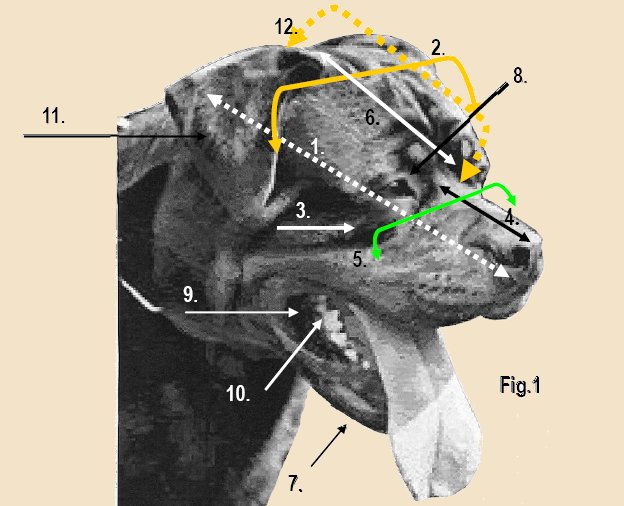
1.
The length of the topskull and muzzle. Measured from the tip of the nose to the
occiput
2. Width of the topskull.
3. Zygomatic arch
4. Muzzle length. Measured from the tip of the nose to the stop.
5. Broad muzzle at the base. Correlated to the pronunciation of zygomatic arch.
6. Length of the topskull. Measured from the stop to the occiput.
7. Strong lower jaw.
8. Almond shape, dark eyes, tight fitting eyelids, hair present on eyelids, no ocular discharge.
9. Dark gum pigmentation (the color of dark, chocolate).
10. Complete correct dentition.
11. Ears, set correctly hanging close to the cheeks, of medium size.
12. Correct, moderate arch of the topskull.
Page 3 describes correct head type. Some dogs come close to the ideal; others possess essen-tial traits in varying amounts. Today, the most common problem worldwide is the lack of zygomatic arch and a shallow muzzle at the base. A shallow zygomatic arch accompanies a shallow muzzle at the base and produces a muzzle that is conical in shape. Conversely, a pronounced zygomatic arch accompanies a muzzle wide and powerful at the base. The zygomatic arch and muzzle thickness at the base are
correlated. When incorrect, they greatly diminishing the powerful masculine head type we appreciate. Figure 2 demonstrates the shallow zygomatic arch and narrow muzzle at the base.
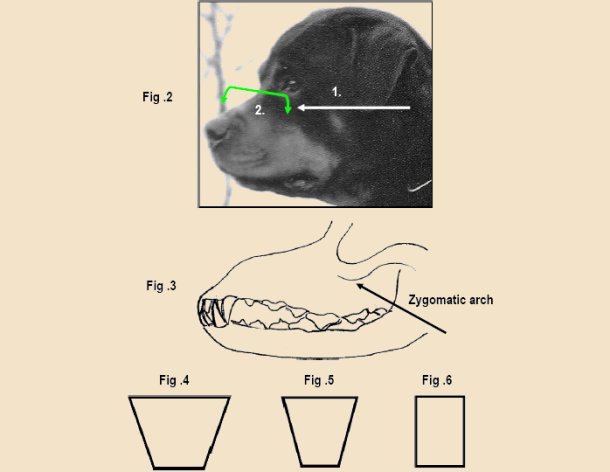
Above are three different muzzle shapes presently appearing in the gene pool. Only Fig. 4 is cor-rect for the Rottweiler. Figure 4 depicts the wedge shape, a wide based triangle, blunt at the tapering end (the nostrils). Currently, we can observe both a conical shape (Fig.5) and a rectangular shape muzzle (Fig.6). These types of muzzles (Fig. 5-6) are incorrect.
CORRECT SHAPE AND PLACMENT OF THE EYES
The eyes of the Rottweiler play a pivotal role in correct head type. The standard makes special mention of this by detailing the expression of the Rottweiler along with the shape, placement, size and color of the eye.
The standard specifies;
-
Expression is noble, alert and self assured
-
Eyes, medium size
-
Almond shape
-
Well fitting lids
-
Moderately deep set, neither protruding or receding
Serious faults
A. Yellow eyes (FCI standard - a disqualification)
B. Eyes of different color or size (FCI standard - a disqualification)
C. Hairless eyelids
D. Loose fitting eyelids
Two anomalies not mentioned in the standard, yet serious faults nonetheless, are excessive ocular
discharge and the presence of a prominent third eyelid. The latter is uncommon and both are indicative of
an eye problemgenetic or environmental.
CORRECT EYES AND PLACEMENT

Dark, almond shape, with tight fitting, hair present on the eyelids,
noble serious expression, clear with no ocular discharge.
Set well apart, at approximately a 15 degree angle above the bridge of the nose.
EARS

Correct
Incorrect
Ears, correctly placed and carried have a subtle role in correct head type. Their correct shape is that of an isosceles triangle, equal on all sides. When correct, they augment the width of the head and give the dog/bitch a serious, focused appearance. Incorrect, they detract from a correct head.
CORRECT HEAD TYPE: POWERFUL SKULL AND MUZZLE, STRONG
ZYGOMATIC ARCH AND STOP, POWERFUL LOWER JAW
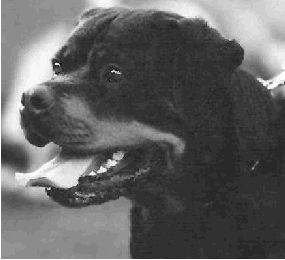
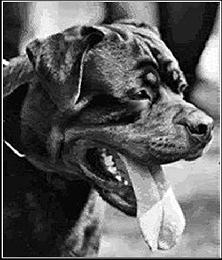
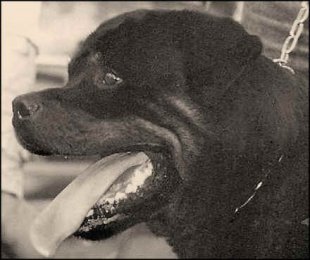
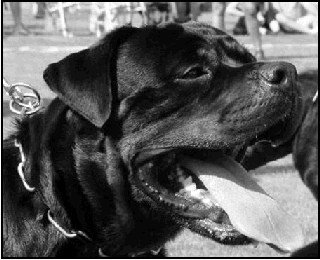
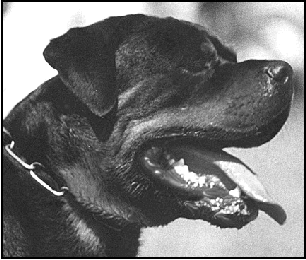
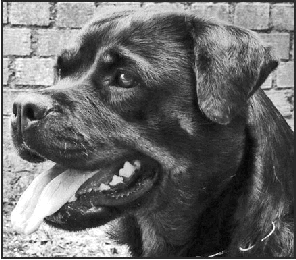
INCORRECT HEAD TYPE: NO PRONUNCIATION IN
ZYGOMATICH ARCH, CONICAL MUZZLE SHAPE, SHALLOW STOP
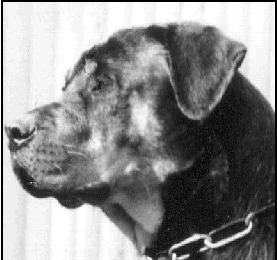
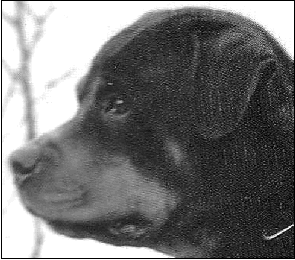
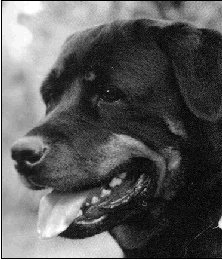
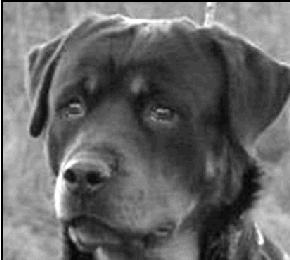
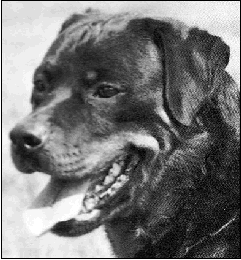
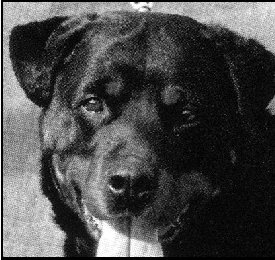
WHAT ARE THE DIFFERENCES
BETWEEN DOG AND BITCH HEAD TYPE?
Many enthusiasts incorrectly believe there should be a distinct difference in the architecture of head types between the dog and bitch. Whereas, only the dog should be the sole possessor of power, substance and masculinity, and the bitch, because she is a female, should possess soft lines, be shallow in the topskull and muzzle with little to no stop or zygomatic arch. For them, in essence, the bitch is less than the dog! The standard does not affirm this notion. The American Rottweiler Club standard states:
Dogs are characteristically more massive throughout with larger frame and heavier bone than bitches. Bitches are distinctly feminine, (here is the important caveat) but without weakness of sub-stance or structure.
In the FCI Rottweiler standard there is no mention of a difference between the sexes other than a marked reversal of sexual type as an eliminating fault stating:
Distinct reversal of sexual type, i.e. feminine dogs or masculine bitches.
The architecture of the head is to include power in the muzzle, stop and zygomatic arch. It is the same for the dog and the bitch.
Following are the two exceptions:
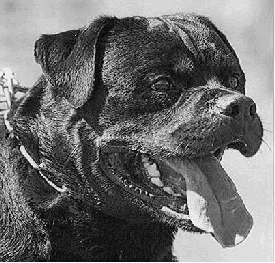
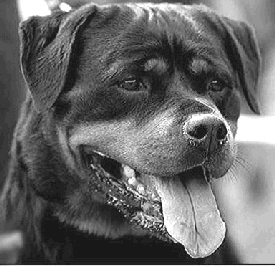
Correct Dog
Head
Correct Bitch Head
SUMMARY
Correct Rottweiler head type is multi-faceted and complex; more than some would like to admit. Its comprehension and recognition are essential in completely understanding Rottweiler breed type. Dis-missing its importance would be analogous to dismissing the value of the engine in a racing car. Both will get by with less, yet both are missing what makes them unique!
* This article cannot be reprinted in part or whole without written permission from the author.
References
The American Rottweiler Club Breed Standard
Federation Cynologique Internationale Rottweiler Breed Standard
Nr. 147 / 19.06.2000 / D Rottweiler
Rottweiler il Cane, Carla Romanelli Lensi
The Priority of Breed Type in the Rottweiler, Steve Wolfson
|
Top of page
|
NEW MYSTERY NOVEL FEATURES ROTTWEILERS
Rottweiler
Rescue, a Mystery for Dog Lovers, Features Rotties as
Crime-Solving Partners

|
After ten years active in Colorados Rottweiler rescue community, Ellen OConnell published her first novel, a mystery titled Rottweiler Rescue, in February of this year. Rottweiler Rescue is now available on Amazon.com in paperback and as an ebook for the Kindle. Other ebook formats are available at
Smashwords.com. Ellen is donating one-half of her royalties from sale of the paperback edition of the book to the Colorado Rottweiler rescue group, Rottie Aid
(www.rottieaid.org).
Rottweiler Rescue tells the story of Dianne Brennan, who plans to help save lives as a volunteer foster home for Rottweiler rescue. Little does she know that her volunteer work will take her into the path of a canine-phobic killer! Worse, although Dianne cannot identify the murderer, he begins stalking her with deadly intent. Can she keep herself and her Rottweilers safe long enough to collar the killer?
Rottweiler Rescue has been an Editors Choice in the Mystery Category of the Rocky Mountain Fiction Writers Annual Colorado Gold Contest. Amazon readers have given the book a thumbs up: Highly recommended. Check this book out, you won't be disappointed! Terrific! I couldn't put this one down.
For more information, see www.oconnellauthor.com.
Click
here to read our review.
|
|
Top of page
|
What
I Learned At The Dog Show
May
24 2010
UPDATE:
This essay is now available as a two-page PDF
handout for easy printing and distribution.
 I
spent this weekend at the Myrtle Beach kennel Clubs
all-breed dog show in Florence, South Carolina. The club
invited me down to talk about the threats its members are
facing from the Humane Society of the United States and
the rest of the animal rights movement. Since I had never
been to a dog show, I said yes. (I grew up thinking that
fancy was an adjective. Silly me.) I
spent this weekend at the Myrtle Beach kennel Clubs
all-breed dog show in Florence, South Carolina. The club
invited me down to talk about the threats its members are
facing from the Humane Society of the United States and
the rest of the animal rights movement. Since I had never
been to a dog show, I said yes. (I grew up thinking that
fancy was an adjective. Silly me.)
Im
not a big fan of people who pooh-pooh things theyve
never tried or seen up-close. If one of my children says
she doesnt like something on the dinner table
before taking even a tiny bitewell, lets just say
that doesnt wash in my house.
And
Ive always thought the whole dog show community
was rather mysterious, a kind of benevolent secret society
with its own rules, customs, and vocabulary. Sorta like
Deadheads, but with a lot better grooming and a lot less
fleas.
Truth
be told, the dog breeders I met this weekend do have their
own peculiar ways of saying and doing things. But
theyre really just ordinary people with a shared hobby.
Theyre really into what they do. And they
taught me a lot in just a Saturday. Heres some of what
I learned.
-------
- When
you go to a dog show, bring your own chair. But
dont be surprised if someone offers to lend you
theirs. (Im typing this in someone elses
customized, embroidered lawn chair.)
- Dog
shows are competitive, but the people involved are
remarkably supportive of their human opponents. I
heard a steady stream of congratulations!
offered to blue-ribbon holders from handlers who were
trotting away empty-handed.
- If
youre a first-timer who asks what kind of dog is
that? too loudly, somebody might look at you funny.
 These
people treat their dogs like royalty. It was 90
degrees in the shade on Saturday, and the dogs had
shade, electric fans, and cold watereven if their
owners didnt. These
people treat their dogs like royalty. It was 90
degrees in the shade on Saturday, and the dogs had
shade, electric fans, and cold watereven if their
owners didnt.
- Judging
from this weekend, the typical show-dog handler
isnt a stuffy Brit wearing Saville Row tweed.
Sheyes, sheis an energetic 40-year-old
married mom whose husband packs up the kids and brings
them along on the trip.
- Sometimes
the kids strut the dogs around the ring. The
under-18 handlers even have their own judging category
in which their skills are being judged, not
the qualities of their dogs.
- The
name of the game is conformation (not
confirmation, as I used to think). Dog show
breeders are trying to breed animals that
conform to a set ideal of how a breed can look,
gait, and behave if they do everything right. (I
read an article in Wired this week about how
Cheetos in the factory are checked every 30 minutes
against a reference sample from Frito-Lay
headquarters, just to make sure the ideal color,
texture, and crispiness is being matched. Its kinda
like that, but it takes years for these folks to make
a single Cheeto. And Cheetos dont pee on you.)
- Watch
where you step in the parking lot.
If this
particular dog show is any indication of whats typical,
the dog fancy is a lot of fun for a lot of people
who contribute a lot of money to the economyand
arent hurting anyone. If were not having fun
here, one judge told me, very much off-the-cuff, we
shouldnt be doing this.
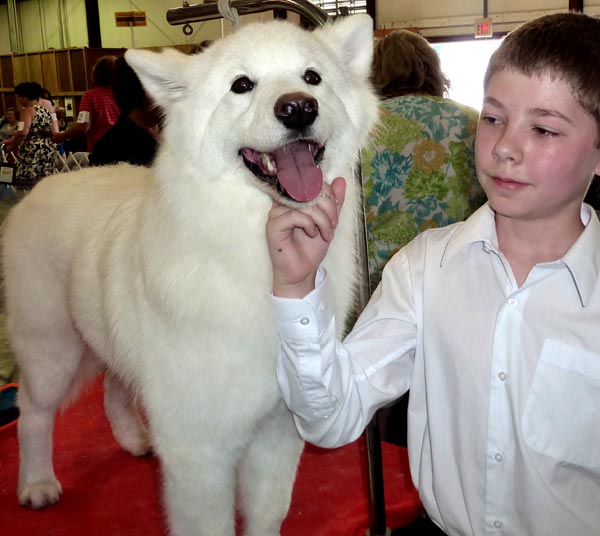 For
the life of me, I cant figure out why the Humane
Society of the United States has such a visceral hatred of
everything they stand for. For
the life of me, I cant figure out why the Humane
Society of the United States has such a visceral hatred of
everything they stand for.
I think
whats going on is that HSUS, PETA, and other animal
rights groups are conflating breeders whose main goal is
to sell puppies with those who just happen to
really love Pomeranians, Pinschers, or Poodles. This
latter clique of people (far larger than the former) shows
their favorite animals because theyre proud of them,
not because they believe it will make their next litter
worth more money.
Its
not hard to understand HSUSs stated motivation for
attacking people who breed dogs. The group wants everyone
to believe that rampant pet overpopulation in America is
all their fault. But personally, I just dont see it.
I
didnt meet puppy millers this weekend. I met
hobbyists, just like if I were at a model railroad
convention, an antique fair, or a swim meet. They ask
after each others kids. They visit each other in the
hospital. They have knitting circles where the dogs watch
approvingly. Theyre 50 percent garden club, 50 percent
church pot-luck. Zero percent animal abusers.
I asked
one breeder how much money she had spent raising her
champion dog, a mammoth Anatolian shepherd. Who
knows? she answered. I never really added it up. If
youre pinching pennies you probably aren't treating
the dog right. In addition to the two purebred dogs she
was showing, she had two rescue mutts at home, and they
have the same food, supplements, and everything else my
show dogs get.
And
when I asked one of the veteran breeders how many of her
peers raise dogs so they can sell the litters
commercially, she looked at me like I was from Mars. We
all sell dogs, son, she told me. But none of us make
a cent doing it. And I know where all my dogs live. If
anyone cant provide for them, we take em back.
And then, almost as an afterthought: I sure dont
want any of mine going to the pound or a rescue.
Everyone
I asked about this had the same kind of answer. If they
found out that any of their puppies wound up in a
shelter, theyd sure do something about it.
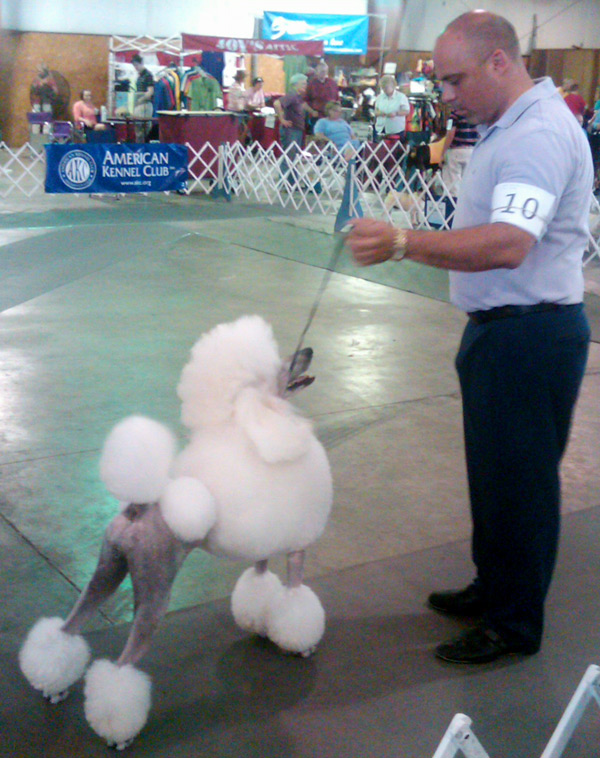 So
why all the hostility from the Humane Society of the
United States? Why did I hear from North and South
Carolinians who had beaten back attempt after attempt from
HSUS to have them taxed, registered, regulated, raided,
and otherwise priced out of their hobby? What is it about
these men, women, and children, so passionate about
running up and down a concrete floor with their pets, that
demands intervention from activists who think they know
better? So
why all the hostility from the Humane Society of the
United States? Why did I hear from North and South
Carolinians who had beaten back attempt after attempt from
HSUS to have them taxed, registered, regulated, raided,
and otherwise priced out of their hobby? What is it about
these men, women, and children, so passionate about
running up and down a concrete floor with their pets, that
demands intervention from activists who think they know
better?
Maybe
its that HSUS thinks the only way to shut down puppy
mills is to paint every dog breeder with the same broad
brush. Maybe. I havent yet really wrapped my mind
around why HSUS is opposed to everything I saw
this weekend. I just know that it is.
As with
pretty much every group of ranchers, dairymen, biomedical
research scientists, and chicken farmers Ive met, the
breeders I spoke with this weekend had varying levels of
awareness about the looming political threat from HSUS.
Some of them cant be bothered to be bothered. Others
are fired up at the mere mention of Wayne Pacelles
name.
Somebody
has to take that guy on, one 50-ish man barked when I
brought up the name of HSUS's CEO. That whole movement
is nuts. After I showed up to lobby against HSUSs last
North Carolina breeder tax, I started getting calls in the
middle of the night, untraceable phone calls, from these
people saying they were going to come on my property, take
my dogs, and burn my house down. I told em my new rifle
has an awesome night scope. That pretty much ended it.
I spoke
to the crowd after the Best In Show was awarded, in this
case to a fluffy pekingese named Noelle. I told them
that their problem is the same as the one faced by pork
producers, egg farmers, dairymen, and even cancer
researchers. But it was up to them to reach beyond their
circle of friendsoutside their comfort zoneif their
kids and grandkids were going to keep being Junior
Handlers and continue to raise the dog breeds theyve
come to love.
At the
end of the day, I have to be skeptical of HSUS's blanket
condemnation of pet breeders. I'm confident that there are
some horrible ones out there, as there are with any
group of people (including animal activists...), but any
legislative or cultural movement that lumps the people I
met this weekend in with the bad actors is just plain
wrong-headed.
Because
the dogs I met in South Carolina were among the
best-cared-for animals I've ever seen. Anyone who's truly
interested in animal welfare would want to make sure more
dogsnot fewerare treated this way. So how 'bout it,
Wayne? Why aren't you promoting dog shows?
Probably
because you've never been to one.
Related
People
Related
Organizations
Posted
on 05/24/2010 at 09:55 AM by David
Gov't,
Lobbying, Politics Pets
(131) Comments
|
Top of page
|
Rottweiler saves runt of the litter's bacon
Published
October 9, 2009 by: Richard Jones
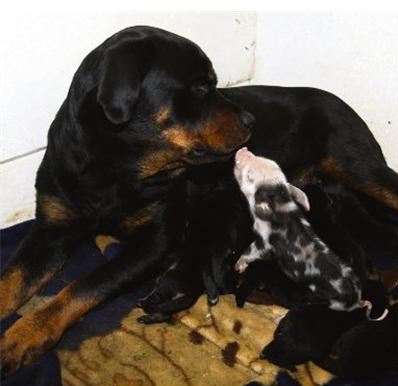
|
A ROTTWEILER dog and a tiny piglet cuddle up as if they were family after the baby runt was dismissed by its own mother.
Surrogate mum Sasha, an eight-year-old Rottweiler, took on motherly duties for grunter Apple Sauce a tiny Belgium Blue and seems to be taking the adoption in her stride.
Lonely Apple Sauce was one of 11 piglets but unwanted by her own mother she had her bacon saved when Sasha fell in love with her after being introduced to the one -and-a-half-year-old dog by owner Heidi
Rhiann.
And the unlikely relationship has made the wrinkly piggy a genuine sausage dog. In these adorable images Apple Sauce can even be seen trying to suckle from her gigantic new mum.
The two animals live together in Pont Llogel, near Lake
Vyrnwy, where pig breeder owner Heidi Rhiann, runs a catering business.
Caring Heidi owned a pig that gave birth to 13 piglets. She has managed to give a few away but Apple Sauce was the runt of the remaining herd introducing her to Sasha was her one last chance of survival.
Heidi told the County Times: We didnt know what to do so we thought we would give Apple Sauce one last chance and introduce her to our dog.
We rubbed her in one of the puppies blankets to leave her with the same scent and just left them to become acquainted.
A couple of hours later we came back to find Apple Sauce suckling on
Sasha.
We hope the bond continues, so far though Sasha is the best mother you can imagine. She immediately fell in love with the piggy.
Days later she started lactating again and giving milk for the piggy. She obviously regards it now as her own baby.
Mum of the year? Quite possibly!
|
|
Top of page
|
Cosmetic Faults
By Steve Wolfson
|
Every
breed standard highlights and describes certain
faults that it wants to diminish and/or eliminate.
Faults are a warning of characteristics that the
standard considers undesirable and will degrade
breed type or the breeds function. This process
insures stability and uniformity of type,
construction and temperament. The Rottweiler
standard, a highly descriptive and exacting one,
contains 25 faults.
Below
is a list of the 25 faults in the American
Rottweiler Club standard. All are listed as
serious, except numbers 13 and 25. Number 13 and
number 25 have less gravitas and are listed only
as faulty.
1.
Lack of proportion
2.
Undersized
3.
Oversized
4.
Reversal of sex characteristics (bitchy dogs,
doggy bitches)
5.
Yellow (bird of prey) eyes
6.
Eyes of different color
7.
Eyes of different size
8.
Hairless eye rim
9.
Improper ear carriage
10.
Total lack of mouth pigment (pink mouth)
11.
Level bite
12.
Any missing tooth
13.
Wavy coat
14.
Open coat
15.
Excessively short coat
16.
Curly coat
17.
Total lack of undercoat
18.
Any trimming that alters the length of the natural
coat (caused by grooming not a fault due to
genetics)
19.
Straw-colored markings
20.
Excessive markings
21.
Insufficient markings
22.
Sooty markings
23.
Rust markings other than described
24.
White markings any place on dog (a few rust or
white hairs do not constitute a marking).
25.
Any structural fault that detracts from the
above-described working dog must be penalized to
the extent of the deviation.
Despite
the standard referring to serious and non-serious
faults, many breeders and exhibitors often speak
about faults as "cosmetic". There is
nothing in the standard referring to faults in
this manner.
Labeling
faults as "cosmetic" is dismissive. It
implies that a fault can be easily removed or
overcome. For example, the correct color for
markings is mahogany. However, many presently
exhibited Rottweilers possess light or straw
colored markings (#19). It is listed as serious. A
good amount of breeders and owners of dogs with
this fault address this as a problem of cosmetics.
If this were just a matter of cosmetics, then why
are so many
Rottweilers
exhibiting this fault? All Rottweilers should
possess rich mahogany markings. Currently they do
not.
Another
example of a fault labeled "cosmetic" is
pink gum pigmentation. Not only is this listed in
the standard as a serious fault (#10), more
importantly, it is a type fault as well. That is
why dark gum pigmentation is highly desirable,
difficult to obtain and maintain once achieved in
a breeding program. Nonetheless, a problem often
observed on many exhibits is
"bubble-gum" pink inner mouth
pigmentation.
All
involved with the Rottweiler for any length of
time understand that faults are not easily
surmounted, nor disappear or go away. This is why
the study of a pedigree and knowing its strengths
and weaknesses is so important. Discovering and
acknowledging problems within a bloodline helps to
prevent a fault from emerging.
Below
are the prevailing faults, which are incorrectly
categorized as cosmetic.
Light
markings: Tan Yellow
Light
eye color (3b - 5a)
Dark
markings
Sooty
markings on pasterns
Poor
ear carriage (high set, low set, fly away)
Large
ears
Small
ears
Ears
that have a fold in them
Coarse
coat
Wavy
coat
Fine,
silky coat
Pink
gums
Pink
spotted gums
Rose
colored gums
Tuck
up in groin area like the Doberman
Why
do some label these faults cosmetic? Most likely,
they are called "cosmetic" so an owner
or breeder of a dog can make palatable certain
faults encountered on an otherwise good specimen.
It is easier to rationalize a fault than it is to
acknowledge it. One should always be objective and
critical when faults are the topic of discussion.
Avoid making a fault more palatable by labeling it
merely cosmetic
|
|
Top of page
|
Rottweiler Beats Odds To Return To Family
Posted: July 24, 2009
-- Click
here for video
|
Dogs are not our whole lives, but they make our lives whole." It's a quote animal lovers will tell you is true.
After all, dogs are man's best friend, for their ability to show us unconditional love. As NewsChannel 5 photojournalist Nathan Sharkey and reporter Jeff Tang tell us a Rottweiler named Ella is teaching us all, the true meaning of loyalty.
How fitting is it that in the town of Only, Tennessee there is a dog with only one wish.
"She's somebody's baby you could tell," said animal rescuer Kathy Wilkes-Myers. "If her eyes could talk, speak words I mean they'd speak volumes."
Sitting on the front porch of Myers' house Ella is happy but not at home. Ella is waiting for something.
"She seems happy but she has this look in her eye like this is okay, but where's my family?" said Myers.
Most humans would say that Ella is lost, but she'll tell you it's the other way around. Her family has been missing ever since the accident.
"She slammed the breaks and we went into a spin," said accident survivor Joe Kelley.
On July 1, the Kelley family nearly died in a horrific car accident in Hickman County.
"I just remember slamming right into the mountain and I thought to myself well this is it God," said accident survivor Michelle Kelley.
A frightened Ella watched as the medics took Joe, Michelle and their three children away to the hospital.
"The last thing I've seen was her looking straight in the eyes before she ran up into the woods," said Joe.
The family pet, Ella, got scared and ran away from the scene.
"Couldn't find my dog - couldn't find my dog," said Michelle.
She could have wandered east or west, north or south, but she did not. Instead, for 13 days Ella waited.
Kathy Wilkes-Myers drove by the accident the day it happened and two weeks later she spotted a dog near the same spot.
"That's the last spot she saw her family and she was going to stay there," said Myers. "She was starved and covered with ticks."
Kathy brought Ella back to her rescue ranch where the two became quick friends. She also brought back a plastic bag full of clues hoping it could lead her to Ella's owners.
"I found another little nest where she had put all these personal items," said Myers.
Since Ella could not find her family at the crash site, she decided to find everything that belonged to them.
"It just blew my mind and I thought this dog was just trying to find some comfort," said Myers.
While searching the area, Kathy also found a notepad that led her to insurance agent April Bowers.
"I knew exactly who it was, whose dog it was - what's going on," said Bowers.
Just like that the pieces came together. Despite all they've been through, the Kelleys never once forgot their dog and Ella never forgot them.
Myers brought Ella to reunite with her family.
Every member of the Kelley family was expected to make a full recovery. Though the family has faced some major medical and financial setbacks since the accident they said getting Ella back makes it all worthwhile
|
|
Top of page
|
Airline for Pets Takes Wing
By SAMANTHA BOMKAMP AP
Pet Airways, the world's first pets-only airline, took to the skies on Tuesday. The company is the brainchild of Dan Wiesel, seen embracing one of his passengers, and his wife, Alysa Binder. Their fleet includes five refitted planes,
in which the seats have been replaced by spacious carriers.
|
NEW YORK (July 14) - One trip for their Jack Russell terrier in a plane's cargo hold was enough to convince Alysa Binder and Dan Wiesel that owners needed a better option to get their pets from one city to another. On Tuesday, the first flight for the husband-and-wife team's Pet Airways, the first-ever all-pet airline, took off from Republic Airport in Farmingdale, N.Y.
All commercial airlines allow a limited number of small pets to fly in the cabin. Others must travel as checked bags or in the cargo hold--a dark and sometimes dangerous place where temperatures can vary wildly.
Binder and Wiesel used their consulting backgrounds and business savvy to start Pet Airways in 2005. The last four years have been spent designing their fleet of five planes according to new four-legged requirements, dealing with FAA regulations and setting up airport schedules.
The two say they're overwhelmed with the response. Flights on Pet Airways are already booked up for the next two months.
Pet Airways will fly a pet between five major cities--New York, Washington, Chicago, Denver, and Los Angeles. The $250 one-way fare is comparable to pet fees at the largest U.S. airlines.
For owners the big difference is service. Dogs and cats will fly in the main cabin of a Suburban Air Freight plane, retooled and lined with carriers in place of seats. Pets (about 50 on each flight) will be escorted to the plane by attendants that will check on the animals every 15 minutes during flight. The pets are also given pre-boarding walks and bathroom breaks. And at each of the five airports it serves, the company has created a "Pet Lounge" for future fliers to wait and sniff before flights.
The company will operate out of smaller, regional airports in the five launch cities, which will mean an extra trip for most owners dropping off their pets if they are flying too. Stops in cities along the way means the pets will take longer to reach a destination than their owners.
In this July 9, 2009 photo, Pet Airways' Alyse Tognotti prepares a canine passenger during a training session. Pets, numbering about 50 per flight, are escorted to the plane by attendants, who check on them every 15 minutes once the plane is airborne.
|
A trip from New York to Los Angeles, for example, will take about 24 hours. On that route, pets will stop in Chicago, have a bathroom break, play time, dinner, and bunk for the night before finishing the trip the next day.
Amanda Hickey of Portland, OR. is one of the new airline's first customers. Her seven-year-old terrier-pinscher mix Mardi and 2-year-old puggle Penny are taking their first flight soon.
Hickey said the service was a welcome alternative to flying her dogs in cargo when she transplants them from her soon-to-be Denver home to Chicago to stay while she and her fianc travel to Aruba to get married.
"For a little bit more money, I have peace of mind," she said.
It was a stressful experience in a cargo hold that spurred Binder and Wiesel to start their airline. Their Jack Russell terrier, Zoe, flew once in cargo and Binder said they worried about how the dog was doing, but were unable to check on her or get information. The couple soon started looking for a better solution.
"One time in cargo was enough for us," Binder said, walking through an airplane hangar as Zoe trotted in front of her. "We wanted to do something better."
The company, which will begin with one flight in each of its five cities, is looking to add more flights and cities soon. In the next three years, Binder hopes to fly to 25 locations.
Among the big U.S. carriers that offer pet services, AirTran, Spirit, Southwest and JetBlue only allow pets to fly in the cabin. Most U.S. airlines charge between $100 and $125, but Delta and Northwest charge $150 for cabin trips. AirTran is the cheapest among big carriers at $69.

Employees load passengers on a Pet Airways plane in Farmingdale on Tuesday. An Oregon woman, whose two dogs were already booked for a flight, saw the white-glove service as a big improvement over the cargo hold, where animals travel on most planes. "For a little bit more money, I have peace of mind," she said. (Source: AP)
|
The charge is more to fly in the cargo or check-baggage holds. Delta and Northwest are the most expensive at $275. Alaska Airlines and Midwest charge the least, at $100. Frontier prices its checked pets fees between $100 and $200 and only takes pets as checked baggage.
Anne Banas, executive editor of SmarterTravel.com, questions the viability of an airline with such a specific niche.
"I'm not sure how sustainable it is," she said. "But if people are trying to go for a first-class service, it could make sense."
She said the service's popularity could spike in peak summer or winter months when airlines in some areas don't allow pets to travel.
Betsy Saul, co-founder of Petfinder.com, which has ranked the pet-friendliness of airlines for three years, said she's excited about the expected impact Pet Airways will have on pet travel across major airlines.
"The entire industry will stretch because of Pet Airways," she said. "It's a challenge that says 'let's make this (experience) better for pets.'"
|
|
Top of page
|
SPCA
EXEC'S DOG DIES AFTER BEING LEFT IN HOT CAR

The 16-year-old dog dies of kidney failure after being left for four hours.
RICHMOND, Virginia - An executive for an anti-animal cruelty group says her 16-year-old blind and deaf dog died after she accidentally left him in her hot car for four hours.
Click
here for more......
|
Top of page
|
The Anatomy of a Dog Attack
by Ryan O'Meara
Out of the blue, it attacked for no reason
When a dog attack is reported we will often hear the same old phrases bandied about.
It came out of the blue
It was totally unprovoked
We didnt see it coming
It was totally out of character
Ring any bells? Well lets try and understand how and why a dog might attack someone.
Dogs rarely, if ever, attack for no reason. Us humans often misinterpret a dog attacking out of the blue and without warning because we simply missed the signs.
Lets be clear about one thing. A dog who is prepared to bite someone has his reasons. Can we, as humans, justify those reasons using the social values of people? Probably not. But of course, dogs do not live their lives according to human social values.
Here is the story of John, Henry and Max.
John has no wife or children. For the last five years hes lived with his best friend in the world a playful Labrador called Max.
John is exited today. Henry, an old friend from school who he hasnt seen for many years is visiting.
John decides today would be a good day to get his garden tidied, make a good impression on his old school chum.
As John gets busy in amongst the weeds in the front garden, he spies his old mate making his way up the street.
Henrys been looking forward to catching up with John for weeks and, as hes never been to his home before, finds himself feeling somewhat jubilant to realise hes managed to find the street on which John lives without too much trouble and can now relish the prospect of seeing his friend again as well as finally getting to meet the only true love of Johns life, the much talked about Max.
Its a hot and sunny day and Henry is wearing his sunglasses. Further up the street he spots John working in his front garden.
Johns already noticed Henry making his way towards him and yells out, Hi Henry. Fancy a beer?
Henry shouts back, Sounds just the job. Can you believe this heat?.
As per usual, Max has been helping John with his gardening exploits by digging holes of his own all over the lawn. John doesnt mind. He only wanted the garden so he could have somewhere safe to play fetch with Max on sunny days like today. Hes never been one for trying to keep it immaculate when Maxs favourite hobby is trying to tunnel his way to China.
Max has stopped his gardening though. Hes become preoccupied by the exchange between John and Henry and hes taken a trip the front gate to see whats going on.
I wonder who this bloke is? ponders Max.
Why would he and John be shouting at other? he thinks to himself.
Id better be on full alert. he concludes. Johns just shouted at this chap so he obviously wants me to keep an eye out.
Max fixes himself in position at the front gate and hoists his tail high into the air, hes keen to let the oncoming stranger know hes about.
John doesnt notice.
Henrys still coming. So Max decides he needs to be more clear. He starts to emit a deep, low growl in Henrys direction just to make certain the stranger whos purposely striding towards him, his owner and HIS garden is left in no uncertain terms that hes not moving
Henrys still coming. And now hes close enough for Max to notice his sunglasses. This is getting more serious by the second, thinks Max. Hes not only not listening to me, hes staring right at me. I know, Ill stare right back at him. See if hes as brave then.
Problems. Henry is still as brave. To Max, Henrys sunglasses look like wide, staring eyes, boring straight ahead and as he marches staunchly toward the increasingly anxious Labrador, Max wonders what his next move might be. As body language goes, Henry is showing all the signs of refusing to listen to Maxs advice.
Now tense and feeling genuinely threatened, Max is offered an escape. John jogs inside to fetch a couple of bottles of beer and Max is only too pleased to hurriedly follow his master. Max is somewhat relieved to suspect that John, his idol, is just as scared as he is about the relentless stranger pursuing them both from outside the garden gate.
Shut the door John, shut the door Max worries. Hes still coming and you havent closed the door.
Too late. Maxs heart leaps as he hears the gate swing open. Too late.
His worst fears are confirmed. The unrelenting Henry is now purposefully making his way up the garden path and toward the the house where Max and John are isolated, cornered and in Maxs case, petrified.
Gathering up every ounce of his canine courage and without a seconds thought for his own safety Max charges out of the house, tail hoisted aloft and barking his war cry as loud as his voice will muster. He heads straight for Henry wondering why this stalking maniac refused to listen to all of his earlier warnings.
You might kill me but youll never take John, Max decides.
Henry, his face very quickly drained of all its
colour, is shocked and taken aback to be confronted by a clearly furious Max, the dog hed heard so many nice stories about from doting John. This isnt at all the dog he thought hed be meeting.
Henry, alarmed and frightened makes his way toward Max, attempting to offer a hand of reassurance and friendship.
Max is having none of it.
John warned you. Then I warned you. Why wouldnt you just listen?, reasoned Max.
Undeterred by Henrys advance and determined not to let his owner come to any harm, Max lunges in Henrys direction.
The realisation that Max is a long way past the stage of being able to be pacified dawns on Henry fast and he hastily tries to beat a retreat back out of the gate from which he entered.
John, hearing the commotion and now panic stricken by Maxs attack bellows No! Max, no.
Acutely tuned to his owners emotions and sensing the fear and alarm in Johns voice, Max forges ahead and launches into a full scale attack on Henry.
And then, as quick as it began, it was over.
An ambulance arrives to take Henry away and, hearing the commotion, Johns neighbours have summoned the Police.
John can be heard explaining, Hes never done anything like this before, the attack came totally out of the blue, Max was always such a trustworthy dog, hes never shown any signs of aggression in his life, the attack was totally unprovoked.
But we know differently dont we?
Lets look again at how Max saw things unfold:
Max spots a man walking toward his and his owners garden his territory
Not unduly worried, Max paid little attention to the stranger until John shouted in Henrys direction. To Max, this was a clear signal to watch for danger
Obediently, Max sat at the front gate and watched for that danger.
He attempted to signal to Henry by putting his tail in the air and growling, that he was prepared to defend his owner and territory.
As Henry gets closer, Max again postures but now spots Henrys aggressive body language, his wide eyes refusing to overt their gaze a clear signal of intent. Henrys point blank refusal to alter his path, a sure fire gesture of defiance.
As John runs inside, Maxs thoughts turn to escape. He now believes John is as scared as he is and they should both seek shelter from the safety of the house.
Too late. As Henry enters the garden (Max and Johns territory) Max does what he thinks his owner needs him to do. He defends against the threat.
As Henry runs away and John panics, Max takes this as a sign that he should increase his attack, his canine instincts now in complete overdrive.
So let us again question whether John was correct when he explained to Police that Maxs attack was unprovoked.
Was it unprovoked? Not at all.
Was it unjustified in human, social terms? Absolutely.
Was it avoidable? Totally.
The Aftermath
Henry, his pain eased only slightly by drugs lies motionless in a hospital bed and starts to face the reality that a visit to see a dear, old friend has left him disfigured for the rest of his life. He ponders how best to explain to his young children that hes still their Dad even though he knows his mutilated features will upset them deeply. He wonders how life will be from now on, how people will react to him.
Max, confused and still frightened by the terrifying ordeal earlier in the day is now wondering why hes found himself confined to a small, secure cage at the vet surgery.
He stares through the bars and looks longingly towards the door, hoping against hope that he will soon be reunited with his trusted friend and master, John.
Unbeknown to Max, hell never see John again.
As the door swings open, Maxs tail momentarily begins to wag but hes deflated. Its not John. Its a vet nurse.
Hes still pleased to see her. Hes lonely and upset and he just wants to go home and be with his friend.
Hes too pre-occupied to wonder why the vet nurse seems so wary of him. Wanting to put her at ease, he submissively offers up his paw. As the vet nurse holds it, she carefully shaves a small patch of fur away from his leg.
Max didnt even notice the injection.
On this day it wasnt only Maxs body that was destroyed as Johns memories of a kind, gentle, fun loving dog died too.
He asks himself once more, Why did my dog attack someone for no reason?
John may never know it, but Max had his reasons.
Dogs do not bite people without reason. They do not attack out of the blue. They do not launch into savage, frenzied assaults without provocation despite what you will undoubtedly read in news reports when the next dog attack hits the press.
There are NO devil dogs. There are NO unprovoked dog attacks. There IS a huge gap in understanding amongst some dog owners about why dogs attack and until we can bridge that gap in education people will continue to be attacked and more and more dogs will join Max, their memories destroyed along with their bodies.
Killing individual dog breeds is not the solution to a problem whicn runs throughs an entire species. Oh, and if you were left in any doubt, that species isnt canine.
Originally published on Stop Dog Attacks | Copyright Ryan OMeara
|
|
Top
of page
|
Shawnee Kennel Club donates pet oxygen masks to fire and rescue services in Warren County
By M.K. Luther --
mkluther@nvdaily.com
Lt. Tony Maiatico, of the Warren County Department of Fire and Rescue, demonstrates a pet-sized oxygen mask on Paris, a
Rottweiler owned by James Noll, 14, of Winchester, at the North Warren fire house on Tuesday. The Shawnee Kennel Club of Berryville donated 20 sets of masks to be distributed to town and county fire and rescue services to carry on ambulances. Rich Cooley/Daily
|
FRONT
ROYAL -- Volunteer emergency services in the town
and Warren County just became a little more
pet-friendly.
The
Shawnee Kennel Club of Berryville donated 20 sets
of pet oxygen masks on Tuesday to the county's
emergency fire and rescue services at the Company
10 Fire House in North Warren County.
Kennel
club member Linda Noll and her son, James, 14, of
Winchester, brought along their black Labrador,
Max, and Rottweiler, Paris, so members of the fire
company and trained emergency technicians could
test and begin training with the snout-sized
masks.
The
approximately 40-member AKC-registered Shawnee
Kennel Club serves the Northern Shenandoah Valley,
as well as parts of West Virginia, and works on a
community service project each year in addition to
participating in dog shows.
"We
try to do a community project every year and this
seemed like a really cool idea," Noll said.
"Especially when we found out the fire
company did not have the masks."
Noll
said the kennel club has spent thousands of
dollars over the past few years outfitting
regional volunteer fire departments and emergency
services with these masks to help provide pets and
small animals with a fighting chance if they are
involved in a life-threatening situation.
The
oxygen mask sets cost about $70 each and contain
three mask sizes -- small, medium and large -- to
fit large and medium-size dog breeds, cats and
other smaller house pets.
Noll
said the masks cannot aid emergency services
personnel in resuscitating an unconscious animal,
but can help treat for smoke inhalation.
"It
just gives them one more chance," Noll said.
Warren
County Fire and Rescue Capt. Wayne Dodson said the
sets will be divided among the various fire
companies throughout the town and county so all
ambulances will have pet oxygen masks on board.
The fire company has had large animal rescue
training, such as horses, in preparation for barn
or outdoor structure fires, but has never had
access to equipment for house pets before, Dodson
said.
House
pets generally will try to move far away from the
source of a fire and often hide instead of seeking
escape from a residence, Dodson said, increasing
the risk of severe and lasting damage from the
smoke.
Saving
lives is the fire department's main priority, and
Dodson advised homeowners to make emergency
services personnel aware of a pet's presence.
"Obviously,
we want to try to get your pets out," Dodson
said. "Let incoming responders know that
there are pets in the house."
http://www.nvdaily.com/news/2009/07/shawnee-kennel-club-donates-pet-oxygen-m.html
|
|
Top of page
|
The Biting Truth About Dogs
From The Gloucester Times - Gloucester ME:
Health Beat - Elizabeth Eddy - August 7, 2009
|
Dogs are great companions and much-loved members of many families. But all dogs can bite, so their owners must take responsibility to prevent this very normal, but often dangerous behavior.
"Dogs are not furry children," said Dianne Foster, animal inspector for the City of Gloucester. "They are dogs, not children with human qualities, and every dog bites. It's what they do."
"Dogs are everywhere now, and people expect their dogs to interact in public," she said, so there are more opportunities for dogs to bite and more reports of this in recent years.
Foster investigates instances of reported dog bites, and said it is common for adults to receive bite wounds on their legs or hands, but unfortunately, children are often bitten in the face because they are eye level to many mid-size dogs.
"I've seen lots of little kids with bites this summer," she said.
Foster said she has never met a dog that aggressively bites people for no reason, but it is an instinctive response for dogs to bite when they are fearful, startled or protecting their turf.
"Biting is a dog's defense," she said, and they will often bite to protect their territory, food and toys.
Jamie LeVie, Gloucester's animal control officer and dog warden, said, "All dogs bite, but most bites are not a sign of viciousness, and many dogs only bite one time."
Dogs in pain are more likely to bite, and older dogs that are losing their hearing and eyesight are easily frightened and may react by biting, he said. He added that dogs bite their owners as often as they bite strangers. In fact, he received more calls from bitten pet owners last year than from outside parties.
Many people believe that large, strong breeds like pit bull terriers or Rottweilers are the most likely to bite, but they are not. "Actually, the highest biting dog is the Chihuahua," LeVie said, "but if a pit bull bites, you will hear about it. Their propensity for biting isn't greater, but they always show up in the papers." Likewise, no one can assume his or her dog will not bite, even if he owns a so-called gentle breed like a golden retriever, Foster said.
LeVie agreed that predicting dog behavior by being "breed-specific" does not work. "I have seen black Labs and springer spaniels go crazy, so it's not about the dog. It's about the owners."
Since all dogs can bite, owners bear the ultimate responsibility for controlling their pets. "If your dog bites someone, it's your fault," Foster said. "And you will more than likely be sued."
Dog bites, she added, often cost owners $10,000 to $15,000, so there is both a moral and financial incentive to keep dogs restrained.
If a dog bites a person or other pet, they must be quarantined for 10 days to ensure there is no sign of rabies, per city ordinance. If there is no proof of vaccination, the quarantine will be much longer, and in rare cases, the animal could be euthanized for testing.
That is an unpleasant scenario, so preventing dog bites is the best strategy to ensure harmony between dogs and people.
The first step is to understand the dog's nature and needs before adopting it, Foster said. "Do your research before you get a dog." She observed that many people acquire dogs because they like their looks or the breed has been popularized by celebrities and the entertainment world. However, these owners may be unprepared to manage their dog's tendencies and the dog could become a nuisance.
"I have not met any bad dogs, but I have met bad dog owners," she said.
Shelters, such as Cape Ann Animal Aid, are happy to offer guidance and match a family with an appropriate dog. Reputable, long-established dog breeders, those who concentrate on improving the breed, are another option. Puppy mills and backyard breeders who breed for profit must be avoided, because these operate inhumanely and care little about instilling the best qualities in their animals.
After the dog comes home, it should be neutered or spayed, because non-neutered animals, especially males, are more likely to become aggressive.
To protect against unknown dogs, Foster tells people, "Never go up to a dog you don't know, period, and always, always ask before you pet someone else's dog and talk to the owner." It is especially important for parents to teach their children this precaution.
If two dogs seem to be on the verge of fighting, they should be pulled away on their leashes, but no one should try to break up a fight by getting in the middle or using their hands. A hose or long stick can be used to shoo the dogs away from each other.
LaVie also asks local residents to suppress their helpful instincts and avoid loose dogs, which will prevent many bites. He says it is his job to round up these dogs, so if one is spotted, call animal control and leave the dog alone. There is a leash (and registration) law in Gloucester, so dogs should not be running loose in public anyway. In his opinion, the best way to approach a dog is from the side, not straight on, and he advises against reaching over its head.
Foster said to stand still if a dog seems aggressive, because most dogs like a chase, and will pursue someone who runs away. Flailing the hands is also unwise because it may prompt the dog to bite.
"When you are talking about dog-anything, common sense goes a long way," LeVie said.
|
|
Top of page
DOGS AND THEIR TAILS
Wagging tails - dog tails - why dogs wag their tails
(Excerpt from How to Speak Dog)
Dr. Stanley Coren
|
"....In some ways, tail-wagging serves the same functions as our human smile, polite greeting, or nod of recognition. Smiles are social signals, and human beings seem to reserve most of their smiles for social situations, where somebody is around to see them. Sometimes, vicarious social situations, as when watching television or occasionally when thinking about somebody special, can trigger a smile. For dogs, the tail wag seems to have the same properties. A dog will wag its tail for a person or another dog. It may wag its tail for a cat, horse, mouse, or perhaps even a butterfly. But when the dog is by itself, it will not wag its tail to any lifeless thing. If you put a bowl of food down, the dog will wag its tail to express its gratitude to you. In contrast, when the dog walks into a room and finds its bowl full, it will approach and eat the food just as happily, but with no tail-wagging other than perhaps a slight excitement tremor. This is one indication that tail-wagging is meant as communication or language. In the same way that we don't talk to walls, dogs don't wag their tails to things that are not apparently alive and socially responsive.
A dog's tail speaks volumes about his mental state, his social position, and his intentions. How the tail came to be a communication device is an interesting story.
The dog's tail was originally designed to assist the dog in its balance. When a dog is running and has to turn quickly, it throws the front part of its body in the direction it wants to go. Its back then bends, but its forward velocity is such that the hindquarters will tend to continue in the original direction. Left unchecked, this movement might result in the dog's rear swinging widely, which could greatly slow its rate of movement or even cause the dog to topple over as it tries to make a high-speed turn. The dog's tail helps to prevent this. Throwing the tail in the same direction that the body is turning serves as a sort of counterweight, which reduces the tendency to spin off course. Dogs will also use their tails when walking along narrow surfaces. By deliberately swinging the tail to one side or the other in the direction opposite to any tilt in the body, the dog helps maintain its balance, much the same way a circus tightrope walker uses a balance bar. Quite obviously, then, the tail has important uses associated with specific movements. However, the tail is not particularly important on flat surfaces, when a dog is simply standing around or walking at normal speeds. At these times, it becomes available for other uses. Evolution again seized an opportunity and now adapted the tail for communication purposes.
It is something of a surprise to many people to learn that puppies don't wag their tails when they are very young. The youngest puppy I ever saw systematically wagging its tail was eighteen days old, and both the breeder and I agreed that this was quite unusual. Although there are some differences among the various breeds, the scientific data suggests that, on average, by thirty days of age, about half of all puppies are tail wagging, and the behavior is usually fully established by around forty nine days of age.
Why does it take so long for the puppy to start wagging its tail? The answer comes from the fact that puppies begin wagging their tails when it is necessary for purposes of social communication. Until they are about three weeks of age, puppies mostly eat and sleep. They are not interacting significantly with their littermates other than curling up together to keep warm as they sleep or crowding together to nurse. They are physically capable of wagging their tails at this time, but they don't.
By the age of six or seven weeks (when we start to see tail-wagging behaviors on a regular basis), the puppies are socially interacting with one another. Most of the social interactions in puppies consist of what psychologists call "play behaviors." It is through playing that puppies learn about their own abilities, how they can interact with their environment, and most important, how to get along with other individuals. A puppy learns that if it bites a littermate, it is apt to be bitten back, and perhaps the game it was playing might be terminated by its now angry playmate. It is at this point that the puppy also starts to learn dog language. It is not clear to what degree these emerging social communications are prewired, but learning is clearly needed to refine the use and interpretation of these signals. The pups learn to connect their own signals and the signals provided by their mother and their siblings with the behaviors that come next. They also begin to learn that they can use signals to indicate their intentions and to circumvent any conflicts. This is where and when the tail-wagging behavior begins.
One place where conflicts are likely to occur is during feeding. When a puppy wants to suckle its mother, it must come very close to its littermates as it crowds in to find her teats. Remember that this puppy is now coming close to the very same individuals that might have been nipping, jostling, or chasing him a few minutes earlier. To indicate that this is a peaceful situation, and to calm any fearful or aggressive response by the other puppies when they too are pushing toward the mother's teat, the puppy begins to wag its tail. Tail-wagging in the puppy then serves as a truce flag to its littermates. Later on, puppies will begin to wag their tails when they are begging food from the adult animals in their pack or family. The puppies come close, to lick the face of the adult, and they signal their peaceful intentions by tail-wagging. It thus becomes clear that the reason that very young puppies don't wag their tails is that they don't yet need to send appeasement signals to other dogs. When communication between dogs is needed, they rapidly learn the appropriate tail signals.
Tail language actually has three different channels of information: position, shape, and movement. Movement is a very important aspect of the signal, since dog's eyes are much more sensitive to movement than they are to details or colors. This makes a waving or wagging tail very visible to other dogs.
Evolution has used a few additional tricks to make the tails even more visible. Wild canines, like wolves, often have great bushy tails, which are easily seen at a distance. In addition, many tails are specially colored to facilitate recognition of tail signals. Often, the underside of the tail is lighter, to make the high-tailed signals quite visibly different from signals involving the tucking of tails into a lower position. Many canines will also have distinctive markings to make the tail tip more visible. Usually, there is a lightening toward the tail tip, or perhaps simply a white mark which defines the tip of the tail. In other canines, the tail tip is noticeably darker. Either of these two color contrasts helps to make the end of the tail more visible, and this make movement and position cues easier to recognize...."
Excerpted from How to Speak Dog / Stanley Coren All rights reserved / Reprinted by permission
Dr. Stanley Coren is a professor of Psychology. He has written 6 books on dogs and is the host of the television show Good Dog!
Pets.ca 2004 www.pets.ca
------------------------------------------------------------------------------------
|
Top of page
|
Service Dog Discrimination in Killeen Texas
June 16, 2009 by
Jan Hoadley
The Rottweiler is a
capable service dog and can be certified in many service capacities.
Neither they nor their handler may be discriminated against.
(Dog is
not Della)
|
When Heather Jones had multiple seizures at school the Killeen (TX) Independent School District did not call emergency services but did call her mother to pick her up. Heather was in the critical care ward at Kings Daughters Hospital for two days and during that time her certified service dog slept in bed with her. Della, her service dog, reliably alerted hospital staff before Heather would have a seizure.
Due to the seriousness of the situation, when released from the hospital Della was taken to school activities under the protection of the Texas Human Resources code Section 121 that provides protection for the disabled and their service animals. The Eastern Hills Middle School and Killeen ISD refused to allow the service dog in, denying Heather participating in cheerleading, graduation or the graduation dance.
This is something that happens one time - there is no way to give that back. The reason for denying access was discrimination of another kind. Della, a certified service dog, is a Rottweiler. She has passed all training and certification, and copies of that documentation was provided to the school. At a hearing on June 4th it was provided again but the school district wanted more time to review it, with a determination made by June 12, prior to Heather starting summer school.
At the June 12 hearing the district acknowledged that the certification was valid. The district stated on today in a statement from Leslie Gilmore that she could say the student was in school today with the dog today. Ms. Gilmore was on the way to a meeting on the issue.
However, previous attempts to work with the district have been unsatisfactory. The district stated "If Heather is uncomfortable attending summer school without Della..." which indicates that a service dog is but an accessory instead of a certified medical assistant, albeit a 4 legged one. Indeed a statement was made, according to the family's attorney, "if this was a poodle we wouldn't be here." Thus it was not a service dog but the type of service dog at issue.
|
|
Top of page
|
Service Dog Discrimination Continues in Texas
June
17, 2009 by Jan Hoadley
|
In a
previous article it was revealed the discrimination involving a trained service dog owned by Miss Heather Jones, a student in the Killeen Independent School District. While this reporter was told that the handler and her dog were in school there was more that was not said. Unfortunately this paints a much different view of cooperation by the Killeen ISD to comply with the ADA act which is supposed to provide protection from discrimination of all with disabilities.
While school officials assure the callers and media that they are working to resolve the issue the means of resolution involves more discrimination. When Miss Jones had multiple seizures in class a month ago the teachers did not recognize it, did not call for an ambulance and informed her mother to come get her but did not say that she was having seizures.
The school district claimed initially there was no other service dogs in the district. They did not mention the golden
retriever therapy dog that is in a special needs classroom. The school district has in action painted a much different and more threatening picture than what they are saying in words. Indeed the school board itself did not know it was not resolved until yesterday.
The "experience in school was horrifying" Heather's mother Andrea said. Greeted by the principle, Amy Foster and a police officer she thought it was to explain to the other children that Della was a working service dog and they were not to play with or distract her. Instead they stepped into a long hall to find eight police officers waiting, falling in behind them as they walked down the hallway. Why does a school district need to employ these tactics and intimidation? They were then blindsided with a meeting, without their attorney present and a form placed before Andrea to sign. She was told whether she signed it or not it was in effect.
|
|
Top of page
|
A Portrait of Heidi
By Gemma Tamas
May 2008
|
Heidi, who disrupted, inspired and transformed my life. The first time we met, I must admit, I had mixed feelings about her. She was beautiful to look at; her lustrous jet-black hair was short and straight, her deep brown eyes sparkled with intelligence. But great intensity and strong will lurked behind it.
Heidi! I met her every day and without realizing it, she found her way into my heart. It was all her doing! For some reason she chose me to be her friend. When we parted, she looked sad. Her eyes filled with disappointment until our next meet, when she did go out of her way to please me. I became under her spell, there was no way-out to escape from it.
Heidi! The name didnt fit her; it sounded too gentle for such a head-strong character. I decided to look into the matter and to my surprise, I found that Heidi meant cheerful and noble. It certainly described her. During this process, I discovered Heidi was a German name and I knew her ancestors came from Germany. What a unique way to express character, origin, even looks by giving the proper name to someone, I thought. It was the beginning of something that I would never had dreamed of. I started a names search. By the time I finished sorting them, arranging them alphabetically by meanings and by countries, I collected over three thousand names. Without realizing what I have done, it molded into a book, an over three hundred-page book. Since I went so far, my next step was to find an artist, Akiko, whos original drawings, by their artistic value, placed the book in a different category from being only a book of names.
Heidi! Its been two years we live together, Heidi and I. Since she came into my life, my life is not mine anymore. Whatever I do, I do it with her, wherever I go, we go together. Whatever I eat, she eats the same. She sleeps in my bed to keep me warm, chasing away my nightmares during the night.
Heidi! Her dislike towards a person became my own, her fondness for someone transferred to be mine. I trust her intuitions, value them in every respect. When she viciously complained about a men I knew, she was right. I found out the men was a shifty character, not worthy of my trust. I gave up my friends, who didnt like her, gave up my free time to be with her. I didnt spend money on myself but willingly paid for her medications and vitamins, for her every little whim she desired. When she broke her legs, I carried her in and out from the house, in and out from the car until her legs healed. When she hurt me from sheer exuberance once her casts were off, the dozen stitches the doctor gave me, only left marks on my arms, our friendship didnt scar by it.
Heidi! When I am sad, she feels for me. Mopping and sighing with my sorrow, her eyes turn sad, filled with worries. When I am happy, she joins in my happiness. Then she is bouncing around with joy, her steps lively with my own. In the mornings, after spending hours at my desk, she takes me away for a walk, and rejuvenates me with her play. We walk the fields and meadows together, singing and chasing butterflies in our path. We are climbing high mountains and on our way looking down the green valleys and rivers below.
Heidi, who disrupted, inspired, and transformed my life. My companion, my best friend, my
dog. Heidi was an abused dog. She was rescued and I adopted her or I should say she adopted me when she was a year old. Since she came to my life, my life had changed. Now, she is seven years old and she has
vitiligo, a rare but benign disease. Because of that, she looks like a dog from outer space, but I love her dearly.
|
|
Top of page
|
ANIMAL RIGHTS ACTIVISM IS ALIVE AND WELL IN THE UNITED STATES
By Sylvia Panetta
The September 11, 2001 World Trade Center / Pentagon /
demise-of-passengers-on-four-American-jetliners tragedy has brought the word "terrorism " out to the forefront of media all over the world.
The American Heritage School Dictionary defines terrorism as "The use of terror, violence and intimidation to frighten people into submission". What the dictionary does not elaborate on is that there are various "causes" for which groups of terrorists and their cells become active. One of these causes is animal rights.
I would like to take this opportunity to briefly discuss the animal rights mentality and then describe how a few of these fanatics created havoc with my once-peaceful life.
The Animal Rights Agenda (which lists twelve goals for the abolishment of our
relationship and involvement with animals) appeared originally in Animals' Agenda magazine in November, 1987, and was reprinted in The Hijacking of the Humane Movement: Animal Extremism by Rod and Patti Strand [*] (Doral Publishing -1993). They are taken in part as follows:
1. We are firmly committed to the eventual abolition by law of animal research, and call for an immediate prohibition of painful experiments and tests.
2. The use of animals for cosmetics and household product testing, tobacco and alcohol testing, psychological testing, classroom demonstrations and dissection, and in weapons development or other warfare programs must be outlawed immediately.
3. We encourage vegetarianism/or ethical, ecological, and health reasons.
4. Steps should be taken to begin phasing out intensive confinement systems of livestock production, also called factory farming, which causes severe physical and psychological suffering for the animals kept in overcrowded and unnatural conditions.
5. The use of herbicides, pesticides, and other toxic agricultural chemicals should be phased out.
6. Responsibility for enforcement of animal welfare legislation must be transferred from the Department of Agriculture to an agency created for the purpose of protecting animals and the environment.
7. Commercial trapping and fur ranching should be eliminated.
8. Hunting, trapping, and fishing for sport should be prohibited.
9. Internationally, steps should be taken by the US government to prevent further destruction of rain forests.
10. We strongly discourage any further breeding of companion animals, including pedigreed or purebred dogs and cats.
11. We call for an end to the use of animals in entertainment and sports such as dog racing, dog and cock fighting, fox hunting, hare coursing, rodeos, circuses, and other spectacles and a critical reappraisal of the use of animals in quasi-educational institutions such as zoos and aquariums.
12. Advances in biotechnology are posing a threat to the integrity of species, which may ultimately reduce all living beings to the level of patentable commodities.
Although their desired results call for the outlawing and removal of our personal and professional relationship with animals, the one that we must concern ourselves with for the moment is the statement that is listed as:
"10. We strongly discourage any further breeding of companion animals, including pedigreed or purebred dogs and cats."
The strategy for which these fanatics pursue the destruction of dog breeders in the United States is very simple. Most people, when purchasing purebred dogs, want the accompanying registration papers.
Remember, there are three major reasons that papers are required:
(I) to show the dog in registry sanctioned shows
(2) to register the offspring of the registered PARENTS
(3) personal prestige
Although there are many registry organizations in the United States, I will discuss the American Kennel Club (AKC), for which my dogs are registered. Somewhere in their list of regulations, they have a rule that states if anyone is convicted in a court of law of being guilty of "animal cruelty", their privileges are automatically revoked. This means that that particular breeder is no longer allowed to, among other things, register their dogs or any progeny that are produced.
The answer to the animal rights activists' prayers. VOILA!
This makes the rest simplified for these extremists. They merely have to choose their next victim and through various methods, including, but not
limited to, total fabrications, distortions, and altered photographs and video tapes, gain a victory by succeeding in obtaining a court conviction.
The breeders are usually too traumatized or are unable to fight back due to the inability to retain legal representation. Most attorneys do not perceive this type of incident as being serious and worthwhile, or they will charge extremely high fees of which the victim is unable to afford. And those lawyers that do accept the challenge, usually are not familiar with animals or animal law .The representation of their client is weak.
I became one of those victims. ..and appropriately nicknamed the "Poster Child of the Animal Rights Movement" on one of the Internet website forums. Read on, and you will understand why. Please keep in mind what I stated above. The AKC will revoke privileges if you are convicted of animal cruelty. The operative word is "animal". ..it doesn't have to be a breeding dog.
I will capsulize the incidents:
1992: (February) A neighbor, new at being an animal activist, had a personal grudge against me. In trying to make a name for herself, she filed a complaint with the police stating that one of my aged horses (40 years old) was being starved and was dying. At a ratio of three years to one, she was 120 years old in human years. The average lifespan of a horse is 25 years.
Allow me, please, to set the scene. I had six horses at the time, five of which I had rescued from an auction, doomed to go to the slaughterhouse. They were all healthy. ..and roamed a ten acre pasture. They were free-fed hay from a 200 pound round bale, given grain daily and had access to water 24 hours a day.
Although I live on a small, quiet country road, three police cars responded to her complaint, two of which formed a road block! I was verbally abused, temporarily held against my will without an
arrest warrant, threatened with arrest, and was victim to an illegal search of my property .
Her veterinarian was called to the scene. He examined the horse and advised the police she was fine -just a very old senior citizen. They left without the courtesy of an apology.
The woman was advised by my attorney to cease the harassment.
1995: (May) Knowing she had been warned to stay away, she solicited another activist that lived three hours from here to come here and participate in her place. He went to their activist friends from an SPCA from another county with a totally fabricated written complaint and altered and
phony photographs. The SPCA obtained a search warrant and seized my only horse. (They also did an illegal search of the dogs, even though the judge crossed it OFF the search warrant application, and then foolishly admitted in writing that they did so.)
Unfortunately, it didn't work out as they planned because I came out with my camera and took pictures of the horse before they took her away. Also, my veterinarian drove 140 miles to their facility to examine the horse. Two things they didn't count on to dispel their claims.
The animal cruelty charges were dismissed in the beginning at the arraignment level. The case
never went to trial.
1997: (May) I caught the disgruntled neighbor/activist in the field with my horse! She ran as fast as she could to get to her vehicle and drove away.
I pressed charges of TRESPASSING against her.
1998: (April 17) I was falsely arrested for animal cruelty, physically assaulted twice, sexually
assaulted (touched inappropriately), and tortured by two NYS troopers (police). I sustained serious injuries, including spinal injuries (cord compression,
the cal sac compression with one level being totally cut off, and nerve root compression) which requires six operations with possible steel plate insertion. I also need bowel surgery, knee surgery and wrist surgery .
The complaint was again filed by the activist that lived three hours away. It was totally
fabricated, including his personal resume, as in 1995. This time, not only did he use the horse to establish "probable cause" to get a search warrant for the horse, he also fabricated a story about the dogs, even though he never saw any of my dogs!
1998: (April 18) The trooper submitted false information to obtain a search warrant. In doing so, many people, including the SPCA animal activist veterinarian, arrived to execute the warrant. (This happened to be the same veterinarian that lied in the 1995 case). They brought in a deadly airborne virus which over a period of eighteen months, killed off almost all of my breeding stock, including many European imports and several litters of puppies. I lost an irreplaceable genetic pool that I developed over many years. The financial loss was a few hundred thousand dollars.
The horse was not seized. No dogs were seized.
1998: (July 17/18) During the late evening/early morning hours, a person or persons trespassed and penetrated my property and began liberating and stealing my dogs. I interrupted the theft, although I wasn't aware there were people out there. Four dogs, however, were stolen.
NOTE: The April 17, 1998 charge of animal cruelty was again dismissed at the arraignment level never went to trial.
In my quest for justice, as the plaintiff, I then proceeded to start a new trial in Federal Court. On July 6, 2001, NYS Trooper Thomas Crowley was found guilty of false arrest. The charges of excessive force, submitting false information to obtain a search warrant and malicious prosecution were dropped. I am still in a state of shock regarding the verdict.
I continue to pursue it in hopes an investigation will be initiated regarding the incident itself as well as the perjury at the Federal trial. If they proceed with an honest investigation, I presume there will be stiff penalties. ..hopefully jail sentences.
I will never recover from what has been done to me. But perhaps reiterating the experience will be enough to make you think twice about the animal rights movement and how it can effect you.
Please do not think it could never happen to you. You must be prepared. Always have a camera or camcorder handy with fresh batteries and film. You must be able to prove what your animals
looked like, because their real appearance and what you will be accused of are two entirely different descriptions.
You are not immune to terrorism. Terrorism has no boundaries.
September 11, 2001 proved that.
-------------------
[*] Patti Strand is the Director of the National Animal Interest
Alliance. The website address is http://www.naiaonline.org
The NAIA is an educational organization concerned with animal welfare issues and
provides balancing information regarding animal rights activities. It
would be worthwhile for you to spend some time and peruse the site. You
may also be interested in joining their ANIMAL TALK forum, an
information discussion board.
@copyright spanetta September 2001
|
|
Top of page
|
Animal Rights = Bloody Murder!
New York Tail Docking Ban Will Murder
Thousands Of Dogs That Can't Comply
by JOHN YATES
This article is archived at American Sporting Dog Alliance
Website: www.americansportingdogalliance.org
Email: asda@csonline.net
ALBANY, NY - Legislation to criminalize docking puppies' tails is a case study in mercy - animal rights style! It will result in tens of thousands of dead dogs in the first year alone, because there will be no way to allow them to stay alive in the face of criminal charges against anyone who owns them.
The animal rights movement is all about killing animals, either literally right now or gradually, through attrition by sterilization. Every piece of animal rights legislation boils down to dead dogs, which groups like People for the Ethical Treatment of Animals call mercy killings. PETA, which butchers about 90-percent of the dogs that enter its "shelter" in Norfolk, VA, believes that dogs are better off dead than exploited and enslaved by loving homes.
The Humane Society of the United States uses gentler rhetoric, but also creates and supports model legislation that will result in the death of thousands of animals, such as the proposed New York tail docking ban, and supports animal shelter policies that directly result in millions of unnecessary deaths by euthanasia.
The New York legislation is perhaps the clearest illustration yet of the true goals of HSUS and the rest of the animal rights movement.
AB 7218, which is before the Assembly Agriculture Committee, says that anyone who docks a puppy's tail, or has someone else perform the procedure, is guilty of a criminal misdemeanor punishable by a $500 fine. Not even veterinarians would be allowed to dock a dog's tail, except to save its life or for a health emergency.
The legislation also enables any New York animal rights group to act as vigilantes, hunt down violators, and petition the court to prosecute someone whose dog has a docked tail.
In addition, anyone who shows or exhibits a dog with a docked tail, or even attends a show or exhibition where dogs with docked tails are present, is guilty of a misdemeanor and faces a $500 fine.
Those provisions translate directly into dead dogs, by the truckload.
Here's how:
Probably a few million dogs now live in New York that already have docked tails. These dogs are from some of the most popular breeds in America, including all of the spaniels, most terriers, many herding breeds, almost all of the Continental pointing breeds, many miniature and small breeds of companion dogs, and popular companion and protection dogs such as rottweilers and doberman pinschers.
While existing dogs would be grandfathered, if they are certified as having had their tails docked before August 1, 2009, the fact is that most people who own these dogs will not know about the new law, will procrastinate, won't be able to afford a visit to their veterinarian for certification, or simply will forget about it.
Animal rights activists will blame these people for being irresponsible, but the fact is that the dogs will pay the price. They will be killed, and the reason they will be killed is because animal rights fanatics supported a law that will cause their deaths. The owners won't be able to prove the procedure was done before August 1, and will not be able to pay a continual stream of $500 fines. The result will be euthanasia or abandonment.
Some people might think that these dogs simply will be turned over to an animal shelter or rescue group. That won't happen, because animal shelters and rescue groups also could not legally possess a dog with a docked tail.
Nor could they find them adoptive or foster homes, because those people would be guilty of a criminal act merely by possessing the dog.
It goes far deeper.
Animal shelters would have no idea who docked the tails (or when it was done) of stray dogs that are picked up or turned in, dogs that are seized from their owners because of animal cruelty allegations, or dogs that are abandoned. There would be no choice except to kill these dogs, because they could never be legal.
More dead dogs would result because puppies in several breeds (such as Brittanys and Australian shepherds) sometimes are born with naturally short tails. In a mature dog, these natural "docks" look almost identical to dogs whose tails were surgically docked as puppies. They, too, would have to be killed.
Other dogs would lose part of their tails through injuries. If tails are broken by being accidentally slammed in a door, stepped on as puppies, bitten by other dogs, or struck by heavy objects such as falling tree limbs, the part of the tail above the break sometimes atrophies and falls off, creating the false appearance of a cut off tail (sometimes there is even raw or sore flesh at the point of the break for a couple of weeks). Other puppies have the tips of their tails broken off in the mother's uterus.
More dead dogs would result from people who move to New York from other states, and bring their pets with them. They wouldn't know about the New York law, and would be faced with a painful choice when they found out. They would have to either leave New York, or kill their beloved pet.
What about people who visit New York, or just pass through the state, and bring their dogs? If their dogs have docked tails, they would technically be in violation of the law if they didn't have certification that the procedure was done prior to August 1, 2009. Almost no one would have this certification, as it is not required in other states, and the animal rights vigilantes would have a field day.
If all of those scenarios are added up, the result would be a veritable mountain of canine corpses and broken hearts.
This legislation also would have a human impact. It would destroy dog shows, field trials and competitive events in New York, including the famed Westminster dog show.
It also would destroy the businesses of several professional trainers and handlers, and ruin some of the finest breeding programs for purebred dogs in America.
It would cost the economy of New York millions of dollars in lost revenues a year, and the loss of hundreds of jobs.
It also would mean that New Yorkers no longer would have access to dogs from the nation's best bloodlines, which means New Yorkers would not be able to improve the genetics of many breeds of dogs in the state. The impact would be that New Yorkers would be forced to buy puppies that are inferior in terms of genetic soundness, health, utility and temperament.
AB 7218 makes no sense at all from any perspective.
Ironically, the same animal rights fanatics who say that tail docking is cruel disfigurement, probably also circumcise their own male children, pierce the ears of their own daughters, cover their own bodies with tattoos, augment their breasts, tuck their tummies and lift their faces through "vanity" surgical procedures. In contrast to what people routinely do to their own bodies, docking the tails of young puppies is an almost completely safe and almost painless procedure. Puppies experience a feeling of a light pinch for a few seconds.
We don't believe for a moment that the leaders of HSUS and PETA think tail docking is cruel. What they really want is to kill more dogs.
Here is a link to the text of the bill: http://assembly.state.ny.us/leg/?bn=A07218&sh=t\
The American Sporting Dog Alliance is urging all New Yorkers who truly care about dogs to immediately contact members of the Assembly Agriculture Committee to express strong opposition to AB 7218. Letters and faxes are best, followed by phone calls and emails. A combination of two or more is ideal. Please contact as many members of the committee as possible, as they all represent every New Yorker in this capacity.
Here is contact information for committee members:
Assemblyman William Magee, Chairman
LOB 828, Albany, NY 12248
518-455-4807
MageeW@assembly.state.ny.us
Assemblyman Marc S. Alessi
LOB 419, Albany, NY 12248
518-455-5294
AlessiM@assembly.state.ny.us
Assemblyman George Amedore
LOB 426, Albany, NY 12248
518-455-5197
AmedoreG@assembly.state.ny.us
Assemblyman Michael Benedetto
LOB 919, Albany, NY 12248
518-455-5296
BenedeM@assembly.state.ny.us
Assemblyman Marc W. Butler
LOB 318, Albany, NY 12248
518-455-5393
ButlerM@assembly.state.ny.us
Assemblyman Clifford W. Crouch
LOB 450, Albany, NY 12248
518-455-5741
CrouchC@assembly.state.ny.us
Assemblywoman Francine DelMonte
LOB 553, Albany, NY 12248
518-455-5284
DelMonF@assembly.state.ny.us
Assemblywoman RoAnn M. Destito
LOB 621, Albany, NY 12248
518-455-5454
DestitR@assembly.state.ny.us
Assemblyman Gary D. Finch
LOB 320, Albany, NY 12248
518-455-5878
FinchG@assembly.state.ny.us
Assemblyman Tim Gordon
LOB 529,Albany, NY 12248
518-455-5777
GordonT@assembly.state.ny.us
Assemblywoman Aileen M. Gunther
LOB 435,Albany, NY 12248
518-455-5355
GuntheA@assembly.state.ny.us
Assemblyman Stephen Hawley
Room 531 LOB,Albany, NY 12248
518-455-5811
HawleyS@assembly.state.ny.us
Assemblywoman Barbara Lifton
LOB 555, Albany, NY 12248
518-455-5444
LiftonB@assembly.state.ny.us
Assemblyman Peter D. Lopez
LOB 429, Albany, NY 12248
518-455-5363
LopezP@assembly.state.ny.us
Assemblyman Alan Maisel
528 LOB,Albany, NY 12248
518-455-5211
MaiselA@assembly.state.ny.us
Assemblywoman Margaret M. Markey
LOB 654, Albany, NY 12248
518-455-4755
MarkeyM@assembly.state.ny.us
Assemblyman John J. McEneny
LOB 648, Albany, NY 12248
518-455-4178
McEnenJ@assembly.state.ny.us
Assemblyman Bob Reilly
LOB 452, Albany, NY 12248
518-455-5931
ReillyR@assembly.state.ny.us
Assemblyman Peter M. Rivera
LOB 826, Albany, NY 12248
518-455-5102
RiveraP@assembly.state.ny.us
Assemblywoman Linda B. Rosenthal
821 LOB,Albany, NY 12248
518-455-5802
RosentL@assembly.state.ny.us
Assemblywoman Addie J. Russell
LOB 602,Albany, NY 12248
518-455-5545
RussellA@assembly.state.ny.us
Assemblyman Frank K. Skartados
LOB 545, Albany, NY 12248
518-455-5762
SkartadosF@assembly.state.ny.us
Assemblyman Al Stirpe
Room 430, Legislative Office Building
Albany, NY 12248
518-455-4505
StirpeA@assembly.state.ny.us
The American Sporting Dog Alliance represents owners, breeders and professionals who work with breeds of dogs that are used for hunting. We also welcome people who work with other breeds, as legislative issues affect all of us. We are a grassroots movement working to protect the rights of dog owners, and to assure that the traditional relationships between dogs and humans maintains its rightful place in American society and life. We will not compromise on any legislation that takes away the fundamental constitutional rights of dog owners, or which reduces us to second-class citizens. The American Sporting Dog Alliance also needs your help so that we can continue to work to protect the rights of dog owners. Your membership, participation and support are truly essential to the success of our mission. We are funded solely by your donations in order to maintain strict independence.
Please visit us on the web at http://www.americansportingdogalliance.org
. Our email is asda@csonline.net
PLEASE CROSS-POST AND FORWARD THIS REPORT TO YOUR FRIENDS
The American Sporting Dog Alliance
http://www.americansportingdogalliance.org
Please Join Us
|
|
Top of page
|
Why Good Dogs Go Bad
Study Shows Flaws in Aggressive Dog Disciplining
From
ABCNews.com:
http://abcnews.go.com/Technology/DyeHard/story?id=6949062&page=1
OPINION By LEE DYE
Feb. 25, 2009

A police handler demonstrates an attack situation with a German shepherd dog during a tour by HRH Camilla, Duchess of Cornwall at the Metropolitan Police Dog Training
Centre, Jan. 29, 2009, in Keston, London. A new study shows that owners who are too aggressive in training their dogs will only make their dogs more aggressive. (Chris
Jackson/Getty Images)
|
People who are overly zealous in disciplining their dogs will probably make the animals even more aggressive, not less, according to a new study by veterinarians at the University of Pennsylvania.
The study involved 140 persons who turned to the animal behavior experts at Penn because their dogs needed help. The findings are consistent with other studies showing that discipline may not be the best way to correct an errant pet's attitude, but some of the statistics are a little surprising.
It's not startling to learn that kicking a bad dog will probably make him or her angry and likely to bite, but it turns out that even yelling "no" can have the opposite of the desired effect.
"This study highlights the risk of dominance-based training, which has been made popular by TV, books and punishment-based training advocates," said Meghan Herron, lead author of the study, published in the current issue of Applied Animal Behavior Science. "These techniques are fear-eliciting and may lead to owner-directed aggression."
In other words, if you kick your dog because he tried to bite you, he might end up owning your foot.
The study involved dogs that were so problematical that their owners were willing to seek professional help. A high percentage of the dogs became even more aggressive when they were kicked (43 percent), or the owner growled at the dog (41 percent), or something was physically removed from the dog's mouth (39 percent), or the dog was rolled onto its back and held down (31 percent.)
In many cases it didn't take much to make the pooch more agitated.
The researchers found that 30 percent of the dogs became more aggressive when they were "stared down" by the owner. That's defined in the study as "stare at dog until he/she looks away." Only 13 of the owners admitted they actually "growled" at their dog, and nine of those dogs (41 percent) "responded aggressively."
|
|
Top of page
|
The Long Island Working Rottweilers ~ A Retrospective
By Steve Wolfson

In 1989, a group of Rottweiler
enthusiasts and I were displeased with our local and national Rottweiler clubs indifference towards the working aspect of the breed. The emphasis for
those clubs was on conformation, not performance. We wanted more than fulfillment in the conformation venue; we sought a Schutzhund/Performance orientation. To
my surprise, our small group was not alone in our sentiments; we had many others in the Long Island, New York area that felt the same. We were committed to the idea
of starting a working club dedicated to the performance aspect of the Rottweiler and initiated the Long Island Working Rottweilers. Our club had a starting roster of 50
dedicated members with me as president and Mike Prisco as training director.
At that time, the United States Rottweiler Club was offering the direction we were seeking, but was relatively unknown here on the east coast. So in 1990, when the
USRC held its national show in Pennsylvania, hosted by the Berksiana Rottweiler Club, we eagerly attended.
To us, the Berksiana show was quite exciting and encompassed the working aspect we wanted to embrace. This European style show was quite different to what we
were accustomed. All entries were critiqued and awarded a conformation rating by the judge. It had 300
entries, and I believe 20 entries for the ZTP! The judges chosen
were from the ADRK, Kurt Lohnert and Juergen Wullf, both specialists in the Rottweiler.
The following year, my good friend Bill Alexander conducted the first American Rottweiler Verein national show on the east coast.
That too had over 300 entries and about 10 entries for the Ztp. The judge for that show was retired ADRK judge George
Erschinger. We also attended
the first Housatonic Rottweiler Club sanctioning show in Connecticut with my good friend Dietrich Neumahr as president.
After attending those exhilarating shows, we were convinced that this was the right path to chose. We joined the USRC in 1992 and held our first sanctioning show that
same year. The judges for our first club event were Volker Czechowski and Felicia
Luburich. Not surprisingly, we had a super entry of 60 for our sanctioning show,
which I believe is an outstanding entry for an opening event.
For our first USRC select event, we decided upon Carla Lensi as our judge. She had international recognition in the breed and was noted for her detailed judgments. This
first show garnered 110 entries and was attended by over 300 spectators from the entire New York Metro area. To the Long Island Working Rottweilers credit, our
other shows had on average 129 entries, aggressive spectatorship (in addition to the owners of the entries) and an average of 5 ZTP entries per show. In our 7 year
membership with the USRC, and despite never hosting a national event, our club had approximately 900 entries pass through our portal, 30 ZTPs, 1 breed symposium
and 2 conformation seminars.
In 1998, we conducted a double event we were very proud of, How to Judge the Rottweiler in Conformation and Gait, and the USRC North East Regional Sieger
Show. The lecture was conducted by Carla Lensi, our judge for the regional show, and was held at the Marriott hotel. It was an educational super event. The lecture
included breakfast and lunch. It was accredited by the USRC (for those that chose to become a conformation judge) and attended by 50 people! The show was
noteworthy. Although it was adjudicated by our one judge, Carla
Lensi, it had a spectacular entry of 167 with spectators three people thick around the ring! Despite it not
being a national, it had a generous entry in the working dog classes, 12 working dogs and 10 working bitches, and drew entries from Canada, the entire Eastern Seaboard,
the Southeast and California. A great thank you must go to the sponsor for all our shows: the Iams Co. Their generosity and financial help made all of our shows and
events successful.
There were many reasons for the success for our events and conformation shows. For one, they had drama and excitement. The winners were not predictable. If you
won, or placed it was on the merits of your dog; the shows contained absolutely no politics! Secondly, they ran on time and were conducted in an orderly manner with
strong supervision from the club. Thirdly, all our events were profitable without extracting additional unnecessary money from the participants. We went to great lengths
to make all feel they had an honest chance at winning and would want to come back to enjoy the competition the following year. Additionally, the ring was the right size
for shows of this style, 35 meters by 50 meters. There was no crowding. All handlers had ample space to move about and present their dogs. The judge also had ample
perspective to assess the dogs locomotion. We also strongly believed that our events should contain a venue to learn and grow in our knowledge about the Rottweiler.
Therefore, we held numerous seminars and a symposium. Even though it is no longer a club, the Long Island Working Rottweilers maintains a respectable record and
reputation to this day!
Included in this retrospective are photos taken by the late Doug Loving from those great shows. These photos contain friends and people, past and present. All, in their
own way, had an influence on our breed here in the US. Photos are numbered below each picture. Corresponding explanations are at the end of this article.
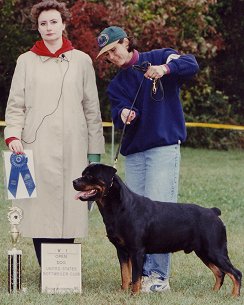
1 |
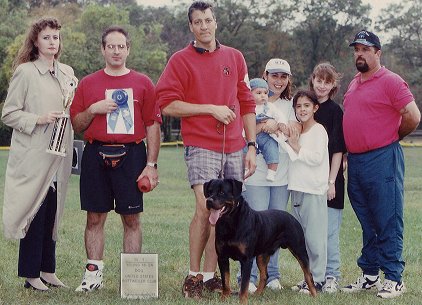
2 |
1.Jane Hobson, Gabrielle Wodak
2.Gary Ramis & friends, Gabrielle Wodak
3.The late Mark Schwartz, Gabrielle Wodak
4.Lynne Panno, Roger Vanderyken
5.Kris Boucher, Roger Vanderyken
6.Frank Romano, Gabrielle Wodak
7.G&M Schneider, Lori Rizzitano, Roger Vanderyken
8. The late Joe Weber, Roger Vanderyken
9. Mike & Mimi Prisco, Roger Vanderyken
10. Dietrich Neumahr, Roger Vanderyken
11. Bill Alexander, Merillio Duran, Roger Vanderyken
12. Ed Dupont, Dr. Otto Schimpf
13. Joe Allegrini, Dr. Otto Schimpf
14. John Dubarton, Dr. Otto Schimpf
|
Top of page
|
Rottweilers
are happy haulers for Spencer woman
By Steve
Huffman
Tuesday,
February 03, 2009
The
Salisbury Post
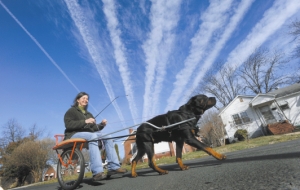
Penny,
a trained Rottweiler, pulls Rebecca Pless
around on a small cart in Spencer. Photo
by Jon C. Lakey, Salisbury Post.
|
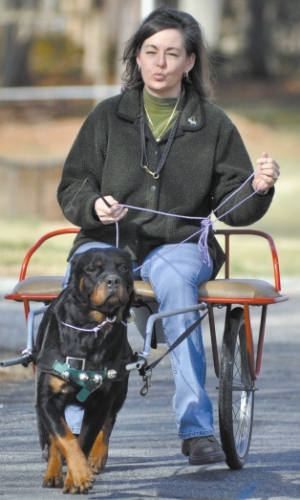
Penny,
a trained Rottweiler, pulls Rebecca Pless
around on a small cart in Spencer. Photo
by Jon C. Lakey, Salisbury Post. |
Penny,
a trained Rottweiler, pulls Rebecca Pless
around on a small cart in Spencer. Photo
by Jon C. Lakey, Salisbury Post.
|
SPENCER
It was pushing 50 degrees one afternoon last
week and Rebecca Pless and Penny, her 4-year-old
Rottweiler, were out for a stroll.
Or
a ride, depending upon one's point of view.
"I'm
just curious," asked a motorist who stopped
to inquire about the assemblage, "do you do
that for exercise?"
Pless
gave Penny a pat before answering.
"That
and fun," she replied.
Penny
(and sometimes Penny's son, Milton) can often be
seen traversing the streets of Spencer with Pless
in tow. They travel from their home on Alexander
Street, covering a half-mile or so to Park Plaza
where they make a loop before heading back.
The
contraption that Penny pulls and Pless rides is a
sulky, a two-wheeled carriage with a single seat.
It's the type often used in harness racing.
Pless
got the sulky in early January. Already, she and
her dogs have become a hit around Spencer,
something of local celebrities.
After
all, when was the last time you saw a Rottweiler
pulling a carriage?
Pless
said residents often stop her to ask about her
sulky and her dogs, both of which she's happy to
discuss.
"You're
just a brilliant dog, aren't you, PoPo?"
Pless said, kneeling and using her pet's pet name
as she lavished the canine with kisses.
Pulling
the sulky isn't hard on the dogs, Pless said, nor
do the animals consider it punishment.
Quite
the contrary, she said, they look forward to their
around-town jaunts.
Pless
said Rottweilers bruisers of dogs that can
weigh as much as 100 pounds were bred to pull
wagons and do similar tasks.
Pless
said that in Germany where they were first bred,
Rottweilers were known as "the butcher's
dog." She said the dogs would herd sheep and
cattle on the way to market.
After
the sheep or other animals were sold, the butcher
would tie the money he'd earned around the neck of
his Rottweiler for the journey home. Rottweilers
have an intimidating look and thieves were
reluctant to try and steal the money.
Pless,
50, has an interesting background. She's a
Kannapolis native who graduated from A.L. Brown in
1977. For 10 years she worked as a stewardess for
Piedmont Airlines, then U.S. Air.
Nowadays,
she works part time, managing rental property for
her father. Pless' husband, Randy, is a carpenter
and the couple is remodeling a house across the
street from where they live.
Pless
said she grew up with a love of horses, an
affection she's transferred to her dogs. In
addition to Penny and Milton, Pless also owns
Mike, another of Penny's offspring.
"I
wanted a short-haired dog that didn't require a
lot of grooming," Pless said of her decision
to settle on Rottweilers. "I have trouble
grooming myself, much less my dogs."
The
sulky she owns was given to her by Bob Busby, a
dog trainer and breeder from Mooresville with whom
Pless has long been friends.
"Rebecca
is great," said Busby, president of the
Salisbury Kennel Club. "She's a great
ambassador for all dogs."
Busby
said he'd owned the sulky for several years,
purchasing it from Bob Cooper, a man in California
who builds them. They're designed, Busby said, to
be pulled by large dogs.
"I
got it on a whim," Busby said. "I have
Rottweilers. It's natural for the dogs to want to
pull wagons, and this is perfect for them."
He
said Pless jumped at the opportunity when asked if
she was interested in the sulky, which hadn't seen
a lot of use in recent years. She re-padded its
seat and gave its frame a fresh coat of red paint
before leashing her dogs and hitting the road.
Pless
said she's especially proud to show off Penny. The
dog is an American Kennel Club and United Kennel
Club champion, and has garnered numerous obedience
titles.
Pless
sometimes takes Penny to schools and nursing homes
to interact with children and senior citizens.
They all benefit, she said, from the opportunity
to give Penny a pat, and Penny enjoys the
attention.
Pless
said Rottweilers are a loving breed, undeserving
of the bad reputation that some people have given
them.
"Where
there is a dog problem, there is always a people
problem," Pless said. "I've never had an
issue with these dogs in 20 years."
Cathy
Rubens, an Apex resident and like Pless a
member of the Carolina Rottweilers, agreed.
"They
love to clean your face," Rubens said of the
affection that Rottweilers bestow upon their
owners. "They're a wonderful breed."
Rubens
said she met Pless at a dog show and they've
become friends through their association with the
Carolina Rottweilers, an organization whose
members work to promote the breed.
"She's
a constant trainer," Rubens said of Pless.
"She is always working with her dogs."
Like
Pless, Rubens owns Rottweilers and said she's
involved them over the years in a number of
activities carting, included.
"The
dogs love it," Rubens said of harnessing the
creatures to a cart or wagon and taking them for a
spin. "These are dogs that were bred to work.
They need a job. They get a sense of
self-importance when they have a job."
Rubens
said carting such as Pless does with her
Rottweilers used to be a common practice.
Centuries ago, there were plenty of carts that
needed moving and Rottweilers were happy to throw
their backs into the tasks.
Rubens
said that not long ago, she had a friend who
regularly loaded a wagon with logs for his
Rottweiler to pull. The logs needed to be moved,
she said, and the Rottweiler loved the chore.
"Having
dogs that have jobs makes them better canine
citizens," Rubens said.
Pless
said she breeds her dogs on occasion, but said
most people don't qualify to buy from her.
"You
don't want to know what you have to go through to
get a dog from me," Pless said. "That's
one reason I don't breed my dogs more often than I
do. I can't find people who are qualified for
them."
Pless
laughed as she recalled what her brother said
about how particular she was with her Rottweilers.
"He
said, 'When I die, I want to come back as your
dog,' " Pless said. "Not just any dog,
your dog."
As
she climbed back into her sulky to continue her
spin about Spencer, someone asked Pless where she
put her feet. There are no foot rests on the
sulky.
Only
then did Pless admit that the art of riding a
sulky as her Rottweiler pulls is still a tad short
of perfected.
"You
just sort of let them dangle," she said of
her feet. "It makes good for a quick exit.
Hang on a second and you'll see."
Pless
said she hopes to have Penny adequately trained so
she can pull the sulky through the streets of
Salisbury and Spencer in the Holiday Caravan
Parade come November.
"With
horses," Pless said, "the trouble can be
getting them to go. With Rottweilers, it can be
getting them to stop."
|
|
|
Top of page
|
AVMA opposes cosmetic ear cropping, tail docking of dogs
By R. Scott Nolen
 The
AVMA
is calling on dog breed organizations to remove ear
cropping and tail docking from their standards. The
AVMA
is calling on dog breed organizations to remove ear
cropping and tail docking from their standards.
The AVMA
opposes ear cropping and tail docking of dogs when
performed for cosmetic reasons and calls on breed
organizations to remove mention of the procedures from
their standards.
The
Association's Executive Board approved the revised AVMA
Policy on Ear Cropping and Tail Docking of Dogs, Nov. 14.
The statement reads:
EAR
CROPPING AND TAIL DOCKING OF DOGS
The AVMA
opposes ear cropping and tail docking of dogs when done
solely for cosmetic purposes. The AVMA encourages the
elimination of ear cropping and tail docking from breed
standards.
The
former policy, approved by the AVMA House of Delegates in
1999, pointed out that cosmetic ear cropping and tail
docking afford no benefits for animal patients, and
advised veterinarians that they should warn clients about
related, inherent risks of anesthesia, blood loss, and
infection.
The AVMA
Animal Welfare Committee recommended the revised policy,
which makes the policy of the Association consistent with
those of the American Animal Hospital Association and the
Canadian VMA.
The
committee explained to the Executive Board in the
recommendation's background that there is little
scientific evidence that the cosmetic procedures of ear
cropping and tail docking convey benefits for dogs.
Prior
to the vote, Executive Board member Dr. Larry G. Dee of
District IV spoke in favor of the revised policy.
"Leaders take risks, and there's a risk in approving
this policy, but it's a risk worth taking," observed
Dr. Dee, a small animal practitioner from Hollywood, Fla.
No
board member spoke against the proposal.
The
American Kennel Club said labeling the procedures as
cosmetic is a "severe mischaracterization that
connotes a lack of respect and knowledge of history and
the function of purebred dogs."
Tail
docking of dogs, with some exceptions for working breeds,
is banned in the United Kingdom, as is ear cropping.
Australia and much of Europe prohibit both procedures. In
the United States, Maine has prohibited ear cropping.
"Because
the AVMA
is an organization that has determined it will create
animal welfare policies based on science, committee
members believe there is no reasonable basis on which to
continue support for these procedures being performed for
cosmetic reasons," stated the Animal Welfare
Committee in the background of its recommendation.
Another
reason Dr. Dee cited for approving the revised policy is
the growing number of veterinary students uncomfortable
with what they see as needlessly painful surgeries.
Student AVMA President Emi Eaton, who was present at the
board meeting, agreed. "The veterinary profession has
been evolving, and many of the younger student body are
behind ear cropping and tail docking only for medical
reasons," Eaton, a fourth-year student at the
University of Illinois, said later.
Read the AVMA press release
about the policy on the Association's Web site at http://www.avma.org/press/releases/081126_earcrop_taildock.asp.
|
|
Top of page
|
Review
of the 2008 NERF Seiger Show
by Karen Billings Our Seiger Show was a hit this year on October 4th & 5th, 2008. We opened our show with the Pledge of Allegiance recited by Mirabelle, Johanna & Megan, followed by the Star Spangled Banner sung by 10 year old Megan Messina.
Once again we had lovely weather, warm enough for the humans, but cool enough for our Rottweilers. Bruce unloaded his truck with our supplies from our NERF shed early in the morning and the tent was erected with the expertise of Barnum & Bailey crew, and the ring set up. It was our 4th Seiger show and we had 80 entries, a good count considering the expense of gas and hotels during these days that we are tightening our belts. We had many Owners & Dogs
come from other states, and again our friends from Canada, whom have supported
us every year.
Once again we had a good turn out of helpers from our membership. We also had non-member volunteers. Steve Wolfson loaned us his sound system and head phones, it was a lot easier for the judge to announce her critiques. Steve gave an informative power point presentation at our judges dinner. Our Judge was Cathy Thompson who managed to stay on her feet for two long days, and do a great job of critiquing.
Noreen Ruscito did all the typing for both days and proof read all critiques herself, for which we are most grateful. She volunteered for next year also. Cheryl was our chief Steward and kept our ring running in perfect precision. Roberta took in all the entries and entered them in the Computer and also completed the catalogue along with Margaret and her typing skills. Whew! that's a lot of work. Scotti
Ferguson & Pamela Clement took care of our Ways & Means table and
sold tickets for our raffle.
Margaret and Maureen did a great job choosing the trophies. They were lovely and stylish. Let us not forget the unbelievable Hospitality Bags. Maureen puts together the best gifts and goodies which every entrant looks forward to receiving. Margaret and her sister made sure that all entrants had their armbands and were recorded. Tracy Benson was our photographer and did an outstanding job of getting pictures of every dog and formatted them on a CD. Each dog has at the least three poses. I suggest purchasing a CD, and you will have a nice collection of Rottweilers to observe. We had our Rottweiler Rescue booths. Old friends and long time members, Pete & Leslie Maddocks visited, as did Jennie Burkhardt. What would our show be without food. Our chefs George & Jay had all the cooking under control, and
cooked to perfection.
We are already starting to plan our next years Show. We already have pledges for donations, Will you pledge a donation and volunteer a couple hours of your time???.
|
Top of page
|
Honoring the best darn Rottweiler in Oakley
By Steve Crump
Buster the pound hound finally got his place in the sun ...
The Rottweiler and his best friend, Mercedes Bedke of Oakley, were featured on cable TV's Animal Planet on Saturday as part of a segment of "Dogs 101" about Rotties ...
Buster was adopted by Mercedes' grandparents soon after they adopted the then 8-year-old girl ...
"We (thought) get her a puppy, but no puppies come available so we got a call from the animal shelter about Buster and went and picked him up and him and her bonded ... I mean he does not leave her," Phyllis Bedke, Mercedes' grandmother, told Boise's KTVB in May 2006 ...
Mercedes was riding her horse, BJ, when the animal shied away from a fence, throwing the girl into it ...
Buster to the rescue ...
He ran to the farmhouse, barking wildly, and led Mercedes' grandparents to the badly injured girl ...
"I come back out to call her for lunch and Mercedes was gone and Buster was at the door of the house and I knew something then was really wrong," Phyllis said ...
"My dad called me and said, you need to call 911, she is hurt bad and she's unconscious," Phyllis said ...
Mercedes suffered serious head trauma, and she was airlifted to Primary Children's Hospital in Salt Lake City ...
Yet she was back home in Oakley within two weeks ... Two years on, she's doing fine ....
And Buster? ... Well, he's not going back to the pound, according to the Animal Planet report ...
"He's got a spot with us forever," Phyllis said.
|
Top of page
|
Mandatory Spay / Neuter
Another form of BSL
By Alex Wisienski
We all know there is an overpopulation of dogs and cats . There is a rising number of strays and shelters across the nation are busier than ever. Many of these pets come from puppy mills and backyard breeders that have no concern for the health or quality of the animals they sell. Many dont even know what a standard is. Knowing this is a problem I believe mandatory laws for spay and neutering will not stop these people and will not end the problem with strays overcrowding shelters and certainly not make it safer for citizens from being bit. Unscrupulous owners and puppy mills will pay the fee for the required in-tact animal permit and continue to make a profit while the quality breeder who pays close attention to health, temperament and breed standards will be burdened by the fees and eventually cease trying. To these people it is a very expensive hobby because they love their breed and strive to maintain perfection. When the hobby becomes too costly they will be forced to stop. Meanwhile the profiteers will continue with their inferior dogs.
Mandatory spay/neutering is a rush to action and only a quick fix remedy without thinking of the big picture. The big picture is the impact it will have on ALL domestic pets for the entire future of domestic petsand humanity. Think of a future with scroungey sickly mutant pets from puppy mills. Or better yet, think of a future with no domestic pets at all when they reach the eventual point of extinction.
There are many ethical breeders that do not breed for profit. They breed for a healthy, premium quality animal and strive to improve the breed and compete in different venues of competition to show their hard work. Eventually these ethical breeders will be squeezed out of their passion and hobby because of costs and restrictions. I dont know of any ethical breeder that makes a profit. In the beginning it may not be too expensive but as time passes legislators will find it to be a good source of tax revenue so costs and restrictions will quickly increase.
Now, besides having lower quality animals from profiteers, think of the spayed/neutered animals that have not grown properly or to their fullest potential for health and structure. Scientific studies have found that dogs spay/neutered before fifteen months of age were smaller.
Dogs spay/neutered before puberty more frequently have longer limbs, lighter bone structure, less bone density, narrow chests and narrow skulls. This abnormal growth frequently results in significant alterations in body proportions and weights. It may cause increased stresses on cranial cruciate ligaments. Studies showed a higher incidence of CCL rupture, hip dysplasia, and bone cancer. Females have a five time greater risk of hemangiosarcoma and males have 2.4 times greater risk. Studies also show increased undesirable sexual behaviors, noise phobias, fearful behavior and aggression.
Other health considerations include female urinary incontinence, urethral sphincter incontinence in males, and hyperthyroidism. Adverse reactions to vaccines and infectious diseases were also more common.
Having mentioned all the health risks, you now need to consider the higher expense for pet owners to care for their beloved pet. There is also a very real possibility of price gouging by veterinarians who will take advantage of those caring pet owners. Many veterinarians are already taking advantage of the animal rights movements by intimidating or embarrassing pet owners to pay for services not really necessary.
Scientific Reference: Chris Zink DVM, PhD, DACVP
|
Top of page
|
Let's Rock 'N Roll
by Ms Dany Canino
Originally published in
Showsight Magazine
 "In the blockbuster movie, "Network", there was a famous line: "I'm mad as hell and I'm not going to take it anymore. "In the blockbuster movie, "Network", there was a famous line: "I'm mad as hell and I'm not going to take it anymore.
Well that's a line currently being used by breeders of a breed whose standard is being bounced around as if the judge is allowed to interpret it as they see fit. Add that to bringing in foreign judges whose country recognizes a different breed standard for most breeds. These judges come to the U.S. and seem to feel that it's OK to revert over to the standard of their country for this breed.
This recently happened in my own breed. Two foreigh judges awarded BOB over several top winning dogs. RELAX, that's not my complaint. My complaint is that on both days each foreign judge awarded BOB and BOS to dogs that are not as our standard says they should be. The standard for Rottweilers say" "Tail-Tail docked short, close to body, leaving one or two tail vertebrae. The set of the tail ismore important than length. Properly set, it gives an impression of elongation of topline; carried slightly above horizontal when the dog is excited or moving." I don't know how anyone can mistake or interpret the words to mean anything else. yet foreign judges, and unfortunately some American judges feel (they) have the right to change any breed standard to fit their own whim.
I once did a seminar on the breed and used pictures of undocked dogs whose heads I'd covered. Not one judge in the room identified the pictures as a Rottweiler. the attendees were shocked when I unveiled the whole dog.
I want foreign judges to have to attend a seminar for the breeds they will be judging before they are allowed to judge in this country. I know that it costs a lot to bring foreign judges here to judge. But, even beyond that fact, the kennel clubs that hire these people owe it to the exhibitors to be sure these judges know the Armerican standard that they're supposed to judge by. I refer to this not only for Rottweilers, I'm concerned about any breed wose standard calls for docking. If the standard says "docked" and the dog's tail is not docked, these dogs should be excused from the ring as they don't conform to the breed's standard. I've excused two Giants for this very reason.
I'm appalled that American judges would take it upon themselves to accept whatevery they choose in a standard and I'm angry that kennel clubs hire foreign judges and don't certify that these judges know our breed standards.
In the show that I refer to the foreign judges didn't even examine most of the dogs. They simply concentrated on the tailed exhibits. when the handlers in the ring brought this oversight up to the judges, the foreign judges said they didn't have to examine the dogs they weren't interested in. They told one very successful handler that she should learn the rules. Two other well known handlerswith two of the top winners of this breed held up their armbands and informed the judge that they were walking out. The judge didn't seem to care.
I was also surprised that the Working group judges didn't excuse either of these dogs. I wouldn't care if it was at the breed lever or group or, (God forbid) the BIS level. A dog who defies the breed standard needs to have a consequence.
When any American judge goes to a foreign country to judge it is understood that you follow the standard of the breeds you're doing for that country.
I hate it when these glitches happen. I am mad as hell because I don't like anything that makes it hard for me to "Rock "N Roll".
|
Top of page
|
The Truth be Known
By Linda D. Witouski
September, 2008
Recently, I was confronted with a comment regarding the distribution of information regarding legislation to the dog loving populace that actually set my hair on fire. I'm sure it was intended to be quite innocent, however, with all of the information flowing across the internet highway, I found the comment to be most degrading to those that have been working in the trenches with legislation issues across the country, protecting those that won't protect themselves and felt it was a worthy comment to respond to. The simple comment that had me talking to myself for several hours was "The animal rights activists seem to be the only people out there with the resources to inform the public. Somebody needs to let the public know what's really going to happen to mans best friend!" So, for all of you out there that have this same thought in your mind, this is for you.
Nothing could be further from the truth.
There are many of us, but not near enough, that have been preaching, writing articles, educating and literally begging for people to see what is going on around them, since the early 80's! The onslaught of information has been escalating over the years and only recently, has anyone decided to actually pay attention. Kennel Clubs across the country have and continue to use the media and the internet to disseminate information - organizations hold seminars regarding the issues confronting the dog loving populace - the AKC sends out alerts, but not near as often as other groups that work in the legislation trenches. Those alerts are non stop, daily and up to date. The internet is agog with information. There has never been a withholding of information or warnings - ever. It isn't the lack of information from our side - it's the apathy of the people who refuse to believe that the possibility of the demise of dog showing, breeding, and ownership could possibly exist. It's those people that, when legislation is mentioned, respond with, "I don't get involved in that." or "I don't have time for that and it will never pass anyway." Those people that say, "I'm sure somebody else is taking care of it." "That could never happen here," are only kidding themselves and in all actuality, are assisting in endangering their passion and sport as a whole. The worst response being, "I don't believe any of that stuff" clearly indicates that people
are not taking advantage of the information available to them and these people who simply refuse to believe or get involved, are a large part of the problem. It's ironic that those very same people who don't have time - seem to have time to be on the computer in some chat group, discussing where the majors could be, or how many dogs they finished so far this year, or how many champion get their dogs have produced, and even go so far as talking about some other breeder in their breed, (especially if it's some rumor) but, they don't have time to take an interest in something that will eliminate all of the discussions on those chat groups? All of that - "stuff" - won't matter if everybody doesn't take the time to get involved in the movement to save their passion and sport - to save their right of choice - to save their dogs.
Laying the cards out on the table and holding nothing back
It's the inability of the dog people to work with others who share the same feelings, whether they are a hobby breeder or a hi volume breeder. It's the attitude and elitism that keeps those who share the concern to "save our rights" from working together on issues that could save our dogs, rights and our sport. It's the refusal to set aside issues of husbandry, breeding practices and selfishness that will cause the demise of the very sport that people are so passionate about. It's the constant use of animal rights phrases and descriptions such as "puppy miller" & "back yard breeder", names that were coined by the animal rightists to use against us, yet our own people use those same animal rights names for those who are their fellow breeders ! The animal rights crowd loves the fact that the dog owning, showing, breeding fancy
can't seem to live in peace and harmony - it's one of their greatest weapons, created for just the purpose it seems to serve. How many times have we seen a fellow dog owner become engaged in problems, whether it is too many dogs or
too many litters and need assistance (for a variety of reasons such as age, health, loss of job, confiscations, et al) yet, people, and people in the very same breed, don't bother to help - in fact, they sit and talk about it and
refer to those people using animal rights terms and have even created their own AR term of "show millers". We're supposed to help each other, not assist in running our fellow dog owners and breeders down. You may not agree with
something they do or the way they do it, but they are still our fellow breeders and if they need help, in order to preserve our OWN integrity and rights, we should help as much as we can (and keep quiet about it) - but people don't.
The issue (and story) becomes compounded, (to the delight of the rightists) by spreading it further. They'd rather agree with those that are fully intending to get to your dogs at a later date, rather than help the poor soul whose
dogs need help. We may not agree with their practices, but that is something to be considered later, once we have managed to solidify our position to continue to do what we do. All else will cease to exist if we don't start
working together and put aside feelings.
People that know me, know I have been passionate about the subject for more years than they care to remember. and in those years, I have learned that there are those that simply choose to remain uninformed. It's not because the
information is not available to them - they just don't care to become involved and don't believe it could happen to them or it "won't affect them". Others are concerned but don't know what to do or perhaps they really don't
understand the severity of the problems, yet when offers are made to help educate people and assist them with truly understanding, nobody seems to want to participate. It is impossible to force people to be involved for they do have a
right to make a choice...for now.
Relax - Somebody will tell you what to do
It's unfortunate that the choice may come down to having animals....or not. Without the concern & assistance from the dog owning, dog loving, rights loving, freedom of choice loving, competitive people, (and I do mean each and
every one) - rest assured, somebody will soon be relieving the burden of your inactivity in legislation issues for they will be telling you how many dogs you can have, if any, what kind, where to get them, how many times you can
breed a dog, if at all, what vet to use, how many permits you will need to own/breed a dog, at what age your dog has to be spayed/neutered, the type of living arrangements required, what kind of records you must have and who gets
copies of them - the list will go on, making it impossible - monetarily, mentally and physically impossible - to consider owning any animal. How will you feel when somebody knocks at your door and tells you that you must "get rid" of
all but 3 dogs - which ones will you choose to keep and how will you feel watching the others loaded into a truck dispatched for some shelter? How will you react to five or six people going through your home, inspecting every
corner and crack, because somebody called in a complaint about your dogs? How much can you afford for citations, lawyers fees, shelter costs and how will you ever recuperate from the heartache? Forewarned is forearmed - sooner or
later, somebody will be making your choices for you and when that happens, there is nobody to blame but yourself. The information and people to help you become involved are out there!
Supporting Legislation and AKC
I just returned from the AKC Delegate meeting and it's dismal. At this time last year, registrations were 1.5 million and currently, for this year, they are 750,000 and continuing on a downward spiral. The AKC has acknowledged
that the future is becoming dim and the possibility of them remaining the reigning registry of the world may soon be history. Though that may not mean much to some of you, it should. If the AKC continues to lose ground, they will
also lose face in other areas, including having "clout" regarding legislation. The word of AKC and AKC breeders will mean nothing to legislators or the general public and AKC pups will be worthless, right along with AKC dog shows,
titles and awards. Although some profess that they don't want to be "thrown in the pile with those other breeders", it's ironic that because of apathy, you will become just what you dislike. The end of the sport, and your
passion for same, will be visible on the horizon. The choice will have been made for you.
Dog people tend to be their own worst enemy and sadly, doing a good job of it. You still have the freedom to choose to make a difference. I, and all the others that have been working to protect all dog owners in this country,
hope you'll make the right decision.
The cards are on the table. Bet, Call, Raise or Fold - the choice is yours.
Linda D. Witouski
Want to keep up with what's going on?
Visit the Monthly National Legislation Report
http://mnlreport.typepad.com/the_monthly_national_legi/
|
Top of page
|
Man in Rottweiler Rescue Case Pleads Guilty
Updated: Wed Sep. 24, 2008
ctvtoronto.ca The Toronto Humane Society officer at the
center of a 2007 controversy over a Rottweiler dying in an SUV pronounced satisfaction after the dog's former owner pleaded guilty in court.
Tre Smith told reporters Wednesday that the individual pleaded guilty Wednesday to one count of animal cruelty and has been ordered to pay $3,500 to the humane society.
The man, who formally received a conditional discharge, will also be banned from owning any animal for a year and has formally relinquished ownership of Cyrus. The dog's foster family will now take permanent responsibility for Cyrus.
In a news release, the society said: "This precedent-setting judgment is the first criminal conviction under section 446.1C of the Criminal Code of Canada (did not provide adequate care)."
On July 31, 2007, Smith had broken into the man's vehicle to rescue Cyrus, who was dying from the high temperatures inside.
He struggled with the man, then handcuffed him to the vehicle while he rushed the critically ill dog to a veterinary hospital. The man later alleged that angry bystanders beat him.
"There's two things I needed to do that day -- Rescue a Rottweiler
named Cyrus and save his life, and to protect myself and the good Samaritans who were helping me," Smith said.
Cyrus "was on death's door," he said. Without help from those bystanders, "we'd be dealing with the death of a dog, and not the rescue of a dog," he said.
The Toronto Humane Society can use the reimbursement money, given that it is funded almost entirely on donations from the public, he said. "Given that this $3,500 came directly out of our pockets, I'm glad we were able to recoup the costs incurred in the rescue and rehabilitation of the suspect's dog," Smith said.
People should consider this case as a warning to take animal protection seriously, he said.
|
Top of page
SHEEP
DOG
By
LINDA
BALL - Staff writer
170-pound
Rottweiler takes orphaned baby sheep under its paw
DALTON
GARDENS -- People driving by Tim and Noelle Branen's
home in Dalton Gardens are stopping to take a second
look.
At first glance it appears that a large Rottweiler and
its puppy are bonding in the front yard, because of
their similar coloring. At second glance, you stop and
stare, and then start to smile, because the little one
is actually a 3-week-old Barbados blackbelly sheep,
named Cinnamon.
"If Cinnamon can't see the dog, she starts to
baaahhh in her sweet little voice and them finds him on
the grass somewhere and nuzzles up against him,"
Noelle said. |
|
Cinnamon,
a 3-week-old Barbados blackbelly sheep, and J2, a
170-pound Rottweiler have been inseparable since
Cinnamon was rejected by her mother.
|
|
Cinnamon and
her twin brother, Moses, were rejected by their mother at birth.
"Instinctually
the mother rejects them for a reason -- they don't just reject
them," Noelle said. "We think there probably was
something wrong with him that we didn't know about, so she
rejected him."
Moses quit eating and died a week and a half ago, but Cinnamon
continued to thrive. Tim, who owns Tim's Special Cut Meats, had
gone to Twin Lakes to get a sheep and that is how he found
Cinnamon and Moses. The owner asked him to find them a home.
"He was tiny compared to her," Tim said of Moses.
But the minute the pair arrived at the Branen home, their
170-pound, 5-year-old Rottweiler, J2, assumed the duty of Mr.
Mom.
"He took
them both right away," Noelle said. "As soon as we
brought them home he instantly started cleaning them, licking
them and nurturing them and loving on them -- they were snuggled
up with him. They've been inseparable."
For the first couple of weeks Cinnamon slept in a kennel inside
their home, and J2 slept outside the kennel, not moving an inch.
Now, they are sleeping outside together. Wherever J2 goes,
Cinnamon follows and vice-versa.
"It was really cute, they were on the dirt piles in the
back, and she would run up and down the dirt piles because she's
twice as fast as he is, because he's a little heavy in the
mid-section," Tim said.
Noelle said it's common for blackbelly sheep babies to climb on
their mother's back and paw at them, which Cinnamon does to J2,
who doesn't seem to mind. She said he has done everything that a
mother would have done.
The Branens' neighbors are in awe, as are their friends.
"I can't believe this," said their friend Donna
Wallace. "I was thinking the attraction is the
coloring."
While J2 is black with cinnamon colored accents, Cinnamon is --
well, cinnamon, with black accents. They do indeed look related.
Noelle said J2 has never been a dominant dog and has always been
a nurturer. Right now, Cinnamon is still being bottle-fed by
Noelle, but they are introducing starter feed.
"She just got her teeth," Noelle said. "Here in
the next week or so she should be able to eat food."
With teeth, comes chewing. Cinnamon is starting to chew on their
couch, electrical cords, paper -- you name it. Noelle said it's
like having a precocious toddler in the house.
"We're starting to do more outside," Noelle said.
The couple have four children in their combined family, Hannah,
8, Jaylen, 8, Jack 6, and Cassidy also 6. The kids are ecstatic
with the new addition to the family. The family cat, Barnum, who
is 17, is not real happy about any part of it.
Too bad for the cat, because Cinnamon is now part of the family
and isn't going anywhere, Noelle said.
|
Top of page
|
Lincoln
Rottweiler and trainer claim Champion Tracker title
By JEFF KORBELIK /
Lincoln Journal Star
Tuesday, Jul 08, 2008
Deuce
was at deaths door.
Dogs, like people, are susceptible to irritable bowel syndrome,
and Deuce came down with it in February.
It took its toll.
Norm
Tucker with Deuce, a 5-year-old Rottweiler. Tucker and
Deuce recently earned a Champion Tracker designation,
the first team from Nebraska to do so. (William Lauer)
|
The
5-year-old Rottweiler, once ranked among the top 10 show
Rotts in the country, was a mere shadow of himself.
His skull became pronounced, and his ribs showed from
losing 40 pounds. He had no energy, and almost no life.
His owner, Cyndy Roggenkamp of Denton, took him to
Kansas City, Mo., to see a specialist. The news wasnt
good.
They basically told me to change his diet again, and
if it didnt work to prepare myself to lose him,
she said.
She relayed the prognosis to Norm Tucker.
Roggenkamp owns Deuce, but Tucker of Lincoln has built a
bond with the dog. Deuce was bred by Roggenkamp and
Norms wife, Jayne.
Cyndy always says, I own Deuce, but hes
your dog, Tucker said.
Thats
because Tucker has spent hours upon hours training Deuce
to track, taking him to participate in American Kennel
Club tracking events around the country.
In February 2005, Deuce and Tucker earned Tracking
Dog (TD) certification, a basic AKC tracking level,
on their first attempt.
Two months later, the pair completed Tracking Dog
Excellent (TDX), a more advanced level, also on their
first try.
The duo was working on Variable Surface Training (VST)
considered the most difficult level of tracking
when Deuce went down sick.
According to the AKC Web site, fewer than 100 dogs have
achieved a VST title since 1995. |
Tracking
definitions
A Champion Tracker (CT) title is awarded to a dog that
has successfully completed all three tracking titles
(TD, TDX and VST). Heres a rundown of three:
Tracking Dog (TD): A dog earns a TD by
following a track 440 to 500 yards long with three to
five changes of direction. The track is laid by a human
and is aged 30 minutes to two hours before the dog
begins scenting. The goal is to use the scented track to
locate an article left at the end of the trail by the
tracklayer. The owner follows the dog on a long leash
and can encourage the dog during the tracking test.
Tracking Dog Excellent (TDX): The TDX
is earned by following an older track (three to
five hours) that is also longer (800 to 1,000 yards) and
has five to seven directional changes. It also has the
challenge of human cross tracks.
Variable Surface Tracking (VST): In the
real world, dogs track through urban settings, as well
as through wilderness. A VST dog has demonstrated this
ability by following a three- to five-hour-old track
that may take it down a street, through a building and
other areas devoid of vegetation.
- American Kennel Club |
Even
more rare is earning a Champion Tracker title, which goes
to teams that have passed all three tests (TD, TDX, VST).
Dian Quist Sulek, training director at Kenl Inn in Lincoln, said
fewer than 10 percent of tracking teams reach this level.
Its
a really big deal, she said. You have to have all three,
and the toughest test is the VST.
She should know. Quist Sulek has a dog that has its TD and TDX
titles, but has failed in 12 attempts on VST courses.
My dog has lots of tracking skills, she said.
Its just a matter of being on the right track on the right
day.
Well, you can guess where this story is heading.
The Tuckers took in the ailing Deuce, changed his diet and
watched the Rottweiler slowly put on weight. The dogs
attitude also began to change.
I played with him, and he perked up, Tucker said.
Then Tucker put down a tracking course near his house, just to
see if Deuce was up for it.
I talked to him while he was in his crate, and he started to
whine, Tucker said. He knew he was ready to do
something.
The dog did it, sniffing and zipping around the course until he
found what he was supposed to find.
He was a happy camper again, Tucker said. He had put
weight on. He had just really lit up. He had come back from the
brink.
So much so, Tucker entered him in a VST event three weeks ago in
DeKalb, Ill. Tucker didnt expect much. The duo had failed in
10 or so previous VST events, and Deuce still wasnt 100
percent.
As Tucker said, the planets and stars seemed to align on this
spring day.
Deuce and his trainer took the course and nailed it.
I thought a couple of times he was going in the wrong
direction, but I let him stick to his guns, Tucker said.
Deuce, Tucker said, knew he had done something pretty cool.
He carried the article (a plastic Tupperware lid) all the way
back to the car, the trainer said. I dumped a couple of
bottles of water on him and played frisbee with him.
Afterward, the pair was awarded the Champion Tracker
title, becoming the first team from Nebraska to achieve the
honor.
Just amazing, Tucker said, especially since he was just
one vet phone call away from being put down.
Reach Jeff Korbelik at 473-7213 or jkorbelik@journalstar.com.
|
Top of page
|
ASPCA Success Story of the Week: Sweeter Than Honey
Date:
July 4, 2008
 While
out for a Saturday drive with her two dogs, Janice Ledbetter of
Livingston, TN, spotted a young Rottweiler on the side of a busy
highway. The canine had scars on her face and appeared to be
starving and crippled in one leg. Remembers Janice, I took my
dogs home and immediately brought the Rottweiler some food. While
out for a Saturday drive with her two dogs, Janice Ledbetter of
Livingston, TN, spotted a young Rottweiler on the side of a busy
highway. The canine had scars on her face and appeared to be
starving and crippled in one leg. Remembers Janice, I took my
dogs home and immediately brought the Rottweiler some food.
Janice
approached cautiously, but very quickly relaxedthe pooch came
right over, allowing herself to be hugged. Now I am a grown
woman, a mother and a grandmother, Janice says, but I
stood right there on the side of the highway and cried just
thinking about what this dog must have endured. She
instinctively named the pooch Honey.
When Janice
returned to her car to get her phone, Honeyhungry as she
wasignored the food, followed Janice and tried her best to
crawl into the back seat. Seeing how much she savored that
little bit of human interaction, remembers Janice, I gave
her a boost into my car and took her home.
A visit to
the vet revealed that Honey was about a year old and severely
underweight. In addition, one leg was broken.
I started
her on puppy chow and wet food and medication from the vet,
says Janice. Three months later, Honey weighs over 90 pounds and
bounces through the house. She and her best friend, my black
Lab, Josie, tire themselves out wrestling together, says
Janice, happily. And Honeys never met a human she didn't
like. She wags her stubby little tail at anyone who comes in
the door.
But theres
one human who comes before all others. Honey rests in the
shower while I brush my teeth and sleeps under my bed at
night," says Janice. "She's become my shadow. I have
no doubt shed give her life for me without hesitating.
|
Top of page
|
Obedience Judge
PREJUDICE Against Rottweilers
Subject: Obedience judge
Date: Fri, 27 Jun 2008
Jim was entered in Novice B at the Bainbridge shows.
Paula Barras an obedience judge, excused Jim with Leo yesterday from the sits & downs in Novice B, he had a qualifying score up til then, they were in the ring getting ready for sits when the judge came over to Jim and said " I am excusing you from the ring BECAUSE I do not like the way your dog is looking at the little dog next to him" !!!! If he was sitting next to a Saint or great dane who would be the little dog!
Jim left the ring. The worst part of it is when I checked the score sheets at the superintendents tent It said and I quote " THE DOG SEEMS TO BE DANGEROUS" Mind you Leo has a CGC and he passed the ATTS test at CRC and he is a Champion.
There was a flat coat retriever also looking around and sniffing others while they were getting ready for sits & downs but he was not excused. Then when they were called back in the ring for the ribbons the flat coat and a bulldog snarled & growled leaping at each other and what did the judge say "now boys no playing in my ring"!!!
Also 4 other Rottweiler breeders and owners were watching this.
We did as much as we could do to complain about this at the show but the AKC Rep said we have to file a complaint with AKC, which we plan on doing.
For now I would like to make everyone aware of this judge Paula Barras, be ware if you ask her to judge.
You may post this to CRC list and any other list that you want to make Rottweiler owners aware in my opinion that they are being discriminated against by this judge for the way they look at others in the ring.
~ Roxanna McGovern ~
|
Top of page
|
Town outlaws five dog breeds!
From the BaltimoreSun.com
It's not a good time to be a dog in the Dakotas.
Voters in Leola, South Dakota, have upheld a decision by the city council to make it illegal to possess pit bulls, bull mastiffs, Rottweilers, Doberman pinchers and German shepherds, and any dogs that are mix of those breeds.
The banned breeds -- get this -- are exempted from the law if they help or are being trained to help people with disabilities. How generous.
Mayor Dean Schock says the ordinance was passed due to concerns from people who walk and bike or whose children bike around town. Residents voted 103-27 last week to endorse the council's action.
Meanhwhile, up in North Dakota, officials in the town of Kenmare, which approved a similar ban last month, decided the proposal needed more review. The town has a scheduled a special meeting tomorrow night to discuss it.
The Kenmare council has been considering a ban on American Staffordshire terriers, Doberman Pinschers, Rottweilers, pit bulls or crosses of any of those breeds. Officials said the ordinance was drafted due to fears of vicious dogs, but some dog owners threatened to move because of it.
For both these towns, I'd recommend doing a little homework on the issue. I'd recommend they meet my dog -- a combination of two "vicious" breeds -- but since that's not possible, maybe they could at least watch his movie, "Hey, Mister, What Kind of Dog is That."
Then I'd recommend they stop here. And here.
A dog's bloodlines don't make him dangerous.
Stupid humans do.
And - From KXMC.com
LEOLA, S.D. (AP) Leola voters have approved the city council's decision making it illegal to possess pit bulls, bull mastiffs, Rottweilers, Doberman pinchers and German shepherds.
The vote this past week was 103-27 to endorse the council's action.
Not only is it illegal to possess the breeds. It's also illegal to have crossbreeds of them.
The new city ordinance also limits to two the number of any breed of dogs anyone can possess.
It has an exception for people who raise and sell dogs. Also, the banned breeds are allowed if they help or are being trained to help people with disabilities.
Mayor Dean Schock says the ordinance was passed due to concerns from people who walk and bike or whose children bike around town.
When they came for the Pit Bulls,
I remained silent;
Surely these dogs deserved death!
When they banned the Rottweilers,
I remained silent;
Who needs these dogs?
When they came for the Guardian breeds,
I did not speak out;
My dog was not one of these.
When they came for the large dogs,
I remained silent;
My dog was small.
When they came for all dogs,
there was no one left to fight with me.
~ Matrix adapted from Niemller
|
Top of page
|
Deja Vu 'nicest Rottweiler in world'
By Geoff Johnson
- DN Staff Writer
May 24, 2008
From Red
Bluff Daily News
She traveled across the United States four times on 17 planes, becoming such
a regular on United that she was allowed to fly free.
At the peak of her career, she could track a man for more than a mile,
at one time leading the search successfully for a drunk driver who
crippled a deputy who had stepped out of his car to check another driver's ID.
|
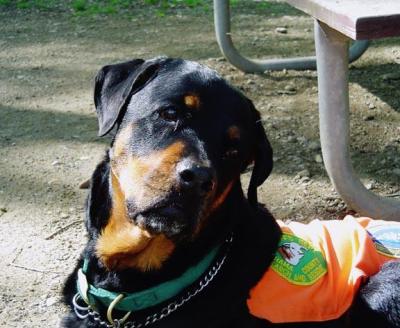
Deja Vu worked for the Tehama County Sheriffs Department
for nine of her 12 years. Here she is seen wearing her traditional orange coat and Tehama County Submarine Veterans patch.
|
After retiring from the Tehama County Sheriff's Department with nine
years to her credit, she made the rounds at educational events.
When not at Camp Tehama, she could be found assisting in hunting and
searching classes across the country with the help of Greg Gormley and
his wife.
She was recognizable by her orange coat, which bore a Submarine Veterans
patch, and her friendly demeanor.
Her name was Deja Vu and on April 28, 2008 she passed on at the age of
12 - 84 to you and me.
Deja Vu worked for the Tehama County Sheriffs Department for nine of
her 12 years. Here she is seen wearing her traditional orange coat and Tehama
County Submarine Veterans patch. She died April 28.
Gormley, the dog's owner and trainer, named her Deja Vu because driving with
a Rottweiler puppy reminded him of the last dog he had. Deja marked
the second Rottweiler he trained after his first search-and-rescue dog,
Badger, succumbed to cancer.
Deja enjoyed a long career as a dog for the sheriff's department and
served until she began to suffer from arthritis and other strains of age,
Gormley said.
"Nobody was ever found in an area that we had cleared," Gormley said.
Though trained as a hunting dog, Deja had a way of deterring narcotics
smugglers. On one flight, an attendant could not find anyone to claim
an unlabeled plastic bottle full of white powder. She went up and down
the aisle, holding the bottle at arm's length until she reached
Deja. She realized no one would claim the bottle with the dog aboard, Gormley
said.
Deja, however, was not a dog to be feared.
"She was the nicest rottweiler in the world," Gromley said. "She
wasn't aggressive in any way."
She loved meeting new people and was a favorite among kids, he said.
At 12, Deja Vu was old for a rottweiler - old enough to be experiencing
arthritis, seizures and enough ailments that she had to be put down,
Gormley said. Some rottweilers die as young as 10 and 14 years is almost
unheard of.
After 33 years with the department, Gormley is thinking about retirement.
But before he does, he has one more dog to train - a rottweiler puppy
by the name of Trace.
Trace will soon be reprising Deja's role at Camp Tehama and other
events, he said.
"I like rottweilers," Gormley said. "They're a noble breed."
Staff Writer Geoff Johnson can be reached at 527-2153, extension 114,
or at gjohnson@redbluffdailynews.com
|
Top of page
|
10 Tips On How To Photograph Your Dog
By: Dog Time
If youre the average dog lover, you think your pooch could out-pose even those silky Weimaraners in the picture books. But if youre the average amateur dog photographer, your photos never match the athleticism, humor, or outrageous cuteness of the real thing.
We asked pet photographer Mark
Rogers, who immortalized our office dogs here, for his best tricks for taking high-quality dog pictureswithout getting into stuff like f-stops and shutter speed. Here are our favorites:
|
|
Time it
well.
If youre looking for action shots, have your photo shoot before
the daily three-mile run. If you want a serene portrait, make it
after.
Let
your dog get used to the camera.
The click and flash of a camera can rattle dogs at first, says
Rogers. Let your dog give the camera a good sniff, then start
casually shooting the surroundings (if youve got a film
camera, you can do this before you load the film). Once your
dogs gotten used to the camera and starts doing his own
thing, begin taking pictures.
The idea is
to keep things natural and relaxed. What not to do: Grab a ton
of treats, abruptly shove the camera in your dogs face, and
repeat, Mommys gonna take your picture! at high pitch.
Take
lots of pictures.
This is the first rule of photography, no matter what the
subject. The more you take, the better your chances of getting a
few amazing shots. Always bring an extra battery, warns
Rogers.
Turn
off the flash.
Most amateur photographers do best with warm, natural sunlight.
To avoid washed-out pictures, shoot in the mornings or evenings,
on slightly overcast days, or in the shade on a bright day.
For indoor
shots, youll probably need a flash. Youll get a more
natural-looking shot if you use an off-camera flash and swivel
it upward so the lights bouncing off the ceiling.
Get
down on your dogs level.
If you stand over your dog and look down, every shot you take
is going to look like everyone elses, says Rogers.
Pay
attention to background.
Simple backgrounds, like a white sandy beach or green
trees, make your dog stand out. If youve got a
point-and-shoot camera, have your dog at least a dozen
feet in front of the background so hell be more in
focus than whatevers behind him, and of course, watch
for the tree branches growing out of his head. Pay
attention to color, too: No black backgrounds for black
dogs, brown backgrounds for brown dogs, and so on.
Enlist
help.
A friend with a squeaky toy will come in handy if you
want a head-on shot or a regal profile. However, keep
your dogs personality in mind with this tip. Some
dogs get amped up really fast when their toys are
around, so it can have the opposite effect of what you
intended, says Rogers.
Get
creative and playful.
Lots of full-body shots taken from ten feet away can get
mighty dull. Get up close so your dog fills the entire
frame. Get even closer so you get the full effect of
that long, wet nose. Photograph your dog head on, in
profile, at 45-degree angles. And dont get hung up on
perfection; sometimes that shot with your dogs tail
out of the frame is the one youll have hanging on
your wall for years. With pet photography,
serendipity is the name of the game, says Rogers.
The best shots are often the spontaneous ones.
|
Top of page
|
ONCE IS NOT ENOUGH
By Steve Wolfson
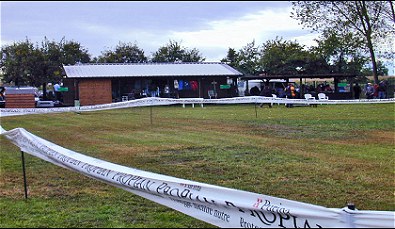 Standing outside the ring, I watched as the judge moved a large class of thirty exhibits. To me, the ring was too small and inadequate for a Rottweiler national specialty! As they moved with their handlers, most exhibits bunched upon each other resembling the rhythm of a giant accordion opening and closing; none could break out of a fast walk or switch gears into a trot. It seemed quite difficult for the judge to correctly evaluate this disorderly group for limping or preliminary assessments. Despite this obvious problem, neither the judge nor the club made any adjustments to ease the congestion. Was the small ring a management problem on the part of the club or simply an incomplete understanding in evaluating structure via locomotion? One can only guess. Standing outside the ring, I watched as the judge moved a large class of thirty exhibits. To me, the ring was too small and inadequate for a Rottweiler national specialty! As they moved with their handlers, most exhibits bunched upon each other resembling the rhythm of a giant accordion opening and closing; none could break out of a fast walk or switch gears into a trot. It seemed quite difficult for the judge to correctly evaluate this disorderly group for limping or preliminary assessments. Despite this obvious problem, neither the judge nor the club made any adjustments to ease the congestion. Was the small ring a management problem on the part of the club or simply an incomplete understanding in evaluating structure via locomotion? One can only guess.
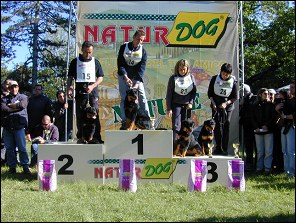 At all-breed shows, time is paramount and space is limited. A judge may have upwards of 175 exhibits to adjudicate in different rings, hand out ribbons, mark the book and be available for photos. Neither the club nor the judge has the luxury of examining each exhibit for the fine details of a breed.
However, a specialty is the exception. There, the breed is exalted and exhibitors have high expectations from both the adjudicating official and the host club. Because of this, the bar is set high at a specialty since the details weigh heavy on all exhibitors minds. Time should be less of a factor and ring size should be large enough to thoroughly evaluate the exhibits while gaiting. Is this not why it is called a specialty? Nonetheless, the rings have grown smaller at many specialties preventing a complete evaluation of gait.
The Rottweiler is originally a drover/guard dog covering the most amount of ground with the least amount of effort. Therefore, his gait is evaluated in the trot. One should not dismiss the purpose of a breed; it is a fundamental aspect in all assessments of structure, temperament and locomotion.
In the evaluation of Rottweiler gait, a judge looks for the following:
1. Structure
a. Congruities
b. Incongruities
2. Harmony of the working parts
3. Temperament
a. Willingness to Perform
b. Endurance
4. The stride of the dog
a. Reach and Drive
b. Power of the Locomotion |
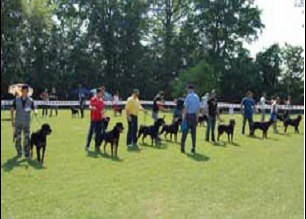
|
| At an all-breed show, it is difficult to acknowledge all the above factors; one does not have the opportunity to test the wider spectrum in regards to endurance, hidden incongruities or willingness to perform. However, at a specialty we can. |
Once Is Not Enough
Exhibits can easily muster the energy to gait in a small ring without taxing the musculoskeletal system, heart
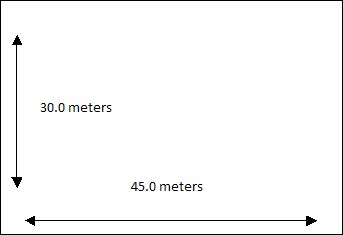 and lungs or temperament. Once around is sufficient. However, the bar and expectations should be set high at a specialty to separate the best of the best. To achieve these goals, we must change the dynamics with a large ring. Now, once is not enough! and lungs or temperament. Once around is sufficient. However, the bar and expectations should be set high at a specialty to separate the best of the best. To achieve these goals, we must change the dynamics with a large ring. Now, once is not enough!
This diagram shows the dimensions of a large ring that would be commensurate for a specialty. This size should be the minimum wherever possible. It is large enough to accommodate big classes, and is most importantly expansive enough for gaiting. It has several advantages over its smaller counterpart. This large ring is advantageous for the judge. The judge can step back far enough to gain a wide perspective. From such a vantage point, the judge has an improved view and can easily assess any exhibits change in gait, structure or temperament in comparison to others in the ring.
In the large ring, we can observe two aspects of the Rottweiler that a small one does not reveal
1. Hidden structural incongruities
2. Temperament
a. Willingness to Perform
b. Endurance
1. Hidden Structural Incongruities
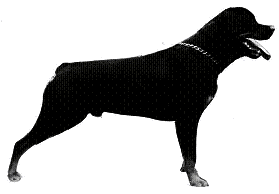
Standing still, many exhibits look great with good to superior breed type, good expression and great structure. Move them more than once around a large ring and the dynamics change. For example, the judge asks the handler to move his dog up and back then around the ring. For now, all appears wonderful and in the judges mind or book, a placement is made for the exhibit. The best six to ten dogs remain and all are asked to gait the full distance of the ring until asked to stop. Suddenly, in the second lap, the great looking exhibit that had all the right stuff starts to limp! What occurred? There are several possible scenarios.
1. While gaiting, the exhibit encounters a low spot in the ground and twists a foot or shoulder.
2. The exhibit is out of condition and its musculoskeletal structure is not ready for the rigors of
extended running.
3. Somewhere in the musculoskeletal structure, lies a covert weakness either in a
ligament or tendon, bone incongruity or muscle.
Obviously, a dog with structural problems such as, straight in the stifle, or very east-west in the front feet, etc., will break down quickly in a large ring after several laps. No surprise here! Most would expect this to occur in a dog with such a problem. In the small ring, save for an environmental twist of the ankle, #2, and # 3 do not occur since no physical stress was applied. However, in the large ring there is considerably more exertion. Under the pressure of exertion, a weakness is revealed.
2.Temperament
Because the Rottweiler is a working dog, there must be some applied mental pressure affecting the temperament of the dog. This is necessary to insure the breed maintains its ability to overcome and endure the rigors of work. It is what the Germans call Belastbarkeit. What we call, testing the dogs Mettle. This is the philosophical foundation for the sport of Schutzhund. An example of this is the gunshot test at a German shepherd sieger show. In the adult classes, the judge fires a starter pistol twice while the handlers stand with their entries. Any exhibit, which demonstrates nervousness, fear or viciousness as a result of the gunshot, is disqualified.
Whether the ring is large or small, there is a degree of stress and mental pressure exerted on an exhibit. Occasionally, we observe exhibits demonstrating extremes i.e. viciousness, shyness, fear, or the inability to stand for examination. Those dogs that display these extremes must be disqualified or excused. With more frequency, we observe dogs that fall in a grey area; they do not demonstrate the extremes, but a reluctance to be involved displayed by ears that are always back or hanging down. All these are obvious temperament flaws that are not acceptable for a working dog such as the Rottweiler.
A. Willingness to Perform
In the large ring, we can observe the temperament characteristic of Willingness to Perform. Its best example is the exhibit that maintains a high energy attitude with ears forward, head held up in exuberant expression, lap after lap. This is the exhibit that appears to enjoy the challenge; it has Willingness to Perform. Conversely, we can observe exhibits that demonstrate reluctance to gait with exuberance in the first or second lap and must be cajoled by their handler. These exhibits do not possess a physical problem, but are handicapped by incorrect temperament.
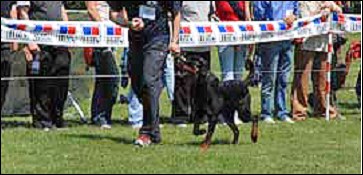 B. Endurance B. Endurance
Endurance is a necessary component of the working dog. Two factors play a role in endurance.
1.Physical condition of the musculoskeletal system and heart and lung capacity.
2.Mental attitude
1. Physical condition
All those that run, or are involved in a strenuous exercise program or body building, know it is impossible to maintain the physical exertion and stress demanded from the heart, lungs, and musculoskeletal system without being in good physical condition. The same is true for a dog. A Rottweiler that is in good physical condition should be able to endure a trot, without rest, in a large ring for at least 10 minutes. Because of, excess body weight, little or poor muscle mass and inferior heart and lung capacity, a great amount of todays exhibits are out of condition. For them, this would be difficult.
2. Mental attitude.
Mental attitude (as part of general temperament) influences the dogs ability to endure and persevere. As laps increase, it becomes more strenuous and exhausting to continue. Despite a dog being in excellent physical condition, without correct mental attitude, it will shut down or run out of gas early in the competition. The dog with drive, when confronted with resistance or difficulty, will continue. The one without drive will give up.
Caveat
There are two things that affect even the best conditioned Rottweiler, even those possessing an exemplary temperament heat and humidity!
Because the muzzle on the Rottweiler is short and the coat is black, heat and humidity have a particularly debilitating effect. Other breeds do not have this problem like the Rottweiler. As the temperature rises and the humidity increases, clubs, judges and owners must take such factors into consideration when competing. Surely, the well conditioned dog with exemplary temperament can cope with these factors but there is a point where high temperature and humidity will take its toll. One must be careful!
In conclusion, many variables affect the success of a specialty dog show i.e., the location, adjudicating official, the management of the show, the time of the year, the weather, and attention to details. Some things are in our control, some are not. When the ring size is small, it sends a message that the judgment of the full spectrum of locomotion will be incomplete. We should demand more from hosting clubs than just providing a place to exhibit our dogs. At a specialty, we want to acknowledge the details of our breed. With correct breed type and the ability to sustain the rigors of the large ring, such are the Rottweilers that should be acknowledged and selected the
Best of the Best!
Note: Thanks to Kreg Zimmerman for help in editing.
|
Top of page
|
Fight
BSL, It's a Matter of Survival
By Alex Wisienski
Our Rottweilers are second only to Pit Bulls on the list of dangerous dogs. EVERY owner should do something to protect their breed.
There are already 75 breeds of dogs that are banned or restricted in cities across the United States. Breeds that include the Pug, Golden Retriever, and Labrador Retriever. No breed is safe from BSL. Just because a breed is not mentioned in a proposed bill, it doesn't mean it can't be added at a lower municipal level.
Let the world know that just because we have a working breed and do Schutzhund or other controlled bitework, it doesn't mean our dogs are mean or vicious. Remind people every chance you get that bad owners are the cause of the dog problems we hear about. If someone sees a movie or a photo of dogs snarling or doing bitework and asks if our dogs are like that, let them know its only a movie or photo for advertising a product. Let them know that it doesn't mean the dogs are really mean. Take advantage of every opportunity to educate every person no matter how young or how old. If they are listening, educate them. Too many people are believing that BSL is the best thing to protect them and make for a safer community. The reason is because there are many news reports on dog bites and not enough information from responsible owners and breed clubs. Remember the old adage, the squeakiest wheel gets the grease. That means if you don't speak up, BSL will win and our dogs will be the biggest losers. When someone asks your opinion, or tries to tell you BSL is good, let them have it.
-
BSL WILL NOT stop dog bites or maulings until ALL dogs are banned or extinct.
-
BSL provides a false sense of security.
-
BSL DOES NOT stop or punish bad owners. They will just get another breed or buy a gun.
-
BSL will increase the number of surrendered dogs to shelters and the euthanasia of healthy sound dogs.
-
BSL will force responsible owners to surrender or euthanize their beloved pet.
A New Jersey legislator introduced a new bill in the Assembly. It is A3401 and it prohibits certain breeding and selling of dogs and cats. YES, cats too. It defines a Breeding Facility as any building or area whether outdoor or indoor, in which more than one cat or dog is housed. The key word here is `any'. This N.J. bill has a lot of support because people don't see between the lines. It appears to be a perfect bill to control puppy mills, which it would, but it is very vague and can be interpreted differently at lower municipalities. It would add a tremendous burden to responsible multi pet owners that are not mills. This too is BSL. BSL is real and it is a major threat to domestic pets as we now know them and a threat to our right to own and care for them.
BSL and other breed ban policies will only legalize extinction. They fail to keep children and communities safe. Bad owners and criminals will continue to reek havoc in communities. BSL only punishes the good dogs and good owners.
The average citizen needs to hear our side of the argument. They need to be educated. Educated people know that dogs are not the problem, bad owners are.
I recommend that EVERY Rottweiler owner that has a website post BSL information and links to BSL information on their websites. It is a matter of urgence to get the message out. It is the responsibility of EVERY Rottweiler owner to do their part to protect our breed. Posting BSL information on your website won't take long and it won't cost anything either. That's the least you can do.
|
Top of page
|
CAUTION - CHANGING A BREED STANDARD
By Patricia (Pat) H. Gilbert
If you open any Breed Standard to small changes, everyone has an agenda and big or inadvertent changes occur. We are working with a half dozen Parent Clubs on changes to their breed Standards that have this problem. The Havanese people are seriously close to splitting a relatively new AKC breed. Why? Members don't like each other and the breed has coat issues.
Standards are written by and for people who know dogs and their breed. They are a blueprint with room for individual interpretation and do not need to spell out everything. Basic anatomy is assumed. Four legs are not really mentioned in any Standard but as a judge show me a three legged dog and see what happens.
The Afghan Hound breed is in great shape because the Afghan Hound Club of America
(AHCA) left the Standard alone. It is untouched since 1948. It is not archaic. It is in "memory of ages past". It tells me the world each time I read it. Yes, there are traditions and additional nuances in the breed not spelled out specifically. It involves knowing the breed. It involves study.
Better to educate the public, owners, handlers, breeders and the judges. The AKC is not responsible for breed education. The Parent Clubs are responsible for breed education.
The AHCA does have excellent programs for breeder's education, and judge's education. Ed and I presented The Heritage of the Afghan Hound in MN a few years ago at the National. We discussed mandarins, monkey whiskers, scented, etc. We discussed the nuances of the breed. We have a CD of the expanded version for sale to benefit Afghan Hound Health and Rescue Efforts.
There are books on the breed such as The Complete Afghan Hound, by Constance Miller & E. M. Gilbert Jr. (out of print).
Go to the AHCA website and read the excellent material there. It is written by some of the most prestigious past and present Afghan Hound people.
The people, the material, the videos, and the CD's are out there. You can lead the horse to water, but...today's horses act more like camels with no thirst for knowledge.
I cannot imagine getting involved in owning or showing or worse judging a breed without study. Yet many believe, people do it every day and it is common.
Yet some in the fancy really think the solution is to change a Standard for people who do not know what the words mean anyway. Change it for people who don't care enough to interpret the words? Change it for people who do not know basic anatomy? Change it for people who do not understand breed specific conformation or movement?
NOOOOOO. Leave the Standard alone and educate the people.
This is, as you can read, a hot point with me. Give them a copy of the Standard and then discuss the various points. Teach people how to read and interpret Standards. That is what Ed and I do at our seminars.
Some advocate changing the Afghan Hound Standard to include allowances for the differences between puppies and adults. Some have stated: "The Standard doesn't differentiate between puppy and adults." Yet a reading of the Standard shows this statement to be untrue.
The AKC Afghan Hound Standard states: Coat - ...the saddle...hair is short and close, forming a smooth back in mature dogs...Fault - Lack of shorthaired saddle in mature dogs.
A study of the breed and semantics will show that a puppy is not a mature dog and therefore is not expected to have a saddle.
Education is the only change I want to see.
When it comes to breed Standards it is best not to open Pandoras box.
Courtesy of Ed & Pat Gilbert's K-9 Seminars.
Copyright 2008 / Web site: www.gilbertk9.com
|
Top of page
|
SLEEPING WITH ROTTWEILERS
Dogs &
Chit Chat by The Silver Haired Lady
|
RULE NUMBER ONE: The deeper the sleep, the heavier the Rottweiler. Most people who sleep with Rottweilers develop spinal deformities rather than rent the heavy equipment necessary to move their snoring canines to a more appropriate part of the bed. Cunning canines steal precious space in tiny increments until they have achieved the center position on the bed -- with all covers carefully tucked under them for safekeeping. The stretch and roll method is very effective in gaining territory. Less subtle tactics are sometimes preferred. A jealous Rottweiler can worm his way between a sleeping couple and, with the proper spring action from all four legs, shove a sleeping human to the floor. |
Let Sleeping Dogs Lie:
If you own and/or love Rottweilers you will treasure this viewpoint (by unknown author).
|
|
RULE NUMBER TWO: Rottweilers possess superhuman strength while on a bed. As you cling to the edge of the bed, wishing you had covers, your sweet pup begins to snore at a volume you would not have thought possible. Once that quiets down, the Rottweiler dreams begin. Yipping, growling, running, kicking. Your bed becomes a battlefield and playground of canine fantasy. It starts out with a bit of "sleep running", lots of eye movement and then, suddenly, a shrieking howl blasted through the night like a banshee wail. The horror of this wake-up call haunts you for years. It's particularly devastating when your pup insists on sleeping curled around your head like a demented Daniel Boone cap.
RULE NUMBER THREE: The deeper the sleep, the louder the Rottweiler. The night creeps on and you fall asleep in the 3 inches of bed not claimed by a Rottweiler. The Rottweiler dreams quiet slightly and the heap of Rottweiler flesh sleeps -- breathing heavily and passing wind. Then, too soon, it's dawn and the heap stirs. Each Rottweiler has a distinctive and unpleasant method of waking the pack. One may position itself centimeters from a face and stare until you wake. The clever Rottweiler obtains excellent results by simply sneezing on your face, or they could romp all over your sleeping bodies -- or the ever-loving insertion of a tongue in an unsuspecting ear.
RULE NUMBER FOUR: When the Rottweiler wakes -- you wake. So, why do we put up with this? There's no sane reason. Perhaps it's just that we're a pack and a pack heaps together at night -- safe, contented, heavy and loud.
Nitey Night and Sweet Dreams to All
|
Top of page
|
Dog's Quick Action Deters Moose
|
ATTACK: Berry charges, herds wild animal to save owner from likely harm.
By TIM MOWRY
Fairbanks Daily
News-Miner
Published: January 29th, 2008
It was dark, but the glow of Julie Closuit's flashlight was bright enough and the moose was close enough that she could see it lay its ears back before it charged.
"I mainly remember it looking at me and putting its ears back and coming at us," Closuit said. "It didn't think twice. It came right for us."
That's when Berry, Closuit's 3-year-old Rottweiler, sprang into action.
"As soon as I saw the moose, she jerked the leash out of my hand," said Closuit, who is six months pregnant. |
JOHN WAGNER / Fairbanks Daily News-Miner
Julie Closuit was charged by a moose last week while walking her dog Berry, but the Rottweiler came to her rescue by scaring the moose away.
|
|
Closuit, 26, had taken Berry for a walk outside their Goldstream Valley home around 7 a.m. Jan. 21. As she does every morning, Closuit walked around the corner of the house with a flashlight to check for moose or the neighbor's loose dog before bringing Berry out. Seeing nothing, she returned with Berry on a leash.
"We got to right about here and Berry started alert barking," said Closuit on Sunday, re-enacting the week-old incident.
When Closuit shined her flashlight in the direction Berry was barking, she saw the silhouette of a moose's head and two glowing eyes. The moose was hidden behind a spruce tree about 20 feet away.
|
Top of page
|
Beware Holiday Hazards For Dogs
by Tracie
Laliberte-Bailey /For The Sun Chronicle
|
The sight of giant snow globes on front lawns and the clog of sale fliers in my mailbox are clear indicators that the holiday season is chasing me.
I've got lists to make, goodies to bake, and gifts to buy. Then there's the tree, the decorations, the lights, and of course there's the all-important task of puppy proofing my Christmas.
My holidays should be doubly fun this year because my little elf just turned eight months old, and she will be at the peak of her puppy obnoxiousness just about the time that Santa Paws is digging his way down my chimney. I'm already cringing at the not-so-sugar plum visions of her tearing the ornaments off the tree, drinking the water from the tree stand, and pee-peeing on the tree skirt. I know that this, and so much worse, is coming to town.
The holiday season is the most dangerous time of the year for dogs. I'm not talking about the kind of irreparable emotional harm that my puppy will insist has been imposed upon her by being safely abandoned at home while I am out battling tug-of-war for the last on-sale squeaky toy among the pit bulls of shoppers at the mall. I'm talking about the ho-ho-horrors associated with the everyday celebrations that occur within our dog dens.
Most every dog owner is familiar with the toxic dangers associated with the consumption of chocolate by dogs. The darker the chocolate, the more dangerous it is. In fact, one square of baker's chocolate can kill a small dog. As a general rule, you should keep all chocolate away from any place where a dog might reach it. Use extra caution when receiving boxes or gifts that may contain chocolate. Don't put these gifts under the tree, and exercise caution by asking that all deliveries be secured safely away from pets.
Believe it or not, the sugar substitute Xylitol that is commonly found in many chewing gums and some flavors of Altoids (which make wonderful stocking stuffers!) is toxic to dogs. Just two squares of gum can cause a reaction in a 20-pound dog, and higher doses can trigger seizures and liver failure. Similarly, raisins and grapes can cause kidney breakdown and macadamia nuts can cause dramatic muscle weakness. These are all treats that often adorn our holiday tables.
Mistletoe, holly, and poinsettia plants have toxic leaves and berries that can be extremely poisonous. I never send these plants to pet owners, and whenever I receive one, I play it safe by donating the plant to the local community center. Glass tree ornaments, angel hair, metal ornament hooks and tinsel can also severely damage and obstruct animal digestive systems. I don't use any of these, but if they are a must in your doghouse they should always be placed on high branches as far away from Fido's forepaws as possible.
My puppy puts everything in her mouth, and last week I caught her standing on the dining room table. Unfortunately, I missed the opportunity to make a correction because I was laughing too hard, so I'm sure she'll do it again. Aye Chihuahua, surviving the holidays will be a Griswold adventure in my house this year.
Wags, Tracie
|
Top of page
|
Cat is Mans Best Friend
A Rushford plumber and his Rottweiler pitch in to help, comfort after flood
By Elena Grimm | Winona Daily News
RUSHFORD, Minn. You could say that Cat is mans best friend.
|
For Jeremy
Volkman, Cat, a 2-year-old Rottweiler, is not only his best friend but his partner in helping flood victims clean up and move back to their homes.
Since his hometown of Rushford flooded five weeks ago, Volkman has spent about 80 to 100 hours a week doing whatever needs to be done, he said.
Cat has been with him every day. Cat rides in Volkmans red Ford pickup into town, where Volkman hitches the 130-pound dog to a wagon for bringing water and supplies wherever needed.
On Saturday morning, the 33-year-old plumber was hauling hay. The afternoon he spent replacing plumbing at a home.
Volkmans own house suffered only a wet basement in the Aug. 18-19 flood that hit about two-thirds of the towns homes. He spent the early hours of the morning after the storm pumping water out of his basement. |

Jeremy Volkman and his 2-year-old Rottweiler, Cat, have been helping with flood cleanup in Rushford, Minn. for the past five weeks. Cat, with Volkman's help, can haul 600 pounds in the wagon. "He just wants to help people," said Volkman.
(Photo by Paul Solberg/Winona Daily News)
|
|
Then he took his first walk through town. After seeing diesel fuel from Kwik Trip floating on top of the floodwaters and the roofs of trailer homes sticking out from what he calls a big trailer court lake, Volkman knew how lucky he was.
I almost felt bad not getting flooded, Volkman said. Its horrible to watch everyone else go through this.
Instead of watching, Volkman and Cat pitched in. He has opened his home to friends who lost their homes, including a woman with three children and three foster children. Others have been in and out of his house the past month, along with pets.
When parts of town were blocked off, Volkman admits he had to sneak in or politely ask to be let in. He said that the work he does is in return for all the people who have helped him.
It is my regular job; Im just not charging as much for it, he said.
Volkman grew up in his grandmothers house in the Brooklyn section of town. Now, whats left is a wood frame of 2-by-4s.
I used to go in the house and you could smell the aroma, and once you smell it you almost see your grandpa, Volkman said. His grandfather died shortly after Volkman graduated from high school.
After graduating from Rushford-Peterson High School, Volkman spent 10 years away from Rushford, but he and his wife,
Candi, moved back to raise their sons, Dalton, 15, and Gaige, 11.
After pumping water out and seeing the deterioration that lay underneath, Volkman said that the hardest part will be keeping the value of Rushford the way he knows it a small, safe community to raise children.
I guess the future of Rushford is pretty uncertain, he said. They say its a 1,000 year flood, but it could happen tomorrow.
Volkman has owned Rottweilers since he was 16. Cat, short for Catastrophic, is the opposite of what his name implies. A hard worker, the dog provides comfort for people who need it, Volkman said
He is something to hug, Volkman said. And Cat got a lot of hugs in all this.
|
Top of page
|
Recognizing, Preventing, and Handling Dog Aggression
Lia Felabhoe
October 11, 2007
A dog is an instinctively aggressive creature. In the wild, aggression came in very handy: dogs needed aggression to hunt, to defend themselves from other creatures, and to defend resources such as food, a place to sleep, and a mate. Selective breeding over the centuries has minimized and refined this trait significantly, but theres just no getting around it: dogs are physically capable of inflicting serious harm (just look at those teeth!) because thats how theyve survived and evolved. And Mother Nature is pretty wily its hard to counteract the power of instinct!
But that doesnt mean that we, as dog lovers and owners, are entirely helpless when it comes to handling our dogs. Theres a lot that we can do to prevent aggression from rearing its ugly head in the first place and even if prevention hasnt been possible (for whatever reason), there are still steps that we can take to recognize and deal with it efficiently.
- Different aggression types -
There are several different types of canine aggression. The two most common ones are:
- Aggression towards strangers
- Aggression towards family members
You may be wondering why were bothering categorizing this stuff: after all, aggression is aggression, and we want to turf it out NOW, not waste time with the details right?
Well not quite. These two different types of aggression stem from very different causes, and require different types of treatment.
- Aggression towards strangers -
What is it?
Its pretty easy to tell when a dogs nervy around strange people. Hes jumpy and on the alert: either he cant sit still and is constantly fidgeting, leaping at the smallest sound, and pacing around barking and whining; or hes very still indeed, sitting rock-steady in one place, staring hard at the object of his suspicions (a visitor, the mailman, someone approaching him on the street while hes tied up outside a store.)
Why does it happen?
Theres one major reason why a dog doesnt like strange people: hes never had the chance to get used to them. Remember, your dog relies 100% on you to broaden his horizons for him: without being taken on lots of outings to see the world and realize for himself, through consistent and positive experiences, that the unknown doesnt necessarily equal bad news for him, how can he realistically be expected to relax in an unfamiliar situation?
What can I do about it?
The process of accustoming your dog to the world and all the strange people (and animals) that it contains is called socialization. This is an incredibly important aspect of your dogs upbringing: in fact, its pretty hard to overemphasize just how important it is. Socializing your dog means exposing him from a young age (generally speaking, as soon as hes had his vaccinations) to a wide variety of new experiences, new people, and new animals.
How does socialization prevent stranger aggression?
When you socialize your dog, youre getting him to learn through experience that new sights and sounds are fun, not scary.
Its not enough to expose an adult dog to a crowd of unfamiliar people and tell him to Settle down,
Roxy, its OK he has to learn that its OK for himself. And he needs to do it from puppyhood for the lesson to sink in.
The more types of people and animals he meets (babies, toddlers, teenagers, old people, men, women, people wearing uniforms, people wearing motorcycle helmets, people carrying umbrellas, etc) in a fun and relaxed context, the more at ease and happy and safe around strangers - hell be in general.
How can I socialize my dog so that he doesnt develop a fear of strangers?
Socializing your dog is pretty easy to do its more of a general effort than a specific training regimen.
First of all, you should take him to puppy preschool. This is a generic term for a series of easy group-training classes for puppies (often performed at the vet clinic, which has the additional benefit of teaching your dog positive associations with the vet!).
In a puppy preschool class, about ten or so puppy owners get together with a qualified trainer (often therell be at least two trainers present the more there are, the better, since it means you get more one-on-one time with a professional) and start teaching their puppies the basic obedience commands: sit, stay, and so on.
Even though the obedience work is very helpful and is a great way to start your puppy on the road to being a trustworthy adult dog, really the best part of puppy preschool is the play sessions: several times throughout the class, the puppies are encouraged to run around off-leash and play amongst themselves.
This is an ideal environment for them to learn good social skills: theres a whole bunch of unfamiliar dogs present (which teaches them how to interact with strange dogs), theres a whole bunch of unfamiliar people present (which teaches them that new faces are nothing to be afraid of), and the environment is safe and controlled (theres at least one certified trainer present to make sure that things dont get out of hand).
Socialization doesnt just stop with puppy preschool, though. Its an ongoing effort throughout the life of your puppy and dog: he needs to be taken to a whole bunch of new places and environments.
Remember not to overwhelm him: start off slow, and build up his tolerance gradually.
- Aggression towards family members -
There are two common reasons why a dog is aggressive towards members of his own human family:
- Hes trying to defend something he thinks of as his from a perceived threat (you).
This is known as resource guarding, and though it may sound innocuous, theres actually a lot more going on here than your dog simply trying to keep his kibble to himself.
- Hes not comfortable with the treatment/handling hes getting from you or other members of the family.
Whats resource guarding?
Resource guarding is pretty common among dogs. The term refers to overly-possessive behavior on behalf of your dog: for instance, snarling at you if you approach him when hes eating, or giving you the eye (a flinty-eyed, direct stare) if you reach your hand out to take a toy away from him.
All dogs can be possessive from time to time its in their natures. Sometimes theyre possessive over things with no conceivable value: inedible trash, balled up pieces of paper or tissue, old socks. More frequently, however, resource-guarding becomes an issue over items with a very real and understandable value: food and toys.
Why does it happen?
It all boils down to the issue of dominance. Let me take a moment to explain this concept: dogs are pack animals. This means that theyre used to a very structured environment: in a dog-pack, each individual animal is ranked in a hierarchy of position and power (or dominance) in relation to every other animal. Each animal is aware of the rank of every other animal, which means he knows specifically how to act in any given situation (whether to back down, whether to push the issue, whether to muscle in or not on somebody elses turf, etc etc).
To your dog, the family environment is no different to the dog-pack environment. Your dog has ranked each member of the family, and has his own perception of where he ranks in that environment as well.
This is where it gets interesting: if your dog perceives himself as higher up on the social totem-pole than other family members, hes going to get cheeky. If hes really got an overinflated sense of his own importance, hell start to act aggressively.
Why? Because dominance and aggression are the exclusive rights of a superior-ranked animal. No underdog would ever show aggression or act dominantly to a higher-ranked animal (the consequences would be dire, and he knows it!)
Resource guarding is a classic example of dominant behavior: only a higher-ranked dog (a dominant dog) would act aggressively in
defense of resources.
To put it plainly: if it was clear to your dog that he is not, in fact, the leader of the family, hed never even dream of trying to prevent you from taking his food or toys because a lower-ranking dog (him) will always go along with what the higher-ranking dogs (you and your family) say.
So what can I do about it? The best treatment for dominant, aggressive behavior is consistent, frequent obedience work, which will underline your authority over your dog. Just two fifteen-minute sessions a day will make it perfectly clear to your dog that youre the boss, and that it pays to do what you say.
You can make this fact clear to him by rewarding him (with treats and lavish praise) for obeying a command, and isolating him (putting him in time-out, either outside the house or in a room by himself) for misbehavior.
- If youre not entirely confident doing this yourself, you may wish to consider enlisting the assistance of a qualified dog-trainer.
- Brush up on your understanding of canine psychology and communication, so that you understand what hes trying to say this will help you to nip any dominant behaviors in the bud, and to communicate your own authority more effectively
- Train regularly: keep obedience sessions short and productive (no more than fifteen minutes maybe two or three of these per day).
Why doesnt my dog like to be handled?
All dogs have different handling thresholds. Some dogs like lots of cuddles, and are perfectly content to be hugged, kissed, and have arms slung over their shoulders (this is the ultimate Im the boss gesture to a dog, which is why a lot of them wont tolerate it.) Others usually the ones not accustomed to a great deal of physical contact from a very young age arent comfortable with too much full-body contact and will get nervy and agitated if someone persists in trying to hug them.
Another common cause of handling-induced aggression is a bad grooming experience: nail-clipping and bathing are the two common culprits.
When you clip a dogs nails, its very easy to quick him that is, cut the blood vessel that runs inside the nail. This is extremely painful to a dog, and is a sure-fire way to cause a long-lasting aversion to those clippers.
Being washed is something that a great many dogs have difficulty dealing with a lot of owners, when confronted with a wild-eyed, half-washed, upset dog, feel that in order to complete the wash they have to forcibly restrain him. This only adds to the dogs sense of panic, and reinforces his impression of a wash as something to be avoided at all costs if necessary, to defend himself from it with a display of teeth and hackles.
Can I retrain him to enjoy being handled and groomed?
In a word: yes. Its a lot easier if you start from a young age handle your puppy a lot, get him used to being touched and rubbed all over. Young dogs generally enjoy being handled its only older ones who havent had a lot of physical contact throughout their lives that sometimes find physical affection difficult to accept.
Practice picking up his paws and touching them with the clipper; practice taking him into the bath (or outside, under the faucet whatever works for you, but warm water is much more pleasant for a dog than a freezing spray of ice-water!), and augment the process throughout with lots of praise and the occasional small treat.
For an older dog that may already have had several unpleasant handling/grooming experiences, things are a little more difficult. You need to undo the damage already caused by those bad experiences, which you can do by taking things very slowly with an emphasis on keeping your dog calm.
The instant he starts to show signs of stress, stop immediately and let him relax. Try to make the whole thing into a game: give him lots of praise, pats, and treats.
Take things slowly. Dont push it too far: if you get nervous, stop.
Dogs show aggression for a reason: theyre warning you to back off, or else! If your dog just cant seem to accept being groomed, no matter how much practice you put in, its best to hand the job over to the professionals.
Your vet will clip his nails for you (make sure you tell him first that he gets aggressive when the clippers come out, so your vet can take the necessary precautions!). As far as washing and brushing goes, the dog-grooming business is a flourishing industry: for a small fee, you can get your dog washed, clipped, brushed, and whatever else you require by experienced professionals (again, make sure you tell them about your dogs reaction to the experience first!)
|
Top of page
|
A Sensible Vicious Dog Law
From OutsidetheBeltway.com
Steve Verdon | Thursday, May 24, 2007
|
|
The town of New Bedford Massachusetts has come up with what is actually a good law in regards to dangerous/vicious dogs. Basically, the law is structured to focus on the deed, not the breed. That is, the law is geared to imposing penalties and restrictions on individual dogs that show signs of being dangerous/vicious.
It goes after the deeds of the dog, the temperament it is showing, said Mr. Maciel. Drafted by City Councilors Linda Morad and Jane Gonsalves along with Mr. Maciels office and various animal control groups, the ordinance avoids being breed-specific.
Instead, said Mr. Maciel, it allows animal control officers to judge a dogs aggressiveness and actions before slapping restrictions, requirements and increased possible penalties on owners who ignore the rules.
He said a dozen dogs are now on the dangerous and vicious list, and only three are pit bull mixes. The others include a boxer, three German shepherds, a Rottweiler, Labrador retriever, mini-pini (Doberman)-chihuahua mix and, unfortunately, a Boston terrier, the state dog, he said.
This is exactly the right approach. Any dog can be vicious and size and breed are at best questionable guides in that regard. Take for example the chihuahua. Most people think that is an okay dog to own because of its small size. Even a young child could probably handle a chihuahua. However, chihuahuas are some of the most animal aggressive and human aggressive dogs. They also tend to be rather excitable and their small size could make it easier for a small child to injure or hurt the dog. While the latter might look like a possible benefit in terms of the child dealing with an aggressive chihuahua it could also mean that children will be more likely to have problems with this type of dog. Will a chihuahua kill a child? No probably not, but still it could inflict a nasty bite and since children like to do things like cuddle with dogs, that could mean getting bitten on the face or some other part of the body besides the ankle. So in this case, size is not a good indicator as to danger the breed poses.
At the same time a larger dog like the labrador retriever tends to be a stable even tempered dog. This dog passes temperment testing at one of the highest rates (and if we go with breeds that have had more than 200 dogs tested it has perhaps the highest pass rate). But this dog is also a medium sized dog and around infants and toddlers even an accident could send the child to the ground, off a chair or bed leading to injury.
A large part of the problem with dangerous/vicious dogs is that people often do not know how to behave around dogs and make for irresponsible owners. Did you get a cute little puppy that you failed to get neutered, licensed and usually spends the majority of its time alone in the backyard? I dont care what breed you have, chances are your dog is more dangerous than the person who owns a rottweiler who has neutered his dog, licensed it, and the dog is well integrated into the family strutcture and well socialized around other people. Yet, most people would have the knee-jerk reaction of looking at the rottweiler as a death machine and the other dog as a lovable family pet.
Then there is the issue of training our children how to approach and deal with dogs. Dogs are ubiquitous in our society so it would be prudent for parents to periodically remind their children what do around dogs. Things like,
1: Never approach a loose/stray dog.
2: Never surprise a dog.
3: Always ask the owner for permission to pet the dog.
4: Let the dog sniff you before you try to give a hug.
5: Never surprise a dog (e.g. wake it up by running up to pet it)
6: Never run from a stray dog.
If more owners would spay/neuter their dogs, make sure they had a secure dog run, kennel, crate or back yard, socialized their dogs (and to be sure this is a continuous process), and train them in basic obedience there would be far, far fewer dog bites and
maulings.
And for Gods sake treat your dog like a dog. I hate it when I hear peopel say, They are babies, or I cant help it, I spoil them. Sorry, but you are a complete idiot. These are dogs and they should be treated as such. Trust me, the dog and you will be happier that way. It doesnt mean you cant love your dog, that you cant buy it treats, or even let the dog sleep in your bed or take it with you when you go on trips. What it means is you should establish yourself as the pack leader, you should be set rules and boundaries for your dog, and when you give a command it should listen and follow the command. And if necessary, you may have to give the dog a job, even if it is something as mundane as carrying some water bottles in a doggie backpack during your walks.
And if you arent up for doing all of the above, then dont get a dog. Get a cat, or even better get some goldfish. When you go out and get a dog you should be prepared for the commitments that such an action entails. Dogs are social/heirarchical creatures. They do well within the family and they languish and suffer outside of it. If you arent prepared to have a dog in your life, then you arent prepared to own a dog.
Still there are some bad parts to that article, IMO.
Dr. Dodman said any legislation ought to target breeders who purposely develop aggressive dogs. He cited the Doberman pinscher as one example of a dog that had a bad reputation, but has since had the aggressiveness removed through good breeding.
Karen Harght, co-owner along with Joan Hopkins of American Canine in Westport, concurred.
When I was a child, Doberman pinschers had a horrible reputation. They were very aggressive, like pit bulls were. Then they kind of fell out of favor. And over the course of the last three decades the aggressiveness has been bred out of them. Now I see a lot of Dobermans that are sweet as pie.
I dont think that aggressivness has been breed out of the doberman, my guess is that since the breed is no longer the fad breed the many of breeders are responsible/reputable breeders who view themselves as stewards of the breed. These breeders are careful in what dogs they breed. First theyll look at the overall health of the dog, then the temperment and only the best dogs with good marks in both areas will be bred. The rest will be spayed or neutered and placed as pets. Further, these breeders tend to be very rigorous when placing a dog. When the dog is in a fad phase every idiot with an unfixed dog looks to turn a quick buck through breeding their dog(s). They dont worry too much, if at all, about health, and temperment isnt even something they can judge. All dogs are placed with people unfixed and there are no conditions about taking the puppy back if things dont work out. In this situtation you get badly bred dogs, dogs that wind up on the streets because their owners abadon them or lose them, and you have a much larger population of that dog. Hence dog attacks by that breed increase and they show up in the paper and you have the new demon dog de jure. This has been seen time and time again. Dobermans were the bad dog. Then german shepherds, St. Bernards, and Rottweilers and now pit bulls.
On the other hand, she said, If I see an Akita, I turn around and go the other way.
While the Akita isnt a dog for your novice/first time dog owner this is just ridiculous. While there are quite a few dog bites every year (several million) there are tens of millions of dogs. And fatalities are even less frequent. Given this, the above attitude is emblematic of people simply not evaluating the risks correctly. If you get so nervous around an Akita that you head the other way, you probably should never go near a car, a pool, or take a bath or shower. Your risks of death/injury with all of these safe items probably far outstips any dangers posed by an Akita.
In New Bedford, Mr. Maciel said, the ordinance may require a succession of precautions to restrain and confine troublesome dogs, and fines for breaking the rules can be heavy, up to $600.
Bad dogs will be spayed or neutered and have a microchip implanted under the city ordinance, and annual licenses will cost more, along with the secure enclosures the city will require and inspect.
Preventing the dogs from reproducing is the most important component, he said. We dont want them breeding and the offspring having the temperament of the mother and the father, he said. That way our community becomes safer.
Somebody in the local government of New Bedford is guilty of having a brain.
|
Top of page
|
AVOIDING HARM FROM DOGS
Properly trained, even aggressive breeds won't attack.
Experts say injuries can be avoided when animals understand their place.
From Freep.com (Detroit Free Press) ~ Detroit MI ~
September 15, 2007
BY AMBER HUNT
FREE PRESS STAFF WRITER
|
One dead baby. Two dead adults. One euthanized dog, and four more possibly will face the same fate.
It didn't have to be that way, animal experts say.
"Most dogs are very stable underneath it all," said Cindy O'Malley, a Howell dog trainer who goes by the moniker Canine Whisperer. "Ninety-nine percent of the time, it's the owners."
Everyone should use caution when approaching a dog on foot, especially larger breeds, O'Malley said.
Jackie Takacs of Huron Township's Obedience Laboratory said it's important to learn how to read a dog's body language. If a dog's ears are back, tail is tucked and eyes are glaring, back off, Takacs said.
"When a dog is looking like that at you, the dog is clearly telling you, 'I'm afraid,' " she said. "Just leave it alone."
Plenty of so-called aggressive dogs -- even the often-maligned pit bull -- can make great pets, Takacs said. The problem, she said, usually lies in lax or improper training or people having too many dogs that end up forming packs.
"If you leave multiple dogs just out in a yard not supervised by humans, when they break loose, they'll go as a pack," she said.
Michigan State Police said it was a pack of dogs that killed a 91-year-old man and a 56-year-old woman Thursday in Livingston County. Those deaths have been blamed on four dogs identified as American bulldogs.
Even dogs with aggressive reputations, such as pit bulls and rottweilers, often can be trained to be trusted when their owners are around, area dog trainers said. Among the tips they offered:
. Make it clear you're the boss. That means training your dog to let you answer the door first and refusing to let the dog sleep with you so it doesn't think it's your equal.
"A dog will work its way to the top of the pack, and if you're not going to be pack leader, then your dog will be pack leader," O'Malley said.
. Begin training early, especially if you have a dog with aggressive breeding in its past. Heather Armbruster of the Birmingham Dog Obedience School recommends at least at eight weeks, with brush-ups as the dog gets older.
. Never leave a dog alone with a baby or child, even if the dog is loving and playful when you're around, Armbruster said.
. Don't assume an aggressive dog will ever have 100% of that aggression trained out of it, said Karen Vaden, who runs Attaboy Dog Training in Pinckney.
On the flipside, any dog can be trained to be aggressive, said Doug Whitman, chairman of the psychology department at Wayne State University.
"It fundamentally comes down, not to the pets, but to people," he said. "You can teach any creature to attack, and you can teach any of them not to."
Contact AMBER HUNT at 313-222-2708 or alhunt@freepress.com.
|
Top of page
|
ROTTWEILER
NURSES ORPHAN KITTEN
By: Jessica
Weinstein, wgrz reporter
Updated: 8/22/2007
|
Many pet owners would say their animals - sometimes seem human, but when a kitten is orphaned, you might expect it to be adopted by another cat. Not so in Lockport, where a dog has begn nursing a kitten.
Three year old Jade is a rottweiler with a soft spot for cats. Her owners say she's always had her share of feline friends.
"She's always loved cats. She thinks she is a cat basically," said 13 year old David Stanley of Lockport.
These days, she's acting the part. She's adopted a hungry little kitten.
"She thinks it's her baby. It is actually. She just didn't give birth to it," said Stanley's mother, Bonnie Donaldson. |
Donaldson says Jade's never had any puppies of her own, but she's decided to become a mom anyway. Much to Donaldson's surprise, Jade is actually nursing.
Donaldson says Jade took over after the kitten's mom, Lulu, was hit by a car. At the time, there was a litter of five.
"And then she started to develop milk, and they just started feeding on her," said Stanley.
"I'm glad she's doing it. She survived obviously, which is good," said Donaldson.
Veterinarian Dr. Stephanie Wolf says it is possible for a dog to produce milk without having babies of her own, but it's "very rare."
"The actual lactation process is not associated with the breeding process. It's a completely different set of hormones," said Wolf.
Bonnie has been supplementing Jade's milk with bottle feeding, and says Jade has become so attached to the little kitten, she just can't bear to separate them.
"I think she'd be lost if I didn't have a cat in the home," she said.
|
Top of page
|
Halloween & Hounds
Halloween is for humans not dogs. Screaming, running, spooky children in masks make many dogs uncomfortable, nervous and frightened. <<<Not to mention igniting PREY DRIVE>>
Halloween costumes are fun and are meant to disguise our normal appearance. Dogs do not understand this change in appearance and may become frightened. Costumes that change the way a person walks, stands, or their general appearance may cause a dog to react different then usual even with those they know.
Keep in mind that children on Halloween night are excited and doing their best to be scary. This is not a fair or safe situation to put even the best of dogs in. Even the normally terrific tolerant family dog can find this night hard to handle.
Along with costumes being frightening to a dog there are some that may become interesting too. Swords, tails and dangling things may be fun for an excited dog to chase and toddlers certainly won't appreciate that.
Every child and every costume is a new opportunity for different reactions from the same dog.
I recommend setting up your dog with their own private Halloween bash in a safe quiet spot with a yummy treat of their own. Here are some tips to help make this safe haven most comfortable.
1.Stuff a food dispensing toy with yummy mush and freeze it until it is Halloween time.
2.Use a fan or radio for white noise. Something consistent is best.
3.Be sure the blinds are down or the dog is not watching kids coming and going by the window. This will only frustrate him and allow him to practice barking and carrying on at the window.
Chocolate is toxic to dogs. Put candy in a safe spot.
Many dogs are stolen, poisoned or injured by Halloween pranks. Keep your dog safe and sound inside your home.
Be safe and aware and have fun!
About The Author
Jennifer Shryock, Canine behavior consultant
Owner of Family Paws - www.familypaws.com
U.S. Coordinator of Doggone Safe - www.doggonesafe.com
|
Top of page
|
Therapy Dog Comforts Boy with Cancer
by FOX 9s Scott Wasserman
June 18, 2007
Two strangers brought together by cancer developed a bond that would give a little boy battling the disease something to look forward to. FOX 9s Scott Wasserman has their story!
Chopper
(owned
by Pat Kinch) doing his job!
|
Top of page
ADDAMO
ASKS....
To AKC Judges:
Are You Part of the Problem?
Are You willing to be Part of the Solution?
It used to be that the purpose of dog shows was to showcase
your best breeding stock. In my opinion those days are mostly a thing of
the past. It seems that shows today have become so political and so money
oriented that the dogs themselves have gotten lost in the shuffle. Sadly,
the dogs are often stripped of their dignity by the win at any cost tactics
put upon them. With that said, I believe it is reasonable for all
exhibitors entered at a dog show to have the expectation that their entry will
get an equal and unbiased assessment by the judge based on their breed
standard. An exhibitor has the right to expect that their entry has an equal
chance of going Best of Breed whether their entry is a class dog (that includes
6-9 puppy!) or a Special. The AKC Judges Guide tells judges they should,
Always judge dogs solely on the basis of their condition as they are
presented in the ring on show day. (emphasis AKC). The judge is
responsible for judging each dog by the breeds standard. (emphasis mine)
In most cases, entry fees are the same for all dogs
entered. (Some clubs will give price breaks to puppies and bred
by). The judging guide does not state that if there are price breaks for
certain classes that those entries receive less consideration and are not
eligible for Best of Breed. In fact, no where does the guide state
that the Winners Dog/Bitch shall receive less consideration for the award of
Best of Breed.
In theory, since a dog show judges duty is to select the
best representative of the breeds exhibited to them, you would expect a dog
show to be an equal opportunity sport. You would expect that every
exhibitor should feel confident that they are getting a fair shake, but are
they? With the above facts in mind:
Are you a judge who, if you disagree with a breed
standard, will not hesitate to award your personal preference, even in some
cases when your preference is a fault? Just two examples are:
1.
having a preference for a specific color and never putting up other equally allowed colors.
2.ignoring the breed standard for minimum/maximum heights
If you answer yes.
You are part of the
problem.
Judges should be professional and their personal preferences
should be set aside. The breed standard is the rule not a
guideline. If the standard states that there is no color preference, what
right does a judge have to assert their preference for color? It is unfair to
the exhibitors that have paid their money for equal assessment.
Judges should not penalize dogs for size when the size of
the dog is in standard. Statements like, I prefer them bigger (who
cares?) is fine as long as the bigger is equal or better and preferably In
the standard. Too often, that is not the case. For example, if
a Samoyed looks to be the same size as an American Eskimo, that probably means
that you have a Samoyed bitch at the bottom of the standard. The bottom
for Samoyed bitches is 19 and the top for the American Eskimo male is
19. Both are correct, neither should be penalized just because you
dislike one end of the standard more than the other. In the case of the
Samoyed, a judge will often put up a dog or bitch out of standard, (on the big
end) or a dog of lesser quality rather than reward the more correct dog that
looks like an American Eskimo. This is not judging a breed by its
standard and it hurts the breed when judges insert their personal preferences.
Are you a judge who believes you have the right to
interfere with a dog owners right to decide what is best for their dog by
withholding the award the dog deserves? In other words you have a dog/bitch
that should win BOB, but you have decided that the dog is too young, too old,
the owner too novice, etc., etc. to go to the group?
If yes, you are part of the problem.
Judges are to judge dogs in their ring based on their
standard. Whatever might happen in the Group should not be of any concern
of the breed judge. The breed judge is supposed to award BOB to the best
dog. That is what exhibitors expect and that is what they pay for.
Exhibitors do not need nor want judges denying their dogs the award they
deserve due to the judges personal speculations on who is ready for the Group
ring. A judge who does this interferes with the dog owners right to make
their own decisions regarding their dog. Judges who do not just judge
dogs, but insert their personal feelings as to who might look better in the
Group actually change the outcome because the Group judge is deprived of
actually judging the best dogs.
Are you a judge that knows or has
strong suspicions that a dog has been groomed illegally and you ignore
it? Examples might be wigs in poodles or over trimming in the Golden
Retriever and Pomeranian, etc.
If yes, you are part of the problem
Judges have the obligation to investigate any
suspicions they may have. The AKC guidelines state, In reviewing a class, avoid
excessive rearranging of a dog's coat, whistling, gesturing or baiting.
However, do not hesitate to feel out a suspected fault beneath a highly groomed
coat. Over grooming has become epidemic. Almost everything in
a breed ring today is sculpted. A friend of mine recently relayed
a phone called she received from a friend of hers who is a Field Rep. The
Field Rep. asked, what the %&*#@ is going on with Newfoundlands? She
was very angry and said, They all look like cookie cutters in the
ring!! Frankly, I dont know why breeders and handlers make more work
for themselves on dogs that should be shown in a clean, groomed and natural
state. If judges would not reward this, it would not continue.
Are you a judge that faults a dog based
on your speculation of what the dogs height, bite, or color might be later?
If yes, you are part of the problem
The Guideline states, Give absolutely no consideration to
what a dog's quality may be at some future time, or what a dog's condition
might have been were it not for some disease or accident Enough
said.
Are you a judge who, regardless of the
quality of competition, always puts up the ranked dog even though it may not be
the best on that day?
If yes, you are part of the problem
Please stop it. This common practice is a total disservice to exhibitors and to the sport of
purebred dogs!
I have heard some lame excuses for this.
One is they do it out of respect for the dogs show record. They do it
because of all the money spent on advertising. IF there is a
better dog, please do the ethical thing and award that dog what it deserves on
that day. That is a judges duty.
Are you a judge that will not put up a
dog unless it asks for it?
If yes, you are part of the problem.
Not all breeds are the bubbly, crowd pleasing,
free stacking stars that ask for it. Several standards state that the
breed is reserved/conservative with strangers or when out of their territory.
(Judges are strangers!) Some of those breeds are Rottweilers, Kuvaszok,
Samoyeds, Clumber Spaniels, Bernese Mountain Dogs, Caanan Dogs and Anatolian
Shepherds. The Rottweiler standard specifically warns judges not to
penalize dogs that are aloof or reserved, as this reflects the accepted
character of the breed. The Mastiff standard states, Judges should also
beware of putting a premium on showiness. If there have been a few dogs
in one of these breeds that were exceptions to the standards description, that
is all it is, an exception and the rest of the breed should not be judged and
compared to the exceptions. Since the exceptions are not displaying
the typical character/demeanor as described in the breed standard some might
consider that in itself a fault. Judges should be mindful of the breed
standards and the descriptions of character and temperament. Frankly, Im
tired of hearing, well, it is a show. Unfortunately, it
is that kind of thinking that has turned the purpose and priorities of dog
shows (including the character and temperament of some breeds) up side
down. As an experienced breeder, who would select the dog that simply has
to ask for it over the dog that has the best overall qualities of the dog
youre looking to breed to? Not all breeds are going to ask for it, but
are still exquisite representatives of their breed and should be appreciated
and rewarded when they deserve it. That is a judges duty.
If you answered NO to the above questions,
most of us probably already know who you are and appreciate your dedication to
our breeds and more importantly to our breed standards. It takes an
honorable and ethical person to set aside personal feelings and reward the
exhibitor what they deserve on that day.
If you answered YES
to the above questions, one has to wonder why you decided to judge. You
are taking too many liberties with the standards. People spend their
hard-earned money for that "equal opportunity in the breed ring. Please give it to them.
Be part of the solution. Its just a
thought
Gini
Addamo symphonysams@earthlink.net
Top of page
The
Rottweiler Pyramid
by
Steve WolfsonCorrect breed type is disappearing!
The powerful bone substance and definitive masculinity of the Rottweiler we once apprized is now hard to find. Replacing these traits are pinheads, fine bones, distilled facsimiles. Not only is breed type on the decline, so is correct working Rottweiler temperament. In its place we now have, shy, soft, little to no willingness to work temperaments. Few Rottweilers in the show-ring and outside it could make the transition from that to the working arena. At the conformation/working spectrum, with rare exception, what we encounter are the extremes; they are beautiful show specimens either with no working temperament or on the working side, great working temperaments with poor structure and marginal breed type. How did this happen? |
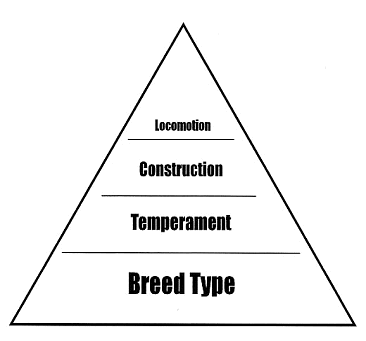
|
When enthusiasts decide to purchase a new puppy or a breeder selects breeding partners for their future litters, they draw conclusions and evaluate their choice from a narrow perspective using only a specific aspect of the breed as their criteria. For example, some breeders only seek to use the construction of the Rottweiler as their mark of excellence. They demand only the best angulated, the most correct fronts and rears as their guide for breeding partners omitting other important aspects that comprise the whole picture. Some only use health certifications as their guide. They will only breed or keep dogs that have attained all the necessary certifications such as OFA, heart and CERF clearances, dismissing from the formula, breed type, construction and gait. From a long-term breed viewpoint, this single-aspect criterion is myopic and disastrous. Is there a guide to facilitate a comprehensive approach to the breed without sacrificing one aspect for another? The answer is yes.
Euclid, the Greek mathematician, stated in his axiom, the whole is equal to the sum of its parts. Despite this being of mathematical relevancy, we can apply this statement to help guide us in a more complete understanding and evaluation of the Rottweiler. By using a Rottweiler Pyramid, where each element of the Rottweiler is prioritized in a hierarchal order of importance, Breed Type, Temperament, Construction, Locomotion, one can view each part on its own merits. Once a thorough understanding of these related elements is achieved, a complete and balanced picture results. It should be the goal of every breeder to incorporate all of these aspects into a breeding program.
(Note: For this essay, I have distilled the topics down to their basic, large block ideas. I also have omitted health clearances from the pyramid, since they are a
prerequisite for breeding, showing and training. It would be foolish to pursue a show/sport career with a dog that possessed dysplasia or other serious health issues further than as a personal companion)
1.
Breed Type
Number one in the pyramid is Breed Type. The description of it comprises 85% of the standard, its major and defining aspect. Its correct understanding is the foundation of any breeding program, evaluation for judgments in the conformation ring and the first rung on the ladder for the
complete understanding of the Rottweiler.
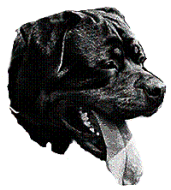 In this area, some prefer to take shortcuts by reinterpreting the standard and taking liberties with its translation, instead of traveling the more difficult path by reading and completely understanding its blueprint. Without a thorough and broad perspective about breed type (or any other segment of the standard), one can only build a house of understanding that is incomplete. This argument, that many do not understand or know what correct breed type is, can easily be proofed with the fine boned, narrow muzzles, pinhead, absence of masculinity exhibits we now encounter in the show ring and obviously on the street. In this area, some prefer to take shortcuts by reinterpreting the standard and taking liberties with its translation, instead of traveling the more difficult path by reading and completely understanding its blueprint. Without a thorough and broad perspective about breed type (or any other segment of the standard), one can only build a house of understanding that is incomplete. This argument, that many do not understand or know what correct breed type is, can easily be proofed with the fine boned, narrow muzzles, pinhead, absence of masculinity exhibits we now encounter in the show ring and obviously on the street.
An excellent and easy test for knowledge of breed type is asking the simple question, What is Breed Type? Many have great difficulty with the answer. When asked this question exhibitors and owners have articulated breed type as excellent gait. Some say it is correct temperament.
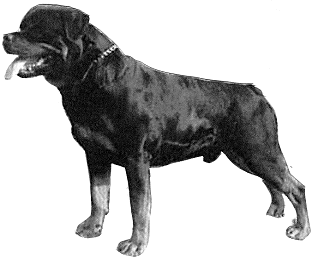 Yet others define it as performance on the working field. None are correct. Breed Type should be defined as
the essence of characteristics that distinguishes it from
others."(1) In simpler terms, it is the appearance of the breed, which separates it from others. Is that not what first attracts us to the Rottweiler? Yet others define it as performance on the working field. None are correct. Breed Type should be defined as
the essence of characteristics that distinguishes it from
others."(1) In simpler terms, it is the appearance of the breed, which separates it from others. Is that not what first attracts us to the Rottweiler?
In the show ring, where we should see only the best examples of type, save for a small percentage that is not, we see the lack of correct breed type abundantly demonstrated. Currently here in the states, many exhibits do not possess the minimum essentials in head and body type. In fact, many heads and bodies are at best, only sufficiently correct and do not possess the implied masculinity of the breed. The most defining aspect of correct breed type, the Rottweiler head, the breeds icon, should have great prominence. The standard devotes detail to its description with its
Broad between the ears, broad muzzle at the base, moderate arch of the
topskull, pronounced stop, zygomatic arch and specified 3 to 2
skull to muzzle ratio. In essence, the head is powerful, substantial and impressive. Yet, so many exhibits now possess
the opposite of what is correct, a long, soft in appearance narrow muzzle, shallow zygomatic arch and stops. This creates a head
type, which recedes in to the body having no prominence. The power and strength specified in the standard for the muzzles and topskull is not there; the heads are hound-like.
In correlation with the details of correct head type, are the details of correct body type. The standard specifies,
"His bone and muscle mass must be sufficient to balance his frame, giving a compact and very powerful
appearance." The standard is direct with its specifications on body type with the key words of compact, powerful and muscle mass.
The bone should be ample in proportion to the size of the body, the muscles mass should be strong and well defined and the body length should appear to be short and compact. There should be not doubt in appearance concerning the amount of bone mass, muscle mass and compactness of the body. However, what we encounter are fine and spindly bones, long bodies, little to no muscle mass and definition.
The underlying theme in the standard for the Rottweiler is masculinity. Correct breed type requires it. The standard does not specifically mention this word; it is implied. Even the bitches should possess power and substance without weakness. Softness, slight in build, refined, feminine are not words to use when describing or having a mental picture of the breed.
2.
Temperament
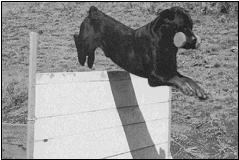 The second tier on the pyramid and essential aspect of the standard is temperament. Without correct temperament, all other aspects or traits, even if they are of superior quality, have little value! It is important to understand what correct temperament is and how to evaluate it. From the standard,
The Rottweiler is basically a calm, confident, courageous dog A Rottweiler is self-confident and responds quietly and with a wait-and-see attitude to influences in his environment. The second tier on the pyramid and essential aspect of the standard is temperament. Without correct temperament, all other aspects or traits, even if they are of superior quality, have little value! It is important to understand what correct temperament is and how to evaluate it. From the standard,
The Rottweiler is basically a calm, confident, courageous dog A Rottweiler is self-confident and responds quietly and with a wait-and-see attitude to influences in his environment.
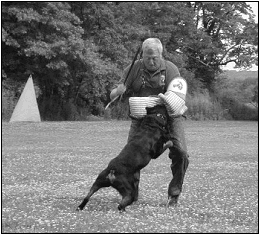 He has an inherent desire to protect home and family, and is an intelligent dog of extreme hardness and adaptability with a strong willingness to work, making him especially suited as a companion, guardian and general all purpose
dog. He has an inherent desire to protect home and family, and is an intelligent dog of extreme hardness and adaptability with a strong willingness to work, making him especially suited as a companion, guardian and general all purpose
dog.
What is correct temperament? How can we recognize it? We must take our template from the standard. Ideally, he is a calm, confident, courageous dog of extreme hardness and adaptability with a strong willingness to work. Few Rottweilers fit the ideal of the standard, which can demonstrate all of its positives. More likely, they measure up or down in differing levels. Because he is working dog, we must test and evaluate these differing levels of temperament through his work.
Albeit, the show ring is largely popular here in the states and in the international community, many rely solely on a dogs behavior within the show ring as a demonstration of temperament. This is dangerous because it does not give us any keen insights to the complete spectrum of temperament; its main purpose is to evaluate conformation. Some would say that the show ring does give us a window into the dogs nature. However, exhibiting and gaiting in the conformation ring can only demonstrate the extreme problems in a dogs temperament, such as the inability to stand for an examination, shy, nervousness or viciousness. It has extremely limited value when assessing the complexity of temperament.
 The Germans use the term Belastbarkeit, a dogs capacity, whether high, medium or low, to sustain its drive, tractability and nerve under the conditions and pressures of work. In Germany, they place a high value in the dogs level of courage and its ability to deal with stress. There, the minimum test is the Zuchttauglichkeitsprufung (breed suitability test where the dog is tested for its courage and stress level); one cannot breed their Rottweiler unless it has passed the Ztp. They also believe that the attainment of a working title is a demonstration of
Belastbarkeit. The Germans use the term Belastbarkeit, a dogs capacity, whether high, medium or low, to sustain its drive, tractability and nerve under the conditions and pressures of work. In Germany, they place a high value in the dogs level of courage and its ability to deal with stress. There, the minimum test is the Zuchttauglichkeitsprufung (breed suitability test where the dog is tested for its courage and stress level); one cannot breed their Rottweiler unless it has passed the Ztp. They also believe that the attainment of a working title is a demonstration of
Belastbarkeit.
By putting a Rottweiler through its paces in its attainment of a working title, be it a CD, CDX, Tracking,
Sch, etc., we gain valuable information about the strengths and weakness of its temperament. In some countries, the attainment of a working title is so highly prized, that a conformation championship title is only awarded when a working title has been previously achieved. Assessing character, the dogs ability to deal with corrections, stress, and its level of enthusiasm while working, tells us much about its mind-set. Without this knowledge of temperament, one cannot have a complete picture for a breeding program.
3.
Construction
T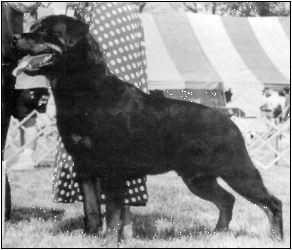 hird in the pyramid is construction, a balanced, harmonious
musculo/skeletal system in accordance with the blueprint of the standard. Understanding the construction of a Rottweiler is analogous to the building of a house. The builder (breeder) must adhere to the architects design (the standard), maintain a stable foundation and alignment of walls (the skeletal system), while creating continuity so that all the segmented parts of the house work together harmoniously (the locomotion of the dog). hird in the pyramid is construction, a balanced, harmonious
musculo/skeletal system in accordance with the blueprint of the standard. Understanding the construction of a Rottweiler is analogous to the building of a house. The builder (breeder) must adhere to the architects design (the standard), maintain a stable foundation and alignment of walls (the skeletal system), while creating continuity so that all the segmented parts of the house work together harmoniously (the locomotion of the dog).
As a breeder, owner or exhibitor, it is important in the complete understanding of Rottweiler construction, to acquaint oneself with the skeletal anatomy of the dog.
The standard dictates how the proportions and ratios, angles and layout of the skeleton should be so that the Rottweiler can gait with the highest efficiency in harmony with its breed type. This insures that its architectural design will best suit the Rottweiler for its task as a multi-purpose working/guard dog.
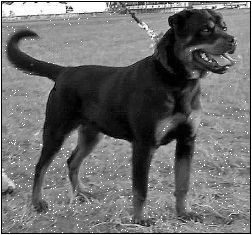 A house must have structural integrity. Walls must be plumb, materials used in the construction must have strength to withstand ware and tear, and parts must work. This applies to the Rottweiler as well. Front and rear legs must be balanced, strong and straight, the back must be firm but flexible, angulations must be ample enough to support proper reach of the front and drive of the rear. There should be symmetry and harmony of the working parts as well as a defined amount of muscle mass to support the skeletal frame. A house must have structural integrity. Walls must be plumb, materials used in the construction must have strength to withstand ware and tear, and parts must work. This applies to the Rottweiler as well. Front and rear legs must be balanced, strong and straight, the back must be firm but flexible, angulations must be ample enough to support proper reach of the front and drive of the rear. There should be symmetry and harmony of the working parts as well as a defined amount of muscle mass to support the skeletal frame.
Like temperament, correct construction is the by-product of a thoughtful, careful, breeding program. A Rottweiler cannot develop good construction from within. With the exception of building stronger or larger muscle mass via a weight gaining and conditioning program, when a dog possesses an incongruity or imbalance in the skeletal system, it cannot be corrected. A short upper arm, long in the back, shallow sternum, east-west feet, low pastern, poorly angulated croup, etc. impedes efficiency. These problems are inherited from the pedigree.
We have often heard exhibitors and breeders say, Dont worry, hell out grow this or grow into that. Unfortunately, ugly ducklings do not become swans! Problems related to the skeletal structure are indelible and take many generations to improve or correct. The most direct path for correct construction is to breed with pedigrees that possess it.
4.
Locomotion
 Fourth in the pyramid is locomotion. Because the Rottweiler was used for driving cattle, its modality for locomotion is demonstrated in the trot. Unlike the other aspects in this pyramid, construction and locomotion have inexorable linkage in that; exemplary gait is the result of outstanding structure. When a Rottweiler is correct in construction, according to the blueprint of the standard, this balanced skeletal architecture produces an unrestricted, harmoniously flowing powerful gait. Fourth in the pyramid is locomotion. Because the Rottweiler was used for driving cattle, its modality for locomotion is demonstrated in the trot. Unlike the other aspects in this pyramid, construction and locomotion have inexorable linkage in that; exemplary gait is the result of outstanding structure. When a Rottweiler is correct in construction, according to the blueprint of the standard, this balanced skeletal architecture produces an unrestricted, harmoniously flowing powerful gait.
Unfortunately, few Rottweilers possess construction with such a high degree of balance and harmony that they move with this ideal effortless grace. Similar to the levels of temperament, locomotion has differing levels of efficiency dependent upon the correctness of construction or conversely, the amount of imbalances within the dog. The more imbalances or incorrect construction the dog possess in its angulations and ratios, the more impedance occurs to free flowing gait.
The best perspective to assess locomotion is to view the dog, going away, coming towards and in the side gait. When the dog moves going and coming, we assess its lateral displacement, which has influence on the lateral center of gravity. A correct front and rear assembly stabilizes the dog and prevents him from excessive side-to-side movement, similar to the effect of torsion bars in a car. Incorrect construction such as, out at the elbow, eastwest feet, crossing over, moving wide and fiddle fronts etc., destabilizes the center of gravity. These incongruities produce impedance, which requires more energy, puts stress on the bones and muscles and leads to fatigue.
In the side gait, we assess all the moving parts working together. Once in the trot and at a reasonable speed, not to fast or slow, the mechanics of the
musculo/skeletal structure is set in motion. Here, we can observe the reach, the drive of the rear, spring of step, amount of ground covered, and temperament in the dogs willingness to perform, an important element. Within the side gait, we observe many examples of locomotion from exemplary to the unharmonious.
Occasionally, we encounter a dog that appears to be sound in structure when standing still, but during the examination of the side gait, they show a short stride of the front legs and rear legs, or a mix of this with a correct front stride, but short rear drive. Here, a problem may exist that does not easily reveal itself. That is why gaiting in a small ring or by moving the exhibits once around does not do justice for the complete assessment. Adding to this mixture is the exhibit that is pushed or cajoled around the ring. Outwardly, the dog appears good in construction and theoretically should gait correctly but for some reason it has no willingness to perform. This is one example of how temperament plays a factor in gait.
The field of canine gait is complex and requires a good knowledge of anatomy, mechanics, breed type and purpose. It is important for the concerned breeder and student of the breed to gain at least a proficient knowledge of these topics to understand Rottweiler locomotion.
References
1. The Priority of Breed Type in the Rottweiler, Wolfson, Steve, Steve Wolfson publisher, 2003
2. The Dog in Action, Lyon, MacDowell, Howell Book House publisher, 1982
|
Top of page
|
Calvin - 2006 Service Dog Of The Year
Submitted
by Beverly Bulson, Owner/Handler/Best Friend
Tagars Carbon Copy V
Blazin, CD, RE, CI, CST, AXP, AJP, PDII, EAC, O-OJC, OGC, CL3,
TT, CGC, TDIA
|
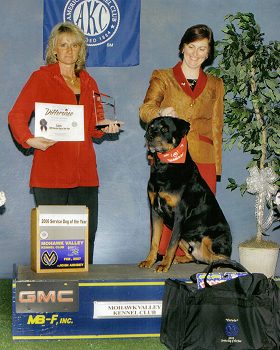
Calvin
with breeder, Tamra Bojarski (left)
and owner, Beverly Bulson (right)
|
Calvin was bred by Tamra Bojarski of Amsterdam, NY and is accompanied by his
owner, Beverly Bulson, of Scotia, NY.
Calvin began his service career as a puppy participating in educational
demos. In 2003, he became a registered therapy dog. Since them, Calvin
regularly visits senior citizens, battered women's shelter residents, and the
developmentally disabled. Calvin has developed deeply rewarding, long-term
relationships with those he visits, becoming fast friends with the
elderly residents, and even one young boy who struggles with autism.
As the owner of Rottweilers, a breed often targeted by breed-specific
legislation, Bev feels Calvin's work carries with it a special purpose, as
each visit is an opportunity to educate people who might otherwise never
know just how gentle a large dog like a Rottweiler can be.
Calvin has been a therapy dog for a number of years. We teamed together with the Schenectady Chapter of TDI. We have had upwards of 75 documented visits many of which were between 1 to 4 hours each and many that were not documented. These visits included working with Schenectady Chapter of TDI as well as demos with Schenectady Dog Training Club.
|
Our visits consisted of trips to the YWCA Domestic Violence Shelter, the YWCA of Schenectady, The Terrace at Glen Eddy, Alterra Wynwood and St. Marys Hospital. We visited monthly at the YWCA Domestic Violence Shelter and at the YWCA of Schenectady. Both of these visits were well received. The children who are staying at the domestic violence shelter very much enjoy their visits with Calvin. At times they can be quiet a handful, but Calvin works with the kids and helps to settle them. They all tell us about their own dogs that were left behind. Spring through fall, our visits were out in the yard and the children and their mothers enjoy playing ball or frisbee with Calvin and the other dogs.
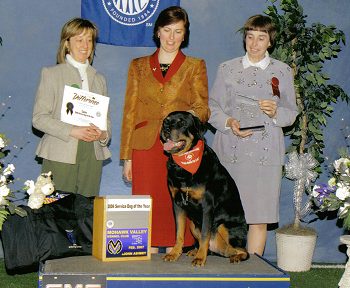 Our visits with residents at The Terrace at Glen Eddy were originally scheduled for once a month, and we soon had to change the schedule to every other Tuesday. These residents just love to sit and pet the dogs. One of the residents has named Calvin Calvin Coolidge. Our visits with residents at The Terrace at Glen Eddy were originally scheduled for once a month, and we soon had to change the schedule to every other Tuesday. These residents just love to sit and pet the dogs. One of the residents has named Calvin Calvin Coolidge.
The residents greet us at the door for every visit. When we pull up, we can see their faces peeking through the windows waiting for the dogs to come in. During the summer, we have done obedience/agility/therapy visit during the day at the Glen Eddy. The residents enjoyed seeing the dogs work as much as they did petting and loving the dogs. One of the residents moved from the Glen Eddy to another assisted living facility. When George moved, his aid called and asked if we could visit at the Alterra facility. We have added the Alterra Wynwood visit to our monthly schedule. George has moved again and his aid again has requested us to visit at the new facility.
One of our special visits that we do is at a local hospital. I received a call from a Mobile Crisis Counselor who asked if Calvin and I would come to some therapy sessions with a woman who is diagnosed with schizophrenia. This woman was attached to a Rottweiler who was owned by her sister. The dog passed away suddenly and the woman was very distraught. The counselor asked if Calvin could come to the therapy sessions. We visited once a month, however we worked with the counselor and were on call for whenever the patient needs us to visit. The first time we met this patient, it was so rewarding to see the smile on her face. She just loves to see Calvin. I believe Calvin has truly made a difference in her life. He is very well received throughout the hospital. Many of the heads of the departments come to visit with Calvin while he is at the hospital. We also visit with the outpatients in the lobby while we are waiting to be escorted to our visit in the mobile crisis unit.
Many of the other visits that we do are one time requests from schools, nursing homes, and camps for handicapped children and adults. Even Boy Scout troops have requested visits. We also participate in local parades, Girl Scout days, and responsible dog ownership days. We love to participate in obedience and agility demonstrations, parades and therapy dog visits whenever possible.
Another one of Calvins specialties is visiting with one of our friends child. This child has a disease called Aspergers Syndrome which is a form of Autism. Whenever this child is visiting at our house or we are away on camping trips together, this child looks to Calvin for a calming influence. We can tell when he is getting upset because he starts to shake his hands and gets very antsy. When he starts this, he will come to me to ask if he can go and rub Calvin. The rubbing and cuddling of Calvin causes him to relax and calm himself. It is very interesting to watch how Calvin can sense that this child needs his attention. He will sit with the child for anywhere from 15 minutes up to an hour or so. These visits are ones that are not documented by any paperwork. They are just special to us as we enjoy helping our friends in times of need.
Calvin is truly a wonderful ambassador for the Rottweiler breed. He is very gentle and loves everyone. He is the guardian and best friend to my Boston Terriers. He often sits out in the yard watching over the Bostons and their babies making sure that the hawks and other predators dont run off with his friends. Because of his wonderful manners, he has won the hearts of many individuals who otherwise had a bad opinion of the Rottweiler breed. I am truly fortunate to have the opportunity to own and love Calvin.
Calvin has received the Seger Award from the Colonial Rottweiler Club in 2005
(which is the volunteer of the year award) and just recently he received the 2006 Mohawk Valley Kennel Club Service Dog of the Year Award.
|
Top of page
Carting helps one breeder win hearts and educate a community
by Rebecca WallworkEven though her dogs have their share of titles, theyre not what puts the biggest smile
on breeder Glenn Pollocks face. The big grin comes when her Rottweilers, Asgards
Covergirl (Dinky) and Ch. Asgards Dive Bomber (Buzz), light up the
faces of the children they meet when they are in volunteer mode, giving cart rides for charity.
Every year, Pollock and the dogs offer cart rides to children at fairs and parades,
including the American Cancer Societys Relay for Life
fund-raiser in Charlotte County, Virginia.
We havent raised a ton of money, says Pollock, But everyone enjoys it, including the
dogs. |
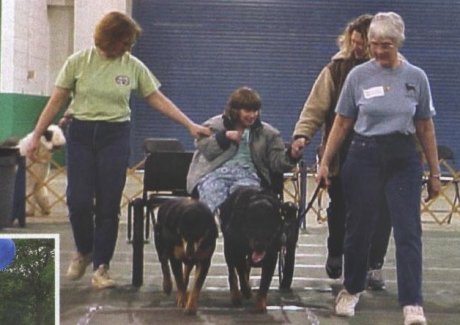
|
Pollocks initial interest in carting developed out of a very practical need. We were
living on four acres in Lancaster, Pennsylvania, she explains. I was using a lawn
tractor to get around and pick up all the rocks on the ground. Then it occurred to me that
it might be better to use a dogcart. I had working dogs and I knew that Rottweilers were
used for carting ... So she stopped by her local carriage store and had a wagon made. A New Calling Takes Shape
 Carting as more of a dedicated pursuit really got under way in 2000, when Dinky competed Carting as more of a dedicated pursuit really got under way in 2000, when Dinky competed
in the American Rottweiler Clubs first carting trial at the national specialty in
Petaluma, California. There, Pollock also offered the kindergarten children touring the
show rides in Dinkys cartand the kids joy told her she was on to something.
The following year, both Dinky and Buzz earned their CS (Carting Started, On Lead) and CI
(Carting Intermediate, Off Lead) titles, as well as a CST team title, placing first.
At home in Pennsylvania, Pollock took the dogs and their cart to the annual
PawsAbilities fund-raiser organized by Susquehanna Service Dogs in Harrisburg. Again,
the cart rides for kidsincluding those with disabilitieswere an instant hit, and
organizers invited Pollock, Dinky, and Buzz back the next year. These days, Pollock lives in Keysville, Virginia, where she breeds under the Asgard
Rottweilers banner. This December, for the third year in a row, Pollock and her dogs will
march in the towns Christmas parade. To get into the holiday spirit, Pollock decorates
the cart with garlands and battery-operated lights, and fills a second wagon with plush
Rottweiler toys and candy to hand out to children. Its a festive gesture, but one with
another important purpose: In any parade, I take the candy and weave from left to right
as we walk, says Pollock. The kids come forward to get the candy and it helps them get
close to the dogs as well.
Out and About, and Into the Classroom
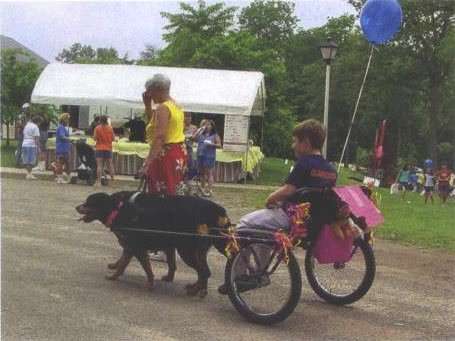 Educating children and the public about dog safety is one of Pollocks passions. Dogs
should be able to live in the community, she says. It sounds obvious, but unfortunately
Pollock knows all too well that not everyone shares her view. When she and her family
moved from Lancaster to Keysville in 2002, she was shocked to discover that her dogs were
not given a warm welcome. In fact, they were feared. We could not secure homeowners
insurance due to the communitys past experiences with Rottweilers and our breeds
reputation. Back in Pennsylvania, Pollock had been giving her Dog Manners elementary school programs
for over 15 yearsusing the AKC Safety Around Dogs and the AKC Best Friends kits to teach
children how to behave around dogs. Knowing how effective they were, she decided to offer
the programs as a Canine Ambassador in Virginia. She is also in talks with Virginia
Senator George Allens office, pitching the idea of legislation that would require all
schools to offer dog safety programs. It helped a lot when the locals had the chance to meet our dogs and see that they were
well-behaved, she says. (Pollocks Asgard Rottweilers contract requires puppy buyers to
complete obedience classes and to earn their CD and AKC Canine Good Citizen certificate
on the dogs by the time they are 25 months.)
Educating children and the public about dog safety is one of Pollocks passions. Dogs
should be able to live in the community, she says. It sounds obvious, but unfortunately
Pollock knows all too well that not everyone shares her view. When she and her family
moved from Lancaster to Keysville in 2002, she was shocked to discover that her dogs were
not given a warm welcome. In fact, they were feared. We could not secure homeowners
insurance due to the communitys past experiences with Rottweilers and our breeds
reputation. Back in Pennsylvania, Pollock had been giving her Dog Manners elementary school programs
for over 15 yearsusing the AKC Safety Around Dogs and the AKC Best Friends kits to teach
children how to behave around dogs. Knowing how effective they were, she decided to offer
the programs as a Canine Ambassador in Virginia. She is also in talks with Virginia
Senator George Allens office, pitching the idea of legislation that would require all
schools to offer dog safety programs. It helped a lot when the locals had the chance to meet our dogs and see that they were
well-behaved, she says. (Pollocks Asgard Rottweilers contract requires puppy buyers to
complete obedience classes and to earn their CD and AKC Canine Good Citizen certificate
on the dogs by the time they are 25 months.)
Because of the bad publicity Rottweilers get, the cart rides and manners classes give me
an opportunity to present the breed in a very positive way, she says. Her hope of convincing
her new neighbors that her dogs arent monsters has been realized through her tireless work in the
community. Many residents were surprised to see how sweet and calm Dinky and Buzz were,
especially amid the clang and clamor of a parade.
Spreading the Word
After years of winning over crowds with her bouncy demeanor, Dinky, who is 12 and suffers
from lymphangiectasia (an inflammatory intestinal disease which causes a loss of protein),
is retiring from carting, relinquishing her duties to another of Pollocks dogs, Ch.
Acosta Mobsters Carolina Lily, who will join Buzz for upcoming appearances.
Id recommend carting to anyone with sound dogs built for the work, Pollock says, but
she does stress the importance of having the right equipment and well-fitting harnesses.
Whatever the activity, Pollock hopes that more and more breeders will become Canine
Ambassadors.
I would love to see more people in the dog sport get involved in the community, says
Pollock. My feeling is: Youve got to get your dog out of the show ring. Not that she
doesnt enjoy conformation, or the agility and rally events her dogs compete in. But
seeing the dogs bring joy to people outside the dog world goes a long way toward
nourishing the soul: I find it just as rewarding as a championship. First
published in the December 2006 issue of the AKC
Gazette. Used with permission.
|
Top of page
|
THE ABUSE EXCUSE and WHY ITS BAD FOR DOGS
Julia V. McDonough
We are a nation of animal lovers. Raised on Bambi and Black Beauty, we grow up
believing in the inherent innocence and good nature of all creatures, and in the notion that
if left to their own devices, all animals would
exist in a sort of modern Peaceable Kingdom. When someone adopts a dog from a shelter or rescue agency, there is an
assumption that the dog is there solely because of some heartless negligence or outright violence.
While this can be the case in all too many situations, a more honest look at the facts will
show that most pets are given up to shelters by people who are not all that different than
the people who wish to adopt or who work at the agency in question. Job relocation,
divorce, a death in the family, loss of income, medical problems, and the threat of
insurance cancellation for the owners of some breeds are the most common practical
reasons people give up their dogs. While we are all familiar with the staggering numbers
who are turned in for real or imagined behavior problems, even that diagnosis doesnt
necessarily jibe with the invocation of abuse that usually accompanies it. If anything, the
more common behavior problems associated with most surrendered dogs are
symptomatic of an indulgent or at worst, benignly neglectful home where no one took time
to address the issues before they got out of hand.
However, the cases of outright abuse against any animal are heinous enough to make
the evening news, and will almost always find their way into the public eye. As animal
lovers, we are horrified to hear about what a few truly brutal humans enact upon an
animal unfortunate enough to cross their path. We feel a genuine surge of compassion for
the beaten dog, the deliberately starved horse, and the litter of kittens saved from
drowning, and we want to distance ourselves from the type of person who could commit
such an act. It is proof of our empathy when such a story gets public attention in the
media and hundreds of outraged citizens line up to adopt the victim. But it is also proof of
our relative shallowness that the victims less notorious kennelmates at the shelter go
unnoticed and unadopted, perhaps for lack of such a tragic back story. It may be cynical
to say that many of the people who devote so much of their energy and emotion to shelter
and rescue work feel best when they feel bad, but as someone who works full time in the
shelter industry, I dont think its untrue.
Based on the horrific nature of the abuse cases which actually make the news and on
the institutional support of their prevalence among some of the major fundraising humane
organizations and animal rights groups, it only follows that an animal lover interprets any
defensive, aggressive or predatory behavior on the part of his dog as being evidence of
some sort of abuse.
Abuse
vs. neglect;
and the effects of each on rehabilitation;
First, what is the difference between neglect and abuse?
On a very basic level, we define neglect as passive and usually a result of ignorance
rather than malice, and abuse as active and intentional. Neglect is a dog who is raised
outside, tied to a tree, hardly fed or attended to. Abuse is a dog who is struck, kicked or
otherwise used as an object of physical violence. Neglect is embodied in the dog of an
animal collector: living in a cage, parasite-laden, ignored except as a possession; a notch
on the belt of a sick person who, ironically, usually thinks he is saving the dog from a
worse fate. The local sociopath who was prosecuted for the hoarding of over one hundred
Shar Pei but who called himself a rescuer who didnt believe in giving up on a dog is an
extreme, but telling, example. Abuse is embodied in the dog of a violent human (who,
according to sociologists, is also much more likely to abuse human members of the
family): physically threatened and beaten, with the attacks usually culminating in an
extremely sadistic event which causes the animal to finally die or be abandoned in critical
condition and/or the abuser to be reported. A female Dobe in our system who had been
corrected with a baseball bat to the jaw for barking is one of our more grotesque in-house
models of true abuse. Neither condition paints a pretty picture. Neither is better than the
other. But they are different, and I find they have different effects on the unfortunate
animals subjected to them. There is a third condition which merits more attention than
either neglect or abuse in its devastating effect on a dog. Ill save that for last.
How does the abused dog differ from the neglected dog when it comes to behavioral
rehabilitation? To explain to new volunteers and employees at our facility, I use the
following anthropomorphic analogy. Obviously, because of self-awareness, the concept of
morality and the ability to question another's motives (among so many other things that
contribute to what we think of as human consciousness), a human psyche can be much
more permanently scarred by the type of mistreatment were discussing. With that in mind,
please accept this analogy as a parable rather than a literal comparison.Three young adolescent kids are put into a progressive reform school. One has been
smacked around and verbally abused since he could answer back. One was the middle
child of a huge family, and it was hardly ever noticed if he was around or not. One was the
spoiled only son and heir of an indulgent parent. How do you think each of them will do?
The abused kid will have a hard time for awhile. He is so used to ducking his head and
cringing that its an automatic response. His teachers and leaders are tough, but unlike
anyone else in his previous life, theyre fair. At first, their demands on him seem too
challenging, and he assumes that he will always be punished for whatever effort he puts
forth. But as time passes he realizes that what theyre asking him to do isnt that hard.
More importantly, its actually something concrete and doable. Pretty soon he starts
hearing how smart he is, and how far he'll go. Maybe hell never forget what happened to
him in the past. But hes better equipped to deal with the future thanks to the trust hes
learned. The neglected kid figures hes just another number. Hes not used to it when he gets
called on, and hes nervous. Sometimes he stammers. Hes afraid to get things wrong, but
hes almost afraid to get things right, because he doesnt know how to deal with the
attention. Sometimes hes the opposite: hes too overbearing and exuberant in social
situations because hes really never learned how to deal with others. Sometimes he goes
from one extreme to the other...school is pretty overwhelming. With time he finds a middle
ground, and eventually he begins to set himself apart as an individual. He still has the
security of a big group, but he also knows his name and his place in that group, and hes
happy with it. Hes prepared for the world. The spoiled kid has a problem. Who do all these peasants think theyre talking to? Dont
they know who he IS? When pouting and sulking dont make things grind to a halt like
they did at home with Mummy, he throws tantrums. Sometimes he hurts people when he
throws tantrums. No matter what his teachers do, they cant convince him that he is part of
a team. They can never tell what will offend him and how hell express that offense. He is
finally expelled. And, the administrators and teachers say, its
a shame, because sometimes he could be such a sweet kid. But he doesnt have what it takes to succeed in
real life.
But why does it matter if we assume the worst about a dogs past?
When one works on the front lines of rescue and animal care, one sees some real toe curling
horrors enacted by genuinely stupid or evil humans upon their dogs. Any abuse is
too much. But we owe it to the dogs who rely on us to improve their lives to recognize the
limits that abuse has on their minds and behavior. I firmly believe that any behavior or
reaction a person puts into a dog is something a knowledgeable and determined person
can remove. Dogs are far more resilient than the people who care for them. In my practice
I have worked with dogs who have been struck with shovels, who have had cigarettes put
out on them, who have been repeatedly booted and beaten, according to actual
documentation, and in all too few cases, with prosecution of the offending humans.
Regaining their trust is nowhere near as difficult as it was for their abusers to lose it. We
all marvel at a beaten dogs tendency to adore its abuser, yet we cant imagine that very
same dog acting normally ever again once its in a normal home. To blame defensive or
aggressive behavior solely on an abusive past can end up hurting the dog even more.
How?
First, writing off a dogs inappropriate behavior as a by-product of abuse cancels out the
diagnosis of other potential reasons: health problems, ineffective training, bad genetics
are just a few of the possibilities. I have had clients in the past whose dogs suffered from
epilepsy, half-blindness, and severe hypothyroidism to name a few examples but who
went undiagnosed for months: the owners were advised by other trusted canine
professionals that their respective dogs were spooky and defensive because they had
been abused. They were assured by well-meaning animal lovers that all their dogs
needed was love and understanding, when what they truly needed was veterinary
attention.
More commonly, the abuse excuse also prevents people from training and controlling
their dogs. Convinced that their dog has suffered enough hardship, they decide to make
up to the dog for his past torment at the hands of lesser humans. This is poisonous, as
the overindulgence of a dog is the main reason he fails in a home. When he arrives with
an either real or supposed diagnosis of abusive treatment, the more compassionate
nature of his caregivers is to spoil him. When he responds to the lack of leadership and
structure by becoming possessive or defensive, his abused status is invoked and a few
more privileges are added in the hopes that he might be placated into pethood.
Suggestions to take away these freebies and to insist on serious compliance with
obedience commands are met with accusations of cruelty and lack of empathy. In too
many cases, this dog is literally spoiled to death: his nasty, defensive behavior finally
results in an injury to a human family member, he is turned in to a shelter or brought to the
vet for euthanasia with the reassurance that they tried everything and that the dog is
hopelessly unable to overcome his horrible past and is better off at rest.
Although their history may not be as colorfully violent as the abused dog, the dogs who
have been either benignly or intentionally neglected are sometimes tougher to help. Often,
they only view a human being as the bearer of a food dish and the occasional giver of a
pat on the head. When they are exposed to humans who actually want to interact with
them, to touch them and speak with them and be close, they are sometimes overwhelmed
with confusion, and can give off a number of mixed messages. This is the trait that gets
them labeled as unpredictable. In almost every abuse case Ive dealt with, the dog is often
a pet who has lived in the house and who suffered his fate due to some transgression of
house rules he was never taught in the first place. The neglected dog is more often a
stranger to normal human contact, good or bad. His rehabilitation tends to take longer
than the dog who has been actively, and usually by human standards, much more
abusively treated. The seriously abused dogs Ive worked with were always a challenge. The neglected
ones required the patience of a saint. But the very worst Dobermans Ive ever dealt with in
rescue have been the ones that came from super-indulgent homes where the dog was
allowed to rule like a privileged prince; treated as a human child; and
otherwise given full charge of the house, its contents and occupants. Unlike their
neglected or abused cousins, these dogs frequently have bitten people in their own family,
and usually more than once. To see them surrendered to the shelter with an honor guard
of teddy bears, a soft bed, special treats and a long list of requests is particularly
heartbreaking, as these are often the dogs that we are least likely to be able to help.
Rather than experiencing a specific, violent set of horrible behaviors enacted on them by a
human, or the desolate vacuum of total neglect, these dogs have been insidiously and
actively lied to for their entire lives. If their innate temperament is particularly defensive
or aggressive, convincing them that they must respectfully defer to kind human leadership
is sometimes impossible. They have been conditioned in such a way that they have an
entirely upside-down view of the world which is often unchangeable in a shelter setting
and which therefore makes them unadoptable. Compared to the neglect or abuse cases,
"removing" the damage done by their well-meaning past owners is a much slower-moving
process with many more risks to the people charged with doing the rehab, two conditions
which get them placed in the highest risk category of training/rehab subjects. Dig deep
enough in the history of one of these tragic cases, and you are likely to find that there was
no actual training or structure in the dogs life, or if there was it was abandoned as being
too mean or because he didnt like it. The owners of these dogs are the ones most
likely to call the shelter frequently, demanding a detailed update on the welfare of their exdog.
They wish to know how he's eating, how many times a day does he get run in the
yard, have we found a family "just as loving as theirs" except one without kids, other dogs,
old people, men with beards, cats, etc. When it is my sad duty to inform this type of owner
that this dog is beyond my help, it is why I will answer his angry protests by telling him that
he has abused his dog in a much more damaging way than if he had put his boot in its
side. The number of dogs surrendered to our agency with a documented abuse is slight. I
have only seen about five actual abuse cases in the past six years, out of the hundreds
who have passed through the rescue system. Severely neglected dogs often come in as
singles or groups from Animal Control cases; picture emaciated, wormy, physically
compromised animals with no normal human contact and you will understand what I mean
by genuine neglect. Sadly, we see a comparatively high number of those, compared to the
abuse cases. But the number of dogs surrendered with an over-indulged history (ie, no
training, no crating, total and unearned freedom in the house, free choice feeding,
furniture and bed access, etc) is far higher. Of the dogs with known backgrounds
euthanized for serious and irreversible behavior issues in our records, almost all come
from the indulged profile. None have a documented or even circumstantially estimated
abuse history.
The other side of the coin: abuse as an excuse against adoption.
In the first year that I officially worked for DRU, I had an experience that Ill never tire of
describing. A young couple had come to look at dogs. The man had done a lot of
research and considered himself quite dog savvy. I stood with them in one of the large
outdoor pens, where a candidate for adoption was trotting around. We were having a
friendly conversation, occasionally punctuated by the nudge of the Dobermans nose,
when suddenly the man stomped his foot violently in the direction of the dog, raising his
arm above his head. the dog startled and decided to confine his explorations to the far
side of the pen. Well, that ones out, said the young man to his lady friend, Hes obviously been
abused.
I asked the fellow what exactly that was that he had done. I had entertained the
possibilities of some sort of Tourettes or a bad reaction to his cold medicine. But he
informed me that he had been reading about temperament testing in one of the many
dog books he was using, and that this test was engineered to diagnose past abuse, with
the understanding that an abused dog is not going to be a good pet. He described pretty
much all of the beliefs held by the Everything Has Been Abused contingent and informed
me that the only reason a Dobe would turn on you was because he had been abused. I
let him go on for a few minutes, and during a pause in the conversation I jumped toward
him, raising my arm. He shrank back, obviously surprised. You may want to look at a different guy, I told his girlfriend, This one has obviously
been abused.
While he wasnt happy about it, it made the point nicely. Strangers coming into a kennel
to look at dogs (especially adult dogs of a breed which is perhaps a little suspicious of
strangers) should NEVER take it upon themselves to raise their hands, shout, stomp or
any of the other foolishness I have seen done in the name of checking for signs of
abuse. The most violently abused dog Ive trained (Roxie, who took a steel shovel to the
back of the head) wouldnt blink if you swung a golf club at her. And some of the most
lovingly treated dogs Ive worked with hit the deck when you clear your throat. My exhusbands
admittedly spoiled Dobe, Ludwig, had lived with us since his conception: I
caught him in my own hands as he was born. In many ways he lived a softer life than
my dogs (although that life was still filled with fair limitations and training). Luddy never
felt a human hand in anything other than an expression of affection. But if one quickly
raised one's hand to hang up the car keys or reach down a can of soup from the top shelf,
he would cringe a little bit. He would fail this abuse test instantly. To think that a sweet
but perhaps genetically soft dog much like Luddy might lose the chance at a great home
because he had a fairly normal reaction to a sudden, unpredictable movement on the part
of some well-meaning but totally misguided person is hard to believe. But based on how
many times Ive seen people do some type of extemporaneous temperament testing
based on what they've read or heard from an erstwhile "expert", Im sure it happens at
shelters all the time.
Some adopters tell us point blank that they dont want an abused dog. They assume
that because we are a rescue, that most of our dogs are abuse cases. They further
assume that if they take a dog which has been abused, there will be a huge problem.
Sometimes, it feels like we are trying to "deprogram" this adopter from a cultish belief
system as we try to convince him that even the most brutishly treated dog will be very
pleased to move on and succeed if guided with compassion and balance . Its our job as
responsible dog people to use our heads and not just our hearts, and to remember that
there is both more and less to the abuse factor than meets the eye.
A rescued or shelter dog is more than his past experiences. He is a marvelous individual
combination of genes, personality traits, nerve, humor and most of all, potential. Those
who see him as a victim make him one. Ironically, that in itself is a serious form of
psychological abuse: limiting a dogs ultimate potential in order to feel like we are
protecting him from a past he would easily forget, if we would only let go of our hearts
ego and allow him to do so.
2003 dobermind press
|
Top of page
Annual show judges top
Rottweilers
CHRISSY VICK
March 12, 2007 - 12:00AM
More than 100
Rottweilers spent a
peaceful weekend at Onslow Pines Park. And Gaye Trevor of Hubert says that is
proof that the breed itself isn't unsafe or aggressive.
Disproving the stereotype is one factor that drives the East Carolina
Rottweiler Klub to put on its Winter Sieger Show each year.
"With the Rottweiler breed the stereotype can be a pretty bad one,"
said Trevor, vice president of the eight-member club. "This show is to
promote this as a good, friendly family dog. With the right training and
handling, these dogs can be a great neighbor."
|
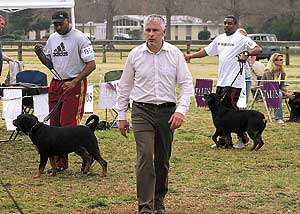
THE DAILY NEWS / Randy Davey / Going
to the dogs: Gerard O'Shea, looking at the female Rottweilers during the
East Carolina Rottweiler Klub 2007 Winter Sieger Show, traveled from Sweden
to judge the show at the Onslow Pines Park. |
Around 200 people participated in the event, which took place Saturday and
Sunday at Onslow Pines Park. Rottweiler enthusiasts came from as far as
Florida and New York to participate in the club's third show.
"It's our sport; we go wherever we can to compete," said Alex
Rodriguez of Nashville, Tenn. "I've had Rottweilers since I was 9 years
old. I have a passion for the dog."
Rodriguez, who runs a construction company, travels as far as Europe each year
for competitions - something he says is just a hobby. He entered four dogs in
this weekend's show and took best overall male and female.
"It was just a beautiful show," he said. "It's worth it."
Rottweilers, which originate from Germany, were judged for structure, shape,
color and breedability, said Trevor, who has entered her dogs in more than 40
shows. Her female Rottweilers took fourth place and her male took a second
place this weekend.
Gerard O'Shea of Ireland came from Sweden to judge the show. He has worked
with Rottweilers for over 25 years around the world.
"I love the education aspect of it," O'Shea said. "My main
passion is the breed and being able to look at dogs and people in different
cultures. I've judged dogs from eastern Russia to South America."
O'Shea gives each dog a specific critique, which Trevor says helps owners
improve for future competitions. Training is a necessity for show dogs, who
must stand still while judges inspect their teeth and other areas.
But training is important for all dogs, Trevor said, as a number of people
cite lack of obedience when they give up a large-breed dog.
"If they aren't trained, they become too much to handle," she said.
"If it's a working dog, it needs a job, even if that is just
obedience."
For more information on the East Carolina Rottweiler Klub, call president
James Bougie at 326-5835.
Contact staff writer Chrissy Vick at cvick@freedomenc.com or by calling
353-1171, ext. 239.
|
Top of page
|
|
|
New-born lambs' Rottweiler 'mum'
 |
Rottweiler
Molly showing her maternal instincts with lambs Lucky
and Charm. She has been doing exactly what a ewe would be doing" to look after the new-born lambs.
|
1st
Published on BBC
News
They have a fearsome
reputation, but one Rottweiler is proving that the breed has a
softer side by helping to rear two lambs.
Molly has been using
her maternal instincts after lambs Lucky and Charm were born
with complications on a farm.
Her owner Maria
Foster, 38, from Forden, near Welshpool in Powys, said Molly
slept with the pair at night, and even protected them from other
animals.
Lucky and Charm are
recovering and will be placed in a field in about 10 days.
Ms Foster said the
pair needed help to improve their circulation soon after they
were born.
They were placed in an
Aga oven for warmth and after being lifted out Molly took over
and started licking them as a ewe would have done.
"The first 12 to
24 hours for a lamb are absolutely crucial and if Molly hadn't
been doing what she was doing, I would have had to have been
there rubbing the lambs through most of the night to keep their
circulation going," said Ms Foster.
"She could have
ignored them but she didn't and it is quite comical to
see."
Now 11-month-old Molly
is like a mother to the two lambs, who stick closely to their
unlikely guardian.
Molly
protects the lambs and sleeps with them
|
Ms Foster added:
"The cat came into the kitchen the other day and walked
over to the bucket where the lambs were sleeping, but Molly
pushed her away as if to say: 'They are mine.'
"She will let the
sheepdog have a look, but only for so long before she pushes him
away as well."
Ms Foster said they
cannot be returned to their mother because they would be
rejected by her after so long apart.
A spokesman for the
Kennel Club, which organises Crufts, said: "Rottweilers
were originally bred as guard dogs in Germany, but in the right
hands they should not pose a problem.
"They are not
born aggressive, they learn it from us.
"Nonetheless,
it's certainly the first time I've ever heard of a Rottweiler
caring for lambs."
|
Top of page
Therapy Dogs Help Kids Read
Submitted
By
Jan Chapman
RedHawk Rottweilers
Pat Kinch and her Rottweiler Chopper (along with another dog, Cooper, from Pals on Paws, a Therapy Dog chapter located in Minneapolis/St. Paul, MN) were on their local
Channel 4 news, showing their
R.E.A.D. skills. R.E.A.D. is a certification program, Reading Education Assistance Dogs, launched by Intermountain Therapy Animals in 1999. This program improves children's reading and communication skills by reading to a dog. Could you put this link below from Channel 4 on your web site? It's a news video, so not sure how long it will be available.
Pat owns two R.E.A.D. certified Rottweilers -- Chopper (Greatheart's Comanche, TDI, CGC, R.E.A.D.) and Panzer (RedHawks Absolute Power, TDI, CGC, R.E.A.D.). Pat is very active in Pet Therapy, she is an evaluator and has a training class at Elk River K9 located in Elk River, MN
(www.elkriverk9.com). She has done a lot to improve the public's opinion of Rottweilers, by doing all these things outside of the usual show venues. She has also encouraged us to do therapy, and all of Panzer's siblings and his dam (our Ivana) are active therapy dogs, too.
The web site for Intermountain Therapy Animals is http://www.therapyanimals.org/read/index.php if you want to learn more about what they do.
|
|
Top of page
Born
With No Tails
By
Deb Clark
Ever have a litter of Rottweilers born without tails???
Graudstarks Nafu and CH Hy Tymes Kickin' Ash produced a
litter if 5 pups, 2 of which had no tails, 1 had a very
short tail. Some breeders say it isnt possible, others say Rottweilers cannot be born without tails. A few say maybe it could happen. Well, I am here to tell you all it is very possible and I have the proof! |
|
 I purchased 2 bitches,
(Nafu and Pella) from a friend, Diane, who originally got them from Judy Johnson of Graudstark Kennels. When Diane got the bitches Judy told her one of them, Graudstarks Nafu could possibly have puppies born without tails. Diane got out of Rottweilers before ever breeding Nafu so she really didnt know if it was true or not. After I had Nafu for a little while we bred her to my Champion male Hy Tymes
Kickin Ash (Monti). Her first litter Nafu had one pup born tailless. I thought
"this is very cool" but didnt really tell anyone except for a couple of my closest friends. When I decided to breed her to Monti again, I mentioned to a few people that I wondered if she would have any tailless pups in this litter. Well she had 5 pups and 2 were born completely tailless, one pup has a tail that is very short and 2 were born with normal tails.
I have pictures of them when they were first born and I am documenting them for myself and anyone who thinks it isnt possible.
Nafus pedigree doesnt contain a lot of well-knowns.
Monti has sired a few other litters and all of his other pups have been born with full tails so my conclusion is that it has to be from
Nafu. I purchased 2 bitches,
(Nafu and Pella) from a friend, Diane, who originally got them from Judy Johnson of Graudstark Kennels. When Diane got the bitches Judy told her one of them, Graudstarks Nafu could possibly have puppies born without tails. Diane got out of Rottweilers before ever breeding Nafu so she really didnt know if it was true or not. After I had Nafu for a little while we bred her to my Champion male Hy Tymes
Kickin Ash (Monti). Her first litter Nafu had one pup born tailless. I thought
"this is very cool" but didnt really tell anyone except for a couple of my closest friends. When I decided to breed her to Monti again, I mentioned to a few people that I wondered if she would have any tailless pups in this litter. Well she had 5 pups and 2 were born completely tailless, one pup has a tail that is very short and 2 were born with normal tails.
I have pictures of them when they were first born and I am documenting them for myself and anyone who thinks it isnt possible.
Nafus pedigree doesnt contain a lot of well-knowns.
Monti has sired a few other litters and all of his other pups have been born with full tails so my conclusion is that it has to be from
Nafu.
Visit
Hy-Tyme
Rottweilers to see more of this litter!
|
Top
of page
ARC Region IV Specialty
By Lynn Deuterman
We had a specialty. Lots of people came.
Dogs were shown. Dogs won, dogs lost.
Lots of great trophies were awarded.
Everyone had a good time!
We all went home.
Now seriously, the ARC Region IV Specialty was held Labor Day weekend, specifically on Monday, September 4, 2006. The newly reformed Carolina Rottweiler Club sponsored the event.
|
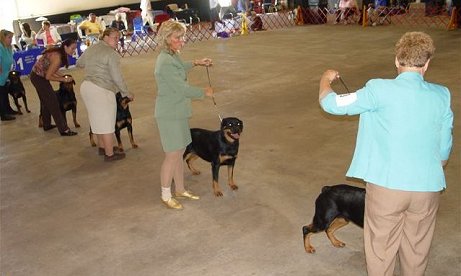
|
 A huge amount of work went into this event and we need to thank Cathy Rubens and Bob Busby for the effort they put into getting the ball rolling and keeping it rolling. That is not to say that a lot of other people didnt put many hours of effort into the event both behind the scenes and at the show. Some of those folks, to name a few are Rebekah
Pless, Michelle Lennon, Kay Lackey and many others. To those I havent named, please forgive me. My memory has never been good and as I age it isnt improving any! A huge amount of work went into this event and we need to thank Cathy Rubens and Bob Busby for the effort they put into getting the ball rolling and keeping it rolling. That is not to say that a lot of other people didnt put many hours of effort into the event both behind the scenes and at the show. Some of those folks, to name a few are Rebekah
Pless, Michelle Lennon, Kay Lackey and many others. To those I havent named, please forgive me. My memory has never been good and as I age it isnt improving any!
Since I havent been able to make it to the Nationals, CRC or many Regional Specialties for several years the entry was the largest Ive seen for some time. Obviously I dont get out much! It was a pleasure to sit and watch the judging of a group of very nice dogs.
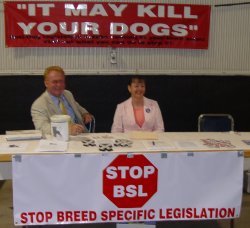 One of the special things that went on all four days was the anti-BSL table. Volunteers manned the table from the start of judging to Best in Show. Information on the current problems facing owners of so-called vicious or aggressive breeds was presented to anyone who stopped by and items such as
anti-BSL pins, buttons stating I own a dog and I vote , and auto magnets were available for the sum of a donation. Over the course of the four days, donations for
anti-BSL efforts totaled $900.00! This surpassed everyones expectations and really pleased Bob. Id like to thank several folks who worked hard to make the BSL table a huge success. Suzi Faulkner, Denise
Nardini, Diane Garnett, Tracy Fowler and Brona Hicks, thank you all for the time and effort you put into this important effort. For those whose names my miserable memory wont allow me to include, a huge thank you to you as well!!
One of the special things that went on all four days was the anti-BSL table. Volunteers manned the table from the start of judging to Best in Show. Information on the current problems facing owners of so-called vicious or aggressive breeds was presented to anyone who stopped by and items such as
anti-BSL pins, buttons stating I own a dog and I vote , and auto magnets were available for the sum of a donation. Over the course of the four days, donations for
anti-BSL efforts totaled $900.00! This surpassed everyones expectations and really pleased Bob. Id like to thank several folks who worked hard to make the BSL table a huge success. Suzi Faulkner, Denise
Nardini, Diane Garnett, Tracy Fowler and Brona Hicks, thank you all for the time and effort you put into this important effort. For those whose names my miserable memory wont allow me to include, a huge thank you to you as well!!
Another part of this great weekend was the Judges Breed Study Seminar presented by Cathy Rubens. Those who participated in this event with ringside mentoring came from New York, Ohio, New Jersey and Florida. Everyone appreciated Cathy sharing her knowledge and expertise. Im sure they went home with a lot of new knowledge swirling about in their heads!
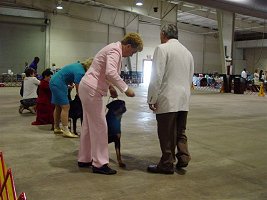 Not only did the ARC Region IV have Sweepstakes and Veteran Sweeps on Monday but at the Durham Kennel Club show on Saturday the entry of Rottweilers was supported by the American Rottweiler Club, Michelle Lennon, and Cathy Rubens. It was wonderful to see the young dogs as well as the veterans strut their stuff. We all enjoyed having two days of Sweeps. Next year will be even better, more to come on that.
I especially love the veterans. They usually make me cry because they seem so happy to be out there working again. Actually CH Hopehills Diamond Affair CD
(Shea) made her mother cry on Monday. She went Best of Opposite Sex to Best Veteran in Sweeps on both Saturday and Monday. I had the privilege of handling her on Monday. Shea really doesnt need anyone to handle her. She tolerates us humans who think we need to be in the ring with her. After she won her class on Monday I came out of the ring with her to find her mother Kay Lackey sitting ringside sobbing. Kay was thrilled to see Shea enjoying herself so much. I think all of the veteran dogs and bitches looked like they were having a ball. I wish them many more happy years.
 Let me fill you in on the day of the Specialty. It started early with quite a few of us meeting to set up the trophy table. What an effort that was! There were loads of lovely trophies! We kept having to spread out more and more and ultimately added another table. Stuffed toys were also abundant. They were given out to the placing dogs in the ring during sweepstakes, were offered as trophies for second through fourth place winners in the regular classes and seemed to be multiplying as the day progressed. There were three Awards of Merit as well. Everyone went all out to make this day and Specialty something to remember. Many of the trophies in both conformation and obedience were donated in memory of Rita Welker, Welkerhaus Rottweilers. Rita was a long time breeder and champion of Rottweilers. Many of the donations in Ritas memory were actually trophies Ritas Welkerhaus dogs had won over the years. Many thanks to everyone who donated money, time, and trophies. You are all awesome!
After the trophy table was set up, it was time for the judging to begin. First, Id like to thank all of the judges who did an excellent job and helped to make the weekend special. Fridays judge Suzan Otto, Saturdays Sweeps judge Diane Garnett, Cathy Rubens in the regular classes, Sundays judge Tony
DiCicco, Mondays Sweeps judge Danny Moore and judging the regular classes Grace McGlynn.
There were 5 point majors four days in a row! Looking for that last, elusive major in 2007? Keep reading!
Results for Friday 09/01/2006 Alamance Kennel Club Judge Suzan Otto
B CH. RUDEOS FOREVER CIMMERRON
OS CH. DORO SOLIDOS DARLIN DARLA
WD TEXADELS BEST MAN
RWD ETERNAL FIRES HEARTBREAKER
WB/BW VON WILHELMS JESSICA JAMES
RWB TAGARS I VANT IT ALL
Results for Saturday September 2, 2006, Durham Kennel Club
Puppy and Veteran Sweepstakes Judge Diane Garnett
BSW VON WILHELMS JESSICA JAMES
BOSW ETERNAL FIRES HEARTBREAKER
BVSW GRANTS KHARBEN COPY
BOSVSW CH HOPEHILLS DIAMOND AFFAIR CD
Regular Classes Judge Cathleen Rubens
B/G1 CH. BERNKASTEL BMER
OS CH. LORALS IMAGE
WD/BW TARAGWYNS TIMEKEEPER
RWD DARKSTARRS ROCCOS REFLECTION
WB LORALS KARMA
RWB ETERNAL MOON DARK ESPRESSO
Results for Salisbury Kennel Club Sunday 09/03/2006 Judge Anthony DiCicco
B CH APOLLONIA ANYTHING GOES
OS CH. DORO SOLIDOS DARLIN DARLA
WD WOODROTTS WORTH THE WAIT
RWD TARAGWYNS TIME KEEPER
WB/BW VON ROXMARS RACING THE DESERT SUN
RWB TAGARS IVE GOT WHAT IT TAKES RN
Results for the ARC Region IV Specialty Monday 09/04/2006
Puppy and Veteran Sweepstakes Judge Danny J Moore
BSSW TARAGWYNS TIME KEEPER
BOSSW MYSTICS ESSENCE OF THE HEART
BVSW CH ETERNAL MOON LORD OF THE RING CD RA
BOSVSW CH HOPEHILLS DIAMOND AFFAIR CD
Regular judging Judge Grace Mcglynn
B/G4 CH WOODROTT ABBAZ KAZMOPOLITAN
OS CH ECKO RIDGES ALL ABOUT MATHILDA
AOM CH TAGARS IKON DO IT ALL RA
AOM CH APOLLONIA ANYTHING GOES
AOM CH VON GAILINGENS GAIUS MAXIMUS
WD/BW DORO SOLIDOS ETTORE THE HERO
RWD VON RIDDLES DESPERADO V MYSTIC
WB TAGARS IVE GOT WHAT IT TAKES RN
RWB SILVERHILLS HOT TAMALE
BP BARSTES TEJAS FOR CIMMERRON
If I have transcribed anything incorrectly or otherwise made an error please accept my sincere apologies!!!
 One of my favorite parts of the day was the Parade of Rescues. That could be because I got to see one of my Katrina rescues again. Does anyone remember Dumpster? She now lives with a wonderful couple in South Carolina and has gone from being a skinny, sad, frightened little wild woman to a well-fed, well-behaved, well-adjusted and much loved little girl. I cried when I saw her. To say that she has fallen into the best situation one could want for any dog is an understatement. Bless you Tim and
Verena.
One of my favorite parts of the day was the Parade of Rescues. That could be because I got to see one of my Katrina rescues again. Does anyone remember Dumpster? She now lives with a wonderful couple in South Carolina and has gone from being a skinny, sad, frightened little wild woman to a well-fed, well-behaved, well-adjusted and much loved little girl. I cried when I saw her. To say that she has fallen into the best situation one could want for any dog is an understatement. Bless you Tim and
Verena.
All of the dogs who participated in the Parade were obviously in such loving and caring homes. Many of them have overcome tremendous obstacles. Some are still struggling but those who have adopted them are patiently working them through their issues. To those who have any part in rescuing and those who have adopted the rescued, you are all jewels. Kiss and hug those babies for me.
Plan now to attend the 2007 ARC Region IV Specialty Labor Day weekend in Raleigh, NC. Im told the event will be a five day cluster with four days of sweeps!!!! Cathy says to polish up your puppies and come to Raleigh. And Barbara, PLEASE dont forget to bring the rum cake! Until then, see you all at the Nationals in the spring.
|
Top of page
Elric
- My Assistance Dog
Catherine Varidel
Sagenhaft Rottweilers
rotticat1@yahoo.com
From 1990 to 1998 I was very active showing Rotties in obedience and conformation, my second passion was mountain biking about 50-60 miles per week. In '98 I began experiencing extreme fatigue and muscle cramps with joint pain. I was diagnosed with post-polio syndrome (polio survivor of 1954). A large number of us that recovered from the initial polio began to experience problems 30-40 years later. Usually it shows up with those that are atheletic and do alot of repetative motion. I saw a well known authority on the disease and was relieved to learn it did not have to progress to requiring a wheel chair--if I paced myself and learned to conserve energy.
I gave up biking and when it became too painful, I gave up showing.
|
|
 In 1993 I bred my girl Cajun Arianna V Ashlind, CGC, TT, (only lacking majors to finish) to Multi-V1, BIS, BISS, SKC, AKC Ch Dillon Von Wacissa, CD, CGC, TT, HIC, RTD. That breeding produced my heart dog, Multi V1 Ch. Dillon's Rope the Moon, CGC, TT, HIC--Dooley. The last litter Dooley sired out of Franlynn's Majestic Amen produced Elric. A tall, gangly pup, tons of enthusiasim but lacking in ring presence. For some reason of the 3 sons I owned during Dooley's life, Elric was his favorite.
In 2003 I left Florida and returned to Georgia to care for my ailing mother. On weekends Elric was my "demo" dog for some small obedience classes I taught.
My symptoms worsened gradually over the next couple of years. I could no longer endure walking on hard surfaces for any length of time due to severe joint pain and muscle cramps. Sitting on the floor or ground made getting up difficult, even getting out of bed was painful. I had to avoid the 12 steps up from my backyard and exit through the gate and go to the front door.
It was while sitting on the ground playing with my dogs that Elric began to
 try and assist me. He would stand near and allow me to support on him to get up. Soon no matter where he was if I said "help" he was right there assisting me. Napping on the sofa found him near by and ready to help me up and wait until I was ready to walk. Soon he began to walk with me and even help me up the stairs. When my hands are full he has learned to open the screen door and pick up items. I often joke that I don't know how many commands he knows as we only speak conversational English that do not sound like commands. try and assist me. He would stand near and allow me to support on him to get up. Soon no matter where he was if I said "help" he was right there assisting me. Napping on the sofa found him near by and ready to help me up and wait until I was ready to walk. Soon he began to walk with me and even help me up the stairs. When my hands are full he has learned to open the screen door and pick up items. I often joke that I don't know how many commands he knows as we only speak conversational English that do not sound like commands.
I had stopped so many activities because I would begin to limp severly and Elric now helps much like a cane to relieve some of the weight on painful joints. All my energy had to be focused on earning income as I am my only source of income. Recently I was able to limit my home health care job to remaining with one patient for 8 hrs instead of running from patient to patient. My patient is fond of Elric and he now accompanies me to my patients' home and does duel duty as assistance/therapy dog on a daily basis.
It has been wonderful to have his help and a joy to see a working dog performing work he loves and as an added benefit the community sees a Rottweiler in such a positive light and we are able to educate so many. I am so grateful to Elric for giving some of my mobility back to me with so much love.
|
Top of page
8
wheels, 1 heart
2006
By Dana Standish
Special to The Seattle Times
Photos by Alan Berner / The Seattle Times |
Tom Tilden and his dog Bernie are both in
custom wheelchairs. He says,
"this dog has my
heart." Here, they're both out for a stroll in Magnuson
Park.
|
"Bernie never gave up on me, and I
wasn't going to give up on her," Tilden says.
|
Using a specially built ramp, Tilden is
able to have Bernie, his three-legged Rottweiler, exit his
van.
|
There are a few things about Tom Tilden that you should know:
He's not some sort of softie animal nut. He'd never even had a dog before
Bernie, his 8-year-old Rottweiler. He realizes Bernie probably won't beat the
bone cancer that led to the loss of a front leg in January. And he's not doing
anything extraordinary by giving Bernie a custom-made wheelchair to help her
get around after her surgery. He's just doing what anyone would do when faced
with a loved one's serious illness: He's trying to buy more time.
Tilden can relate to Bernie's plight in a way that few others could. He's
been in a wheelchair since 1986, when a training accident in the Army left him
a paraplegic.
"Before my accident, I was talking to an Army buddy about people who
were paralyzed, and I said to him, 'If that ever happens to me, I want to
die.' One month later, my back was broken and I became a paraplegic. My first
thought was, 'I want to live.' It's probably the same for Bernie."
The 40-year-old Tilden, a freelance editor who lives in North Seattle, grew
up in Eastern Washington, the youngest of eight children of a farmer who
didn't believe in having indoor animals.
Eight years ago, his future wife, Nancy, said to him, "I love
dogs." Tilden figured they were having a hypothetical discussion, so he
replied, "I love dogs, too." He soon found out that what this really
meant was, "Let's get a dog together."
When the couple went on a fact-finding mission to a kennel, they vowed they
would not come home with a puppy. Then 13-week-old Bernie, a gal with an eye
on the future, crawled onto Tom's lap, and it was all over.
"I had no idea what I was in for," he says. "I didn't know
how much Bernie was going to become a part of me. If I had, I probably
wouldn't have gotten her."
From the outset, Tilden and Bernie were inseparable, spending "every
waking hour within 10 feet of each other." They participated in
competitive obedience training for two years, the major requirement for which
is reciprocal trust and devotion.
Bernie was such a star that Tilden tried her at sheep herding, and she
excelled. "She was gentle enough to herd ducks," he explains. More
important was Bernie's skill with people. "When we went for a walk,"
says Tilden, "everyone would notice how well-behaved she was. I wouldn't
know any of my neighbors if it weren't for Bernie."
Early last year, Tilden noticed that Bernie was tiring easily and that her
enthusiasm for herding had waned. After having surgery to repair a torn
ligament in her right hind leg, she was still limping.
The vet thought she had a sprain, but when it failed to heal, the Tildens
got a grim diagnosis: Bernie had an aggressive type of bone cancer in her left
front leg.
Tilden knew he couldn't leave a fallen comrade. "Bernie never gave up
on me, and I wasn't going to give up on her," he says.
The Tildens debated about how many extra miles they were willing to go with
Bernie, and then decided that her best chance would be amputation of the
cancerous limb, followed by chemotherapy.
This could buy Bernie another 18 months. Without the amputation, she would
have had three months at the most.
"My accident," Tilden says, "influenced me to believe that
just because a dog doesn't have a leg doesn't mean she doesn't want to be
alive."
The Tildens have been working to get Bernie accustomed to her wheelchair.
She still yaws to one side, but Tom is confident she'll get the hang of it.
It's a matter of getting the cart to bear enough weight, without taking so
much weight off that she doesn't have good traction.
The custom-made wheelchair takes some of the weight off her remaining front
leg, which will help to protect her from arthritis and other joint problems.
The $1,100 chair was made by Doggon' Wheels, a custom canine-cart manufacturer
in Bozeman, Mont.
Bernie will have to get over her prejudice against wheelchairs. "She's
suspicious of everybody else in a wheelchair," says Tilden. "She
even barks at them on TV."
So far, she's doing well. She is receiving a drug that was tested at the
University of Wisconsin and found to extend cancer patients' lives by up to
six months. She has finished her chemotherapy and still receives regular
acupuncture, chiropractic care and treatment with Chinese herbs. She also goes
swimming twice a week at Wellsprings, a canine hydrotherapy studio in West
Seattle.
"The swimming optimizes what Bernie has left," says
hydrotherapist Sheila Wells. "In the olden days, people would just shoot
a dog if it got a broken leg. Now you can get them into the pool one week
after surgery, or as soon as the stitches have healed."
Swimming provides Bernie with exercise, with relief from weight-bearing and
with the chance to do a job.
One of Bernie's jobs is to continue to heal and adjust to her new wheels.
But perhaps her biggest job is one that just comes naturally: not to give up.
"The thing that makes Bernie happiest," says Tilden, "is a job
well done."
Dana Standish is an occasional contributor to The Seattle Times.
|
Top of page
Breed Specific Legislation
Press Release by:
BreedersUSA Inc.
Published on openPR 01-03-2006 09:18 am - CET
(openPR) - January 2, 2006, Moreno Valley CA -
Jan Cooper has been an AKC Legislative Liaison since its inception, due to a newsletter which she published about her breed of choice, the Rottweilers.
Jan cooper has been educating the general public and various officials for 2 decades on the problems with Breed Specific Legislation (BSL). She has discussed how any form of BSL is not only impractical, but it does not prevent or reduce canine aggression or irresponsible individuals from obtaining dogs that can become aggressive.
Jan has spent over 40 years owning, training and working around various exotic and domestic members of the Pet Community. She has written various articles during her lifetime on animal behavior to help the average pet owner. She was taught to train using what is now called positive reinforcement, by a respected dog trainer in the field. She has been honored and privileged to know some of the finest animal trainers in history. She became an ardent follower of the well known behaviorist, Conrad Lorenz.
As you have I have learned, Jan's love of the Pet Community compelled her to spend her life promoting ethnical dog ownership, and I am proud to know and support her efforts to prevent Breed Specific Legislation.
Jan has spent her professional career protecting the rights of responsible dog ownership by influencing the field the federal statutes and regulations of the Pet Community. The various federal agencies Jan has worked for include USDA, APHIS, VS; USF&WS, LE Div; and NOAA, NMFS, to name a few.
Jan's dedication to the preservation of the right and privilege of owning the breed of dog of your choice has been surpassed by few. It has always been that she believes every citizen should be allowed to own the breed of their choice BUT not that every citizen should be allowed to own a dog.
It is BreedersUSA's privilege to know a person with such passion for the Pet Community. Please visit Jan Cooper's web site at www.rott-n-chatter.com/bsl_broadcasts .
For More Information:
Jan Cooper
E-mail: jan4rott@rott-n-chatter.com
Website: www.rott-n-chatter.com/bsl_broadcasts
|
Top of page
| Bones Muscle
Power
By Steve Wolfson
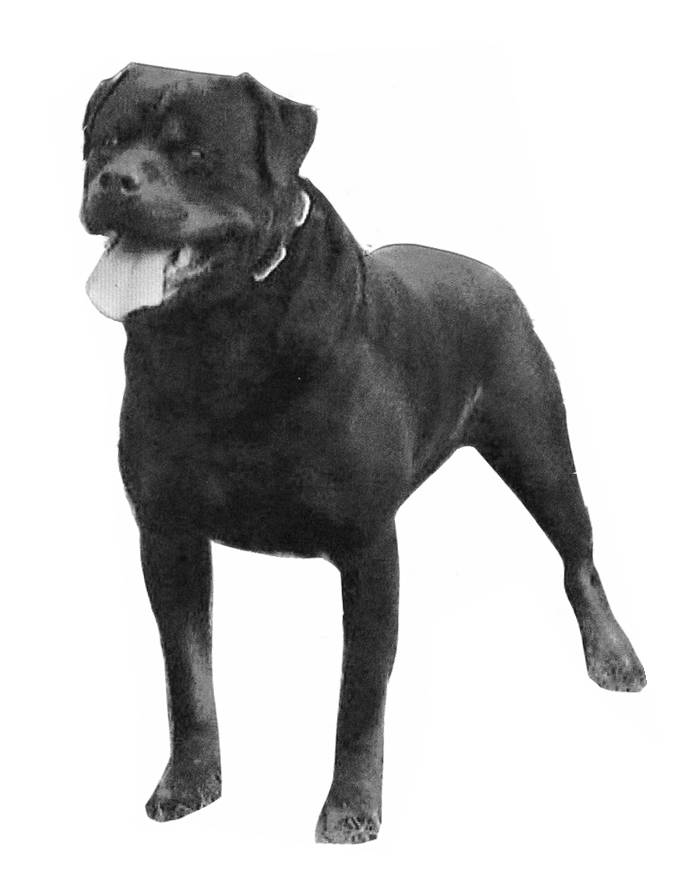 If one were to take a survey asking, Why did you purchase a Rottweiler, Why this breed over
others, it would certainly elicit intriguing answers. I cannot say for sure what the attraction others
had to the Rottweiler when first encountered, however for me, it was his raw masculine appeal, his
unique head and the impressive musculature and power he exuded. From his appearance, one could easily
understand that this was a serious dog! Not alone in this view, many other Rottweiler
aficionados have recognized this hallmark of the breed and expressed a similar perspective as well.
After all, is not the look of a dog that makes the first and lasting impression? Surely, his breed
type is what makes the Rottweiler unique The Germans understood the Rottweilers
distinction when they came together to codify the standard at Heidelburg, Germany in 1907. They
were deliberate when articulating and fixing the appearance of the Rottweiler, which is why the standard
uses detailed language in its description of this essential aspect of breed type. The standard was
modified since 1907, but the general appearance of the Rottweiler has not. Reading the current standard,
one finds the word powerful written 6 times, bone mentioned 3 times and muscle mentioned 5 times.
No other words have such repetition when describing the details. If one were to take a survey asking, Why did you purchase a Rottweiler, Why this breed over
others, it would certainly elicit intriguing answers. I cannot say for sure what the attraction others
had to the Rottweiler when first encountered, however for me, it was his raw masculine appeal, his
unique head and the impressive musculature and power he exuded. From his appearance, one could easily
understand that this was a serious dog! Not alone in this view, many other Rottweiler
aficionados have recognized this hallmark of the breed and expressed a similar perspective as well.
After all, is not the look of a dog that makes the first and lasting impression? Surely, his breed
type is what makes the Rottweiler unique The Germans understood the Rottweilers
distinction when they came together to codify the standard at Heidelburg, Germany in 1907. They
were deliberate when articulating and fixing the appearance of the Rottweiler, which is why the standard
uses detailed language in its description of this essential aspect of breed type. The standard was
modified since 1907, but the general appearance of the Rottweiler has not. Reading the current standard,
one finds the word powerful written 6 times, bone mentioned 3 times and muscle mentioned 5 times.
No other words have such repetition when describing the details.
Excerpts from the
standard:
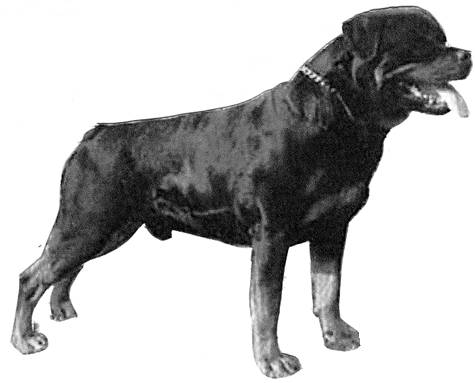 The ideal Rottweiler is a medium large, robust and powerful dog - Dogs are characteristically more
massive throughout with larger frame and heavier bone than bitches - His bone and muscle mass must be
sufficient to balance his frame, giving a compact and very powerful appearance - Neck- Powerful, well
muscled - Loin is short, deep and well muscled - Legs are strongly developed with straight, heavy bone -
Upper thigh is fairly long, very broad and well muscled - Lower thigh is long, broad and powerful, with
extensive muscling - His movement should be balanced, harmonious, sure, powerful and unhindered, with
strong forereach and a powerful rear drive Despite his distinctive breed type and the words used in the blueprint to describe it, a
negative, subtle change has occurred over the years, which ultimately is disastrous to his appearance. The ideal Rottweiler is a medium large, robust and powerful dog - Dogs are characteristically more
massive throughout with larger frame and heavier bone than bitches - His bone and muscle mass must be
sufficient to balance his frame, giving a compact and very powerful appearance - Neck- Powerful, well
muscled - Loin is short, deep and well muscled - Legs are strongly developed with straight, heavy bone -
Upper thigh is fairly long, very broad and well muscled - Lower thigh is long, broad and powerful, with
extensive muscling - His movement should be balanced, harmonious, sure, powerful and unhindered, with
strong forereach and a powerful rear drive Despite his distinctive breed type and the words used in the blueprint to describe it, a
negative, subtle change has occurred over the years, which ultimately is disastrous to his appearance.
Currently in the US, which is observable both in the show-ring and out, is a great loss in the
general power of the breeds masculine design. Now, a rarity and an oddity, the once major factor in the
breeds appeal, its power and substance, were put on the back burner in many breeding programs. One
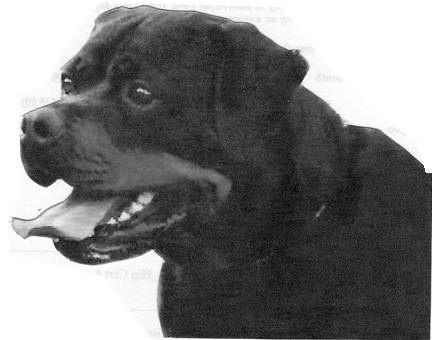 must look carefully to find this trait; the breed has lost its distinction. On the street, we encounter Rottweilers that are a poor representation of once was. They possess
pin heads, narrow, snipey, muzzles, and spindly bones, no muscle mass and shallow frames. To the
knowledgeable, these Rottweilers appear to be a mix breeding, although they are not. To the
unknowledgeable, they appear to be correct! In the show-ring, this problem has crossed the boundaries. One should expect poor
examples of the breed on the street since they are comprised of non-show dogs. However, the show ring
should be the exception. Presently, many exhibits share the same problem of their street cousins and are
only a notch or two above. Many exhibits that enter the show-ring are constructed well but are also as
weak in substance, spindly in bones and musculature as their pet counterparts are. Now, when a dog or
bitch that is in the ring with correct breed type, exuding power and substance, it appears as the odd
man out. A strong masculine dog or powerful bitch seems strange among exhibits with spindly frail
bodies and Doberman-like heads. To the newbie's and unknowledgeable judges, it is untypical and put at
the end of the line. Often, I have heard that a female, which possesses strong bones, muscle and a
powerful head, is now deemed too strong and considered a doggy bitch. What was once correct and
typical is now abnormal. The dogs, which should embody power and masculinity, are now so weak in type
they can be considered beautiful females! must look carefully to find this trait; the breed has lost its distinction. On the street, we encounter Rottweilers that are a poor representation of once was. They possess
pin heads, narrow, snipey, muzzles, and spindly bones, no muscle mass and shallow frames. To the
knowledgeable, these Rottweilers appear to be a mix breeding, although they are not. To the
unknowledgeable, they appear to be correct! In the show-ring, this problem has crossed the boundaries. One should expect poor
examples of the breed on the street since they are comprised of non-show dogs. However, the show ring
should be the exception. Presently, many exhibits share the same problem of their street cousins and are
only a notch or two above. Many exhibits that enter the show-ring are constructed well but are also as
weak in substance, spindly in bones and musculature as their pet counterparts are. Now, when a dog or
bitch that is in the ring with correct breed type, exuding power and substance, it appears as the odd
man out. A strong masculine dog or powerful bitch seems strange among exhibits with spindly frail
bodies and Doberman-like heads. To the newbie's and unknowledgeable judges, it is untypical and put at
the end of the line. Often, I have heard that a female, which possesses strong bones, muscle and a
powerful head, is now deemed too strong and considered a doggy bitch. What was once correct and
typical is now abnormal. The dogs, which should embody power and masculinity, are now so weak in type
they can be considered beautiful females!
WHAT ARE CORRECT BONES AND MUSCLES?
The standard does not give a numerical value for the appropriate bone mass or muscle, only a
verbal guide. Therefore, to state a formula, Dog x must have y amount of bone and muscle to be correct
is not possible. To understand what is appropriate for the correct amount for these attributes, one
must refer to the blueprint. From the standard: His bone and muscle mass must be sufficient to balance
his frame, giving a compact and very powerful appearance. A reasonable guide when assessing an exhibit, one should ask, Does this exhibit exemplify a
powerful appearance? - Is the bone and muscle mass substantial, so that its appearance exudes power?
One should be impressed with the overall appearance for power, muscle and bones.
A. BONE MASS
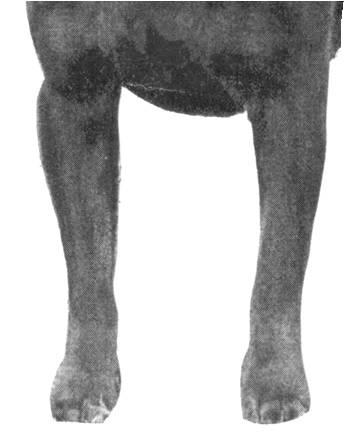 Bones mass should be thick enough in width so that it appears to support the frame of the dog in Bones mass should be thick enough in width so that it appears to support the frame of the dog in
a substantial and powerful manner, without being refined, elegant, too massive or grotesque.
The place to visually assess the bone mass on a Rottweiler, correct or incorrect, is the
thickness in the radius/ulna and humerus. When making an evaluation, the dog is presented head on so
that the full width of the chest (from East to West) can be seen. If a numerical evaluation for the
thickness of the bones is desired, it is measured by using a tape measure and wrapping it around the
circumference of the pastern (see Fig.1). Here is where the least amount of skin, muscle and tendon can
be found. Correct bone mass is correlated to the height. The taller the dog, the more bone mass it should
possess, compared to dogs of lesser height. Additionally, bone mass should always be proportionate and
balanced to the frame of the dog. Out of balance is not correct. Good examples of this are the
extremes. They are exhibited when a tall dog possess long, fine bones of the radius/ulna and
humerus,
giving the appearance of spindles, or when a short dog possesses too strong bone mass appearing like
tree trunks. These dogs are out of balance. The Rottweiler is not a St. Bernard or a
Dobermann.
B. MUSCLE MASS
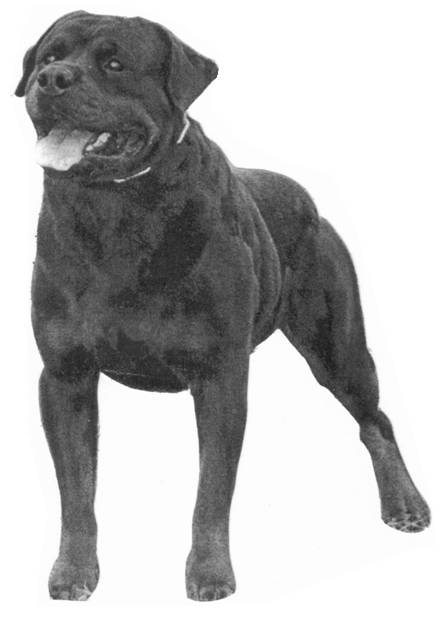 The general muscle mass should be substantial, well defined and in proportion to the frame of the dog so that it exudes strength, masculinity and athleticism. The muscles should be apparent, yet not overpowering, like the Bull and Pit Bull Terriers. The muscle groups that comprise this appearance are the muscles of the front and rear assembly. The general muscle mass should be substantial, well defined and in proportion to the frame of the dog so that it exudes strength, masculinity and athleticism. The muscles should be apparent, yet not overpowering, like the Bull and Pit Bull Terriers. The muscle groups that comprise this appearance are the muscles of the front and rear assembly.
In the front assembly, the muscles of the shoulders, the upper arm and forearm should be well developed and obvious. These muscle groups are the Deltoids, Biceps, Triceps and the Extensor muscles of the radius/ulna.
In the rear assembly, the muscles of the Gluteus and Biceps Femoris should be well developed and defined. Viewing the rear muscles from the back, the depth and width of the Biceps Femoris and Gluteus should be full, supporting the Femur (see Fig.2). Here is where all forward locomotion begins.
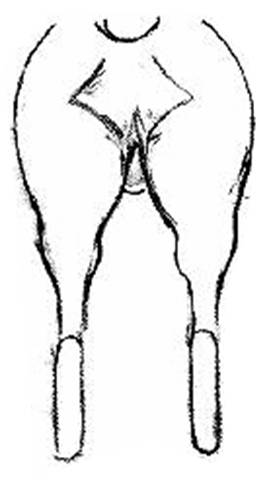
C. THE CORRELATION OF MUSCLE AND BONE
With human body-building, the muscles can be developed, shaped and improved, with discipline,
hard work, good nutrition and much sweat. However, improvement has limits, since body-building is
dependent upon the size, mass of the muscle groups and bone substance. In essence, you are what you
inherited. The thin framed, fine boned man or woman will always work harder and strain longer to build
bulk and definition in the muscle tissue. With this body type, a major factor is bone mass! Strong bone
mass is supported by thick muscles. The same principles hold true for the Rottweiler.
Dogs and bitches that are fine boned possess muscles, which are light in their mass and often
show little or no definition. This type, will always work very hard to make strides improving and
developing what it inherited from the pedigree. Conversely, there are those dogs/bitches, which impress
us with their natural well-developed musculature and powerful bone mass. Their musculature is correlated
to their robust bone mass.
BREED TYPE IS A STEPCHILD
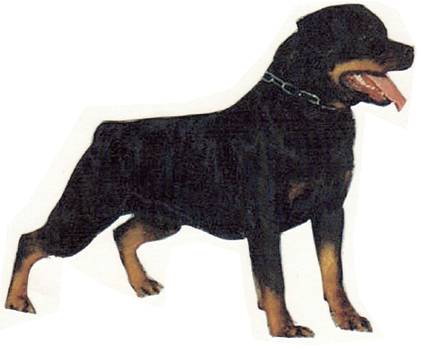 Why is the great majority of Rottweilers here in the states, (especially in the show ring), not uniformly masculine in type with powerful muscle and bones, which is specified in the standard? Why have they become slight in bone, shallow in substance, and soft in appearance? The answer is breed type has become a stepchild.
In the US, the accent is on the best possible construction demonstrated by superior gait. Those dogs, which display this attribute, are the ones that win in the show-ring. Placing the accent on this attribute is both good and problematic. It is good since all concerned breeders have this as one of
Why is the great majority of Rottweilers here in the states, (especially in the show ring), not uniformly masculine in type with powerful muscle and bones, which is specified in the standard? Why have they become slight in bone, shallow in substance, and soft in appearance? The answer is breed type has become a stepchild.
In the US, the accent is on the best possible construction demonstrated by superior gait. Those dogs, which display this attribute, are the ones that win in the show-ring. Placing the accent on this attribute is both good and problematic. It is good since all concerned breeders have this as one of
their goals in mind when planning their next litter. Sound construction, in accordance with the breed standard is essential. All exhibitors want to
win in the show-ring; therefore, many breeders make superior gait their only goal. With this as their prime directive, many breeders have made a detrimental detour; they traded breed type for locomotion. This is problematic.
Often, at ringside, 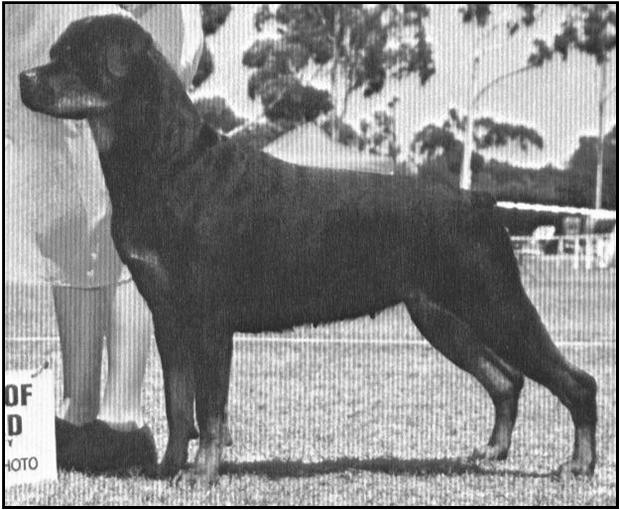 one can hear spectators and breeders alike say, Oh that dog moved beautifully with great reach and drive, It
was well put together. Yes, that could be said however, the dog looked more like a Doberman than a Rottweiler. Excellent construction with outstanding gait is not breed type. These two attributes are separate entities in a breeding program and are not mutually interchangeable or should be misconstrued for breed type. Over the years, the masculinity of the Rottweiler, here in the states, has slowly eroded. Its masculine power and substance, clearly specified in the standard, has been oozing away. Spindly, fine bones with narrow long muzzles and smooth body lines have replaced broad top skulls, wide, short muzzles and powerful bones and muscles. Working character has also eroded and replaced with many Rottweilers that are one can hear spectators and breeders alike say, Oh that dog moved beautifully with great reach and drive, It
was well put together. Yes, that could be said however, the dog looked more like a Doberman than a Rottweiler. Excellent construction with outstanding gait is not breed type. These two attributes are separate entities in a breeding program and are not mutually interchangeable or should be misconstrued for breed type. Over the years, the masculinity of the Rottweiler, here in the states, has slowly eroded. Its masculine power and substance, clearly specified in the standard, has been oozing away. Spindly, fine bones with narrow long muzzles and smooth body lines have replaced broad top skulls, wide, short muzzles and powerful bones and muscles. Working character has also eroded and replaced with many Rottweilers that are
 shy and lack confidence in their temperament. This is a negative and detrimental trend. Once set in motion, it is extremely difficult to reverse. One only has to see our European and
International counterparts by comparison to understand the differences in breed type and working temperament. In the international community, the accent is placed on breed type and working temperament.
Some would argue there is nothing to improve. All is well within the Rottweiler and breed type is where it should be. That is a myopic view. It is valuable and healthy for all concerned to step out of the trenches and obtain an international perspective by making comparisons with our domestic breeding program and our international counterparts. Exchanging ideas and methods to improve genetics and techniques will benefit all. Additionally, it is extremely important to promote and make available more breed seminars in all Rottweiler clubs. There, is where real progress is achievable in an open dialog exchanging opinions and ideas. The benefactor of this is the Rottweiler. shy and lack confidence in their temperament. This is a negative and detrimental trend. Once set in motion, it is extremely difficult to reverse. One only has to see our European and
International counterparts by comparison to understand the differences in breed type and working temperament. In the international community, the accent is placed on breed type and working temperament.
Some would argue there is nothing to improve. All is well within the Rottweiler and breed type is where it should be. That is a myopic view. It is valuable and healthy for all concerned to step out of the trenches and obtain an international perspective by making comparisons with our domestic breeding program and our international counterparts. Exchanging ideas and methods to improve genetics and techniques will benefit all. Additionally, it is extremely important to promote and make available more breed seminars in all Rottweiler clubs. There, is where real progress is achievable in an open dialog exchanging opinions and ideas. The benefactor of this is the Rottweiler.
References
Fiftieth Anniversary of the Allgemeiner Deutscher Rottweiler Klub, Powerhorn Press, 1978
American Rottweiler Club Standard, May 1990
Dog Anatomy-Illustrated, Way Robert VMD, MS Dreenan Press 1974
Der Rottweiler, Korn Hans 1939 |
Top of page
FOR SOPHIE, THERAPY IS A DOGS LIFE
Alamogordo
Dailey News
By Laura Hunt - Staff Writer
Jan 22, 2006
She was in Las Vegas, behind bars, when Michele Mauldin rescued her. Now
her favorite things to do are visit nursing homes and help children
learn to read.
Sophie, a 4-year-old Rottweiler, has come a long way from the Las
Vegas animal shelter where Mauldin adopted her two years ago, only
minutes before she was scheduled to be euthanized.
"I had previously adopted a Rottweiler from the rescue group
that saved her, and when I saw her picture it was love at first
sight," Mauldin said.
It's also love at first sight for many of the people whom Sophie
visits every week. The 87-pound dog's excitement is obvious when her nub
of a tail starts wagging as she approaches one of her favorite residents
at Casa Arena Blanca.
|
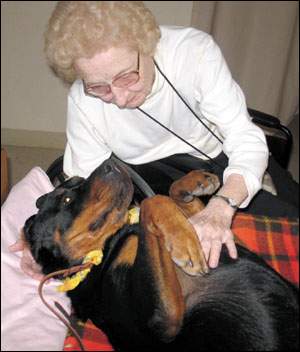
|
|
"She's just adorable," said Mary Ellen White. "There's not a vicious bone in her body." White has her bed made neatly just for Sophie. "This is her bed," she says as Sophie gently steps up onto her red flannel blanket and rolls on her back, awaiting White's hand on her stomach.
White remembers the
first time Sophie visited the home in May last year. White was in bed,
and her wheelchair was nearby. Sophie stepped onto the chair and
delicately made her way to the bed. Now she's made the event a weekly
ritual.
When asked why she
enjoys seeing Sophie, White says, laughing, "maybe because she
enjoys visiting me. We just kind of bonded."
Sophie became a
therapy dog after Mauldin took her to an obedience trial in Missouri.
They were testing therapy dogs, and Mauldin thought Sophie's sweet
personality would make her perfect for the job.
Mauldin's instinct
was right -- Sophie tested very well. Now Sophie visits Betty Dare Good
Samaritan Center and Casa Arena Blanca weekly.
"Many of the
residents consider Sophie a great friend and anxiously await her weekly
visits," Mauldin said. "Her intuitive nature and gentleness
gives great comfort and enjoyment to the residents and staff
alike."
When Sophie enters
Sacramento Elementary School to participate in their after school
Community and Family Enrichment program, children who see her call out
her name and run toward her, giving her a hug.
"She's cute and
cuddly," said third grader Yasmina Hernandez. "She's so
nice."
Yasmina and her
friends, Isabella Garcia and Emily Hingano, also third graders, get up
to offer Sophie a chair at their desk. Sophie accepts. The girls stand
around the dog, generously hugging and petting her behind the ears.
Once, before
Christmas, the class sang the "12 Days of Christmas" and
replaced the partridge with "Sophie in a pear tree."
"If you sing a
song about her, she likes it," Yasmina said.
Fourth grader Frank
Gonzalez also runs to Sophie when she arrives.
"She always
remembers me," he said.
The dog does remember
him, and gives him a chance to rub her stomach by rolling over and
pawing at his arm.
Darlene Lucero, CAFE
site facilitator, said the children in her program love Sophie.
"My kids can't
wait for (her) to come," she said. "It's such an asset."
Typically, Sophie
visits with the children and then sits while one of them reads to her.
"For kids who
are timid about reading out loud, she's great," Lucero said.
"She's not intimidating."
Sophie also calms
some of the rowdy children, Lucero said. One student in particular
always behaves well when Sophie is around.
"I think it's
the relationship he has with her," she said. "She is so
calming to him."
Though Sophie has
many fans, sometimes people who don't know her are frightened by such a
large Rottweiler.
"Some people
will literally cross the street," Mauldin said. "But
generally, they'll like her and ask, 'What kind of dog is it?" As
soon as I say 'a Rottie' they go, 'Oh!' They fall in love with
her."
Mauldin said the
breed gets a bad rap, but many of them are sweet and gentle dogs.
"A lot of it is
socialization and training," she said. "With this breed in
particular, they shouldn't be left chained in the backyard."
Any breed or size of
dog can be a therapy dog, as long as they have a good temperament,
Mauldin said.
"It's
wonderful," Mauldin said. "Its the most rewarding things I've
done with dogs, and I've been in dogs for 30 years."
Mauldin started
showing dogs in the 1970s. Though she has six dogs, Sophie is her only
therapy dog.
Rescuing a dog can be
a rewarding option for people looking for a pet, Mauldin said.
"A lot of dogs
that end up in shelters are really truly wonderful animals,"
Mauldin said. "They can do good for mankind in a variety of
ways."
|
|
Top of page
| Life
Saving Rottweiler
Featured on
the Oprah show
01-11-2006
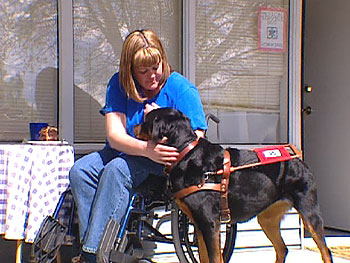 Leana suffers from epilepsy. Her service dog Faith, a Rottweiler, has been trained to detect changes in Leana's body chemistry to warn her before a seizure
hits. One night, after Leana went to bed, Faith refused to let her sleep. Leana suffers from epilepsy. Her service dog Faith, a Rottweiler, has been trained to detect changes in Leana's body chemistry to warn her before a seizure
hits. One night, after Leana went to bed, Faith refused to let her sleep.
"She jumped up on the bed and started running in circles," Leana says. "You have to listen to your service dog's instincts so I got out of bed and sat up with her."
Then, Leana went into the kitchen to make some hot chocolate. Moments later, she passed out. Leana hit her head on a cabinet and immediately started having grand mal seizures. Faced with a life-threatening emergency, 4-year-old Faith leapt into action. Faith ran for the phone and brought it to Leana, but when Leana didn't respond, Faith took charge! She went back to the base of the phone and pressed the speed dial for 911using her nose!
When the 911 operator picked up, Faith replied the only way she knew howby barking incessantly. "The dog that was barking was very insistent," says operator Jenny Buchanan. "It sounded like it was trying to say that there was some sort of a problemI checked to see what the address was and we sent officers out to see what the problem was."
After that miracle phone call, Faith then unlocked the front door and laid down next to Leana, keeping her safe until help arrived. Leana was hospitalized for three weeks after her fall; she is now back at home with her life-saving hero!
Click
here to view Faith's ACE award from the AKC.
|
Top of page
The Dog Who Ate Christmas
By THERESA WILLINGHAM
Our dog recently ate 7 ounces of Baker's chocolate and a half-ounce of gourmet ground coffee and swallowed a marble, to boot. None of these things is part of recommended canine diet. Chocolate is toxic to dogs - a 1-ounce square of Baker's chocolate can kill a
10-pound dog, and it's a wonder 7 ounces didn't do in our 15-pound dachshund. Coffee holds the same dangers.
The whys and wherefores of this accident are irrelevant. Everyone feels badly enough already. The upshot of the whole thing is that the vet bills totaled more than $1,200. Coming on the heels of a rough year and a recent layoff, our little dog effectively ate Christmas.
On the way home from the vet with our pooch, groggy and sore after surgery to remove the offending blue marble, we joked gently about all the things that $1,200 could buy. "Dexter ate a 24-inch flat screen LCD TV," my husband said, laughing. "He ate a lot of video games," my son chimed in. "He ate a used car," one of my daughters added. "A very old and very used one," her father started to correct her. But then we remembered we'd sold our old car for $300 and agreed that Dexter had eaten the equivalent of four old minivans.
Once home, everyone fawned over our sick little dog without reproach, glad he was home and on the mend, the $1,200 and abandoned Christmas gift ideas irrelevant.
Because, truth be told, we're still in debt to Dexter for all he's done for us in the last couple of years.
We adopted him as something of immersion therapy for our then-10-year- old son, who was suffering from an increasingly unreasonable and debilitating fear of dogs. Like many phobias, cynaphobia, the medical term for fear of dogs, doesn't require any negative experiences to exist. Our son's fears had grown to such proportions he couldn't walk down the street or ride his bike without heart-racing anxiety on just seeing a dog.
When we adopted Dexter from a breed rescue group, he was a year and a half old, weighed 13 pounds and stood a foot high at the shoulders. Our daughters were delighted. Our son wouldn't come out of his room for three days. He crawled across the tops of chairs to get to the table to eat and then crawled back across them to return to his room.
On the fourth day, he sat on a stool and observed the dog, who looked back questioningly with those irresistible dark brown eyes of his. At the end of a week, our son was carrying the dog around the house. After a few weeks, he was more comfortable with other dogs. Now, two years later, he still doesn't care for large dogs, but he's not fearful and he roams the neighborhood with a confidence that's carried over to other areas of his life. He's playing piano, riding horses, doing well in his studies and generally a happy-go-lucky kid with a dog.
And that's just what Dexter did for our son.
Each person in the family has a special and unique relationship with the dog. He plays gently and obligingly with our son. With my rambunctious, outgoing daughter, he races and wrestles. He leans against my quiet daughter like a cat, savoring her strokes. And while originally suspicious of men, Dexter adores my husband. They play wild games of chase and spend warm devoted moments snoozing.
I had never owned a dog before and was concerned about how long I could be away from home; picking up after the dog in addition to the rest of the family, who at least could flush; annual shots, tags and whatever other dog ownership issues were bound to occur.
But I found that walks took on new meaning with a little dog trotting at my side. An occasionally bizarre meaning, as we sometimes stopped every few feet so Dexter could check what the girls called his "pee mail" at every post and trunk. But I walk more briskly and more often now.
And coming home has never been so rewarding! No one else in the family greets me so ecstatically and with such genuine joy. Whether I've been gone 15 minutes or a day, Dexter is enormously and unapologetically glad to see me. He's a cuddler, shamelessly squeezing between the desk and my lap while I work, cruising from lap to lap while we watch TV at night. He won't crawl into his bed until the last family member is in his or hers, and he lies curled up beside us until morning, when he starts his equal opportunity doting all over again.
He has taught us patience, charity and the value of forgiveness. He never holds grudges, whether his tail is accidentally stepped upon, or he's ordered out of the kitchen for being underfoot. He certainly didn't like the vet's office during the chocolate Incident. But when we came to take him home, he clearly didn't associate us with his aches and pains. Through the haze of drugs after his surgery, he wagged his tail vigorously when he saw us.
Dogs aren't for the shallow and self-absorbed. They're childlike but without the growing cognizance and independence of children. We are always their heroes; they're always our friends. Even with three children and a quarter-century marriage, I didn't fully understand unconditional love until Dexter came into our lives. The obligation to live up to such devotion and loyalty can be a daunting task and a humbling experience.
Yes, our dog ate Christmas. But the gifts he's given us are priceless and more enduring than anything we could ever put under the tree and more than we could ever repay.
|
Top of page
Warning
for pet owners about potentially-deadly pet food
 |
12/21/2005
(Cathy Orosz, WROC-TV)
The Christmas tree came down before the holiday at the Patrick's
home in Victor. Sue and Bill Patrick said they simply
couldn't stomach the holiday after losing five of their precious
pets, all Labrador Retrievers.
The couple's been breeding Labs for 35 years and has never seen
anything like this: dogs dying from liver toxicity, their pet
food to blame. Vets at Mendon Village Animal Hospital were
the ones who made the link to Diamond Pet Food, after examining
the Patrick's dogs and several unrelated cases.
Diamond confirms it discovered something called aflatoxin in
some of its pet foods. According to the company's web
site, aflatoxin is a "naturally-occurring toxic chemical
by-product from the growth of the fungus Aspergillus Flavus, on
corn and other crops." The company says all affected
products will have this identical code: DMD1001JC32GJL____, BB
11APR07. (The last four digits of the code will vary)
19 different varieties of Diamond Pet Foods are listed as being
suspect on the company's web site. Diamond says the bad
batch of food came from its plant in Gaston, South Carolina.
That plant supplies pet food to 22 states.
"We don't know how far-reaching this is, at this point, how
many dogs are affected," said Dr. Sara Sanders of the
Mendon Village Animal Hospital. "And we also don't
know if the dogs that are affected, how effective our treatments
are going to be at helping them."
Dr. Sanders said all the cases she saw had one thing in common:
the owners reported their dogs stopped eating the food.
Other symptoms include lethargy, yellow eyes, orange-colored
urine, vomiting, and in extreme cases, bloody diarrhea.
Dog lover Rosie Downey immediately booked an appointment at
Mendon when she heard the news. She's been feeding Diamond
food to her dogs, Max and Brownie, for two years.
"I'm very, very upset," Downey said. "I
mean, my dogs are like my other kids." She'll have to
wait a couple days for her dogs' test results. Right now,
they don't appear ill.
"Hopefully, they'll be OK," said Downey.
The Patrick's are holding out hope the 6 dogs they brought to
Cornell's Veterinary School will pull through. And despite
the ordeal, they don't lay the blame on Diamond, saying,
"it could've happened to any dog food."
Related Link:
http://www.diamondpet.com
|
Top of page
|
Mysterious Disease Is Flu Strain
By RANDOLPH E. SCHMID
Associated Press Writer Mon Sep 26,
2005
WASHINGTON - A puzzling outbreak of respiratory disease in dogs has been tracked to a virus that has infected horses for decades a transfer researchers say is rarely seen.
The illness first drew attention sweeping through kennels of racing greyhounds in several states and has also been found in household dogs in some states.
The flu kills between 5 percent and 8 percent of infected dogs, Dr. Cynda Crawford of the University of Florida College of Veterinary Medicine said at a briefing Monday. Some dogs get a cough, runny nose and fever while others show no symptoms at all.
The flu can cause symptoms similar to the common illness known as kennel cough, Crawford said. But kennel cough is usually caused by a bacteria while the new illness is caused by a virus.
Dr. Brad Fenwick, vice president for research at the College of Veterinary Medicine at Virginia Polytechnic Institute, said he thinks mortality from this flu is even less than estimated by Crawford. If infected dogs are treated, mortality can be much lower, Fenwick said in a telephone interview.
While the new virus is easily transferred between dogs, Crawford said people should not panic.
Owners of dogs that have a respiratory infection should keep the animal home for at least two weeks, she said.
Asked if dog owners should avoid kennels or other activities, Crawford said she plans to continue boarding her dogs when needed, walking them in areas with other dogs and entering them at dog shows.
Fenwick agreed, adding that people should not use vaccines intended for horses on their dogs because the safety of the vaccines hasn't been tested in canines.
As for transmission to people, Crawford noted that the strain of flu has been known in horses for more than 40 years and there have been no documented cases of it moving to people.
Nonetheless, Dr. Nina Marano of the Centers for Disease Control said the agency will monitor human exposure to the virus.
Dr. Ruben Donis of the federal Centers for Disease Control in Atlanta called the transfer of a virus from horses to dogs "a very rare event of considerable scientific interest with regards to understanding influenza virus transmission across species."
Donis said the researchers have identified between eight and 10 genetic changes between the virus in horses and dogs, and they speculate that these changes affect the ability of the virus to attach to receptors on cells.
The findings of the research team led by Donis were published online by the journal Science.
He said the research began in Florida and has since traced the virus to dog tracks in other states and to pets in Florida and New York and possibly Massachusetts.
Fenwick, who was not part of the research team, said it is not clear whether the transfer occurred first from horses to the racing greyhounds or to house pets.
There are a lot more pet dogs around horses than racing dogs, he noted. The fact that it was first diagnosed in greyhounds could be because it spread to several animals in kennels where veterinarians were called in to treat the dogs. Since mortality is so low it may have gone largely unnoticed in pets, he suggested.
The published paper reported respiratory disease outbreaks in from June to August 2004 at dog tracks in Florida, Texas, Alabama, Arkansas, West Virginia and Kansas. From January to May 2005 outbreaks were reported at dog tracks in Florida, Texas, Arkansas, Arizona, West Virginia, Kansas, Iowa, Colorado, Rhode Island and Massachusetts.
The research was funded by the Division of Pari-Mutuel Wagering of the State of Florida.
|
Top of page
|
|
|
I cannot
live with those feet, the judge privately exclaimed to me
after placing a bitch first in a class of
excellent specimens. The two bitches up for final
placement of V-1 and V-2 in the working class were
excellent in type, harmonious locomotion, yet, had
important differences between them. Both had superior
heads, good bones, dark eyes, type, however, one was
splayfooted with soft pasterns, the other was a bit soft
in the topline. After pacing back and forth several
times, the judge made a switch and gave the V-1
placement to the bitch that had the correct feet,
strong, firm pasterns, well knuckled, tight fitting,
cat-like paws.
The feet play
a subtle but vital role in Rottweiler type. More
importantly, they are a fundamental component in
Rottweiler locomotion. Possessing correct feet is
essential.
The standard specifies, Pasterns are strong,
springy and almost perpendicular to the ground. Feet are
round, compact with well-arched toes, turning neither in
nor out. Pads are thick and hard. Nails short, strong
and black.
Despite
these exacting words from the standard, one encounters
with great frequency, sloppy feet, low on the pastern
and splayfooted Rottweilers.
The foot is the contact point where the body
meets the ground and where a great deal of torque,
occurring from the torsion of gait is dampened. The feet
are in essence, the canine shock absorbers. It is
valuable for an aficionado of the Rottweiler to
understand the subtle yet powerful influence the feet
have upon the entire musculo/skeletal workings of the
dog.
To understand
what is incorrect, it is important to start with a good
example of what is correct.
Fig 1, is an illustration of correct feet. In Fig
2, is correct feet in 3/4 view and profile.
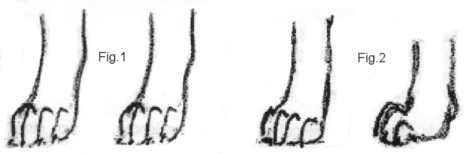
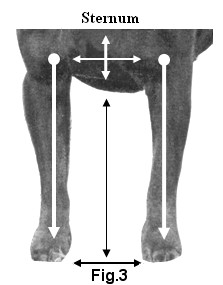
When standing,( Fig 3.) the feet should be in
correct alignment
so the balance point of each leg runs directly in the
center of the pastern through the center of the
toes. This creates
an equal distribution of body weight in the front
section, through the
radius, ulna, humerus and scapula
(the front assembly).
When viewing the Rottweiler head on , one should
not see the feet turning in or out. The legs must
be straight, with a distance from the sternum equal to
50% the width of the chest . Additionally, elbows
should be close fitting to the chest. With this
correct alignment, the front assembly evenly distributes
the
torsion and shock created by forward
motion.
From the standard, Pads are thick and hard... Pasterns are strong,
springy and almost perpendicular to the ground
Compact with well-arched toes... This is important for four reasons.
|
1. The
foot helps initiate forward motion (Fig 4) by
acting as a lever and fulcrum. As the weight of
the body shifts forward, the ball (pad) of the
foot becomes a fulcrum and the pasterns/toes
become a lever. A flat pad and poorly knuckled
toes lessens the
angle of the fulcrum, therefore resulting in
less lift .
2.
Since the pads are the first in line to
absorb the shock transmitted up the front
assembly, it is necessary to have thick
pads to diminish the shock.
3.
The pasterns are part of the lever action
of the foot and absorb shock from
forward movement.
4.
Well arched, compact toes also dampen
shock and heighten lift. |
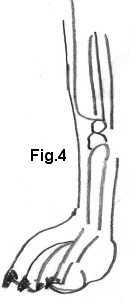
|
Problem
Feet
People
with problem feet can have an adjustment made by an
orthotic support in the shoe. For horses, a shoe can be
tailored to adjust for specific foot incongruities. With
dogs, a corrective device is not possible. Corrections
can only be achieved in the next generation via a
careful and thoughtful breeding program. Therefore, it
is valuable to examine the anomalies found occurring in
the field that effect the feet and pasterns of the
Rottweiler.
The
most common anomalies.
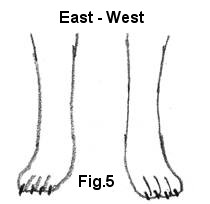 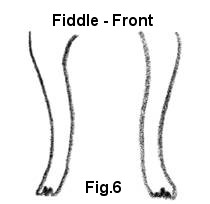
1. The primary occurring foot abnormality is not
specifically a problem with the feet, but an out- ward
turning of the pastern. This is commonly named east-west feet
(Fig 5). Here, the foot on each leg turns outward in an
east-west direction. It can be observed on pups as early
as eight weeks old and may remain this way for the
entire life of the dog or correct itself as the chest
develops. Dogs or bitches with this anomaly should be
avoided in a breeding program since this condition is
passed on to the progeny.
2. In addition to east-west
feet, a structural fault that may accompany it is a Fiddle-Front (Fig.6).
Here, not only are the feet turning outward, but
the elbows turn away from the body as well producing the
appearance of a fiddle .
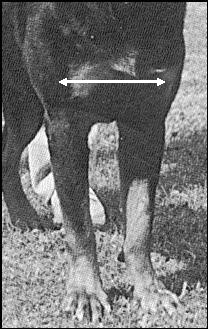
Interestingly, a major factor influencing the
feet is not necessarily the feet, but incorrect
construction of the chest in depth, width and placement
of the sternum. When the chest is broad possessing the
correct width, and a well pronounced sternum, it
correctly supports the upper arm assembly (shoulder
blade, humerus, see Fig. 2), producing a wide center of
gravity. Each foot is positioned from the sternum,
approximately 50% the total width of the chest . When
the chest is narrow, possessing a close center of
gravity (slab sided, pinched front, incorrect spring of
rib) and or shallow in depth, the laws of physics forces
the feet to turn outward, compensating for the incorrect
width or depth (see Fig. 7)
3. Correctly constructed,
the pasterns act like a shock absorber, dampening the
impact while gaiting and help initiate lift.
From the standard,
Pasterns
are strong, springy and almost perpendicular to the
ground. Nonetheless,
incorrect pasterns are visible in the show ring.
Occasionally,
the pasterns are observed to be soft (broken
down). This is not a problem in the bones of the
pastern but a laxity in the muscles of the radius/ulna
and or a laxity in the ligaments and tendons of the
forearm.
Common
pastern problems
A.
Too soft with too much slope (Fig 9), the dampening
effect greatly diminishes in the pastern and the ability
of the foot to help initiate lift is also significantly
reduced. Often, this problem is accompanied by poorly
knuckled toes and splayfooted.
B.
Too stiff and upright (90 degree angle to the ground) in
the pastern. The opposite of too soft, the same effect
results.

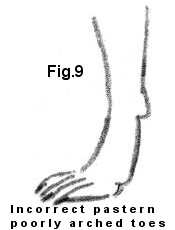
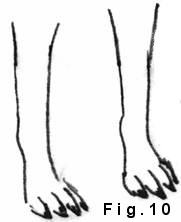
When the pastern is too
lax, the shock transmitted through the upper arm from
gaiting cannot be correctly dampened. This results in
possible structural damage to the upper arm assembly,
poor front arm extension and early fatigue.
4. Splayfooted (Fig.10) is a problem frequently
observable. This anomaly,
too much space between the toes, is caused by a
laxity in the ligaments and muscles of the phalangeal
bones. When the dog is observed to be splayfooted, it
most often has poorly arched toes as well.
Nails
Nails
are always thick, black and rigid. Occasionally, white
nails are observable.
It is not correct.
Additional anomalies
1.Too long in toes (Hare-like feet)
2. Insufficient thickness in
the pads
3. Toes that curl to one
side.
FUNCTION
DICTATES FORM
Because
the feet have a fundamental role in Rottweiler
locomotion and share an importance to correct type, as
breeders and exhibitors it is essential we understand
that Function Dictates Form when discussing this
area. The standard is specific in its blueprint for the
feet. Deviations from the blueprint such as, soft
pasterns, poorly arched toes, long toes, thin pads etc.
impede the initial lift and the ability of the feet to
be the first in line to absorb shock. Any incongruity in
structure impedes its efficiency while gaiting.
The
Rottweiler is a working dog and moves via the trot .
Once around the show-ring or a short exercise can only
result in a limited evaluation about its locomotion.
Therefore, it is possible for an exhibit to go once or
twice around the ring and be observed to gait reasonably
well. A more thorough evaluation about the dogs
entire structure must be determined with at least 5
minutes of gaiting.
|
|
Top of page
|
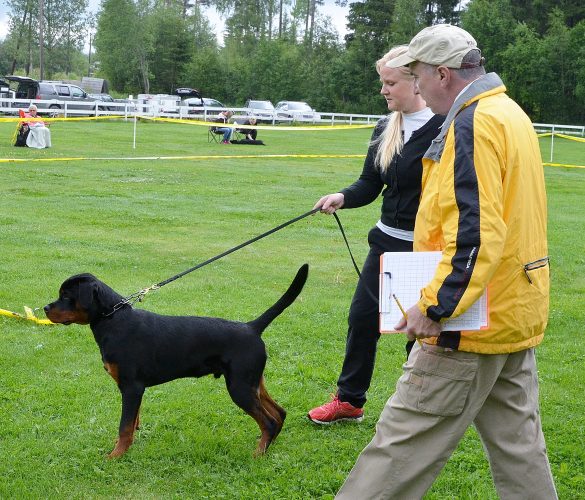
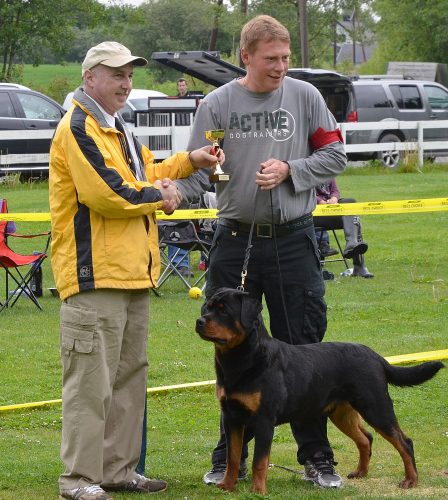
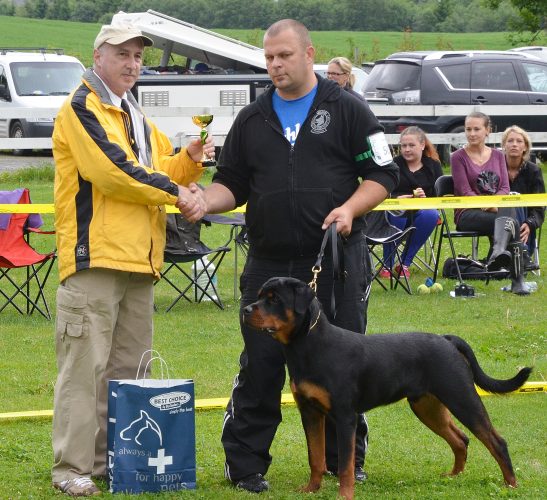
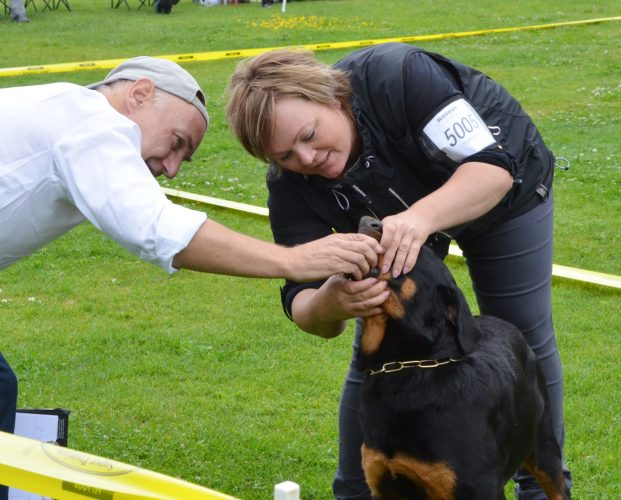
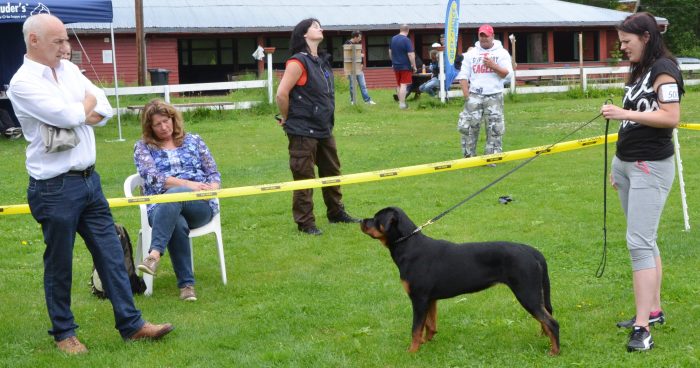
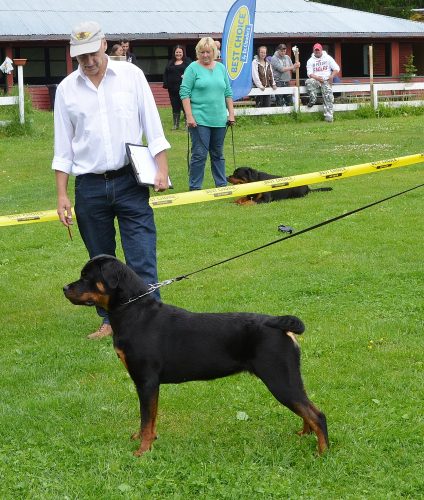
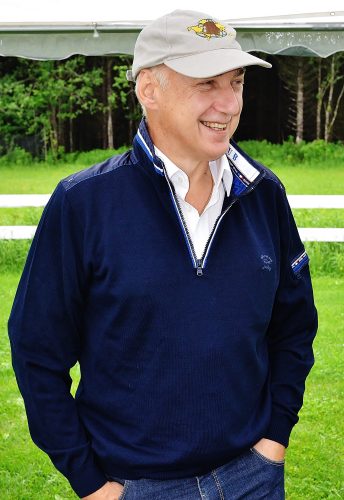
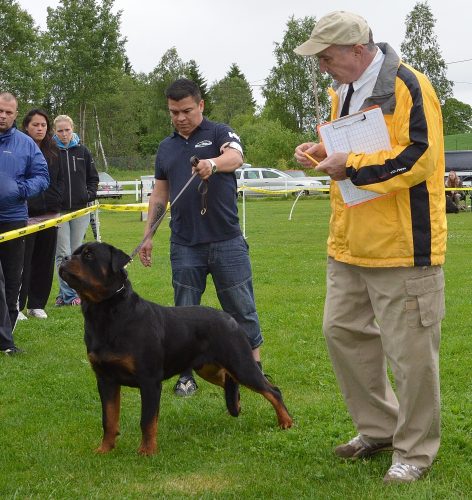
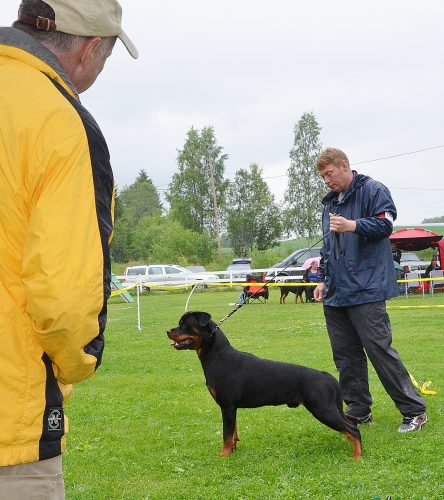
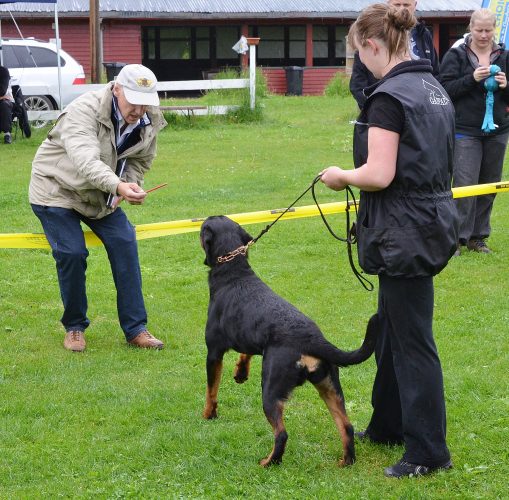
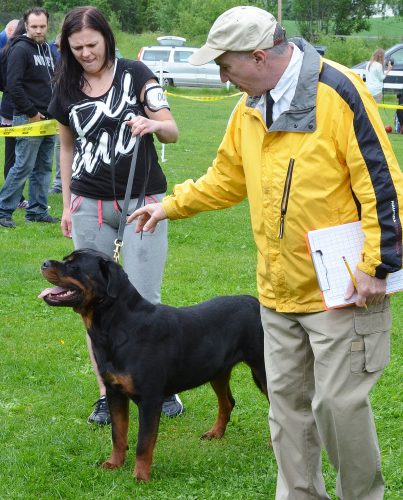
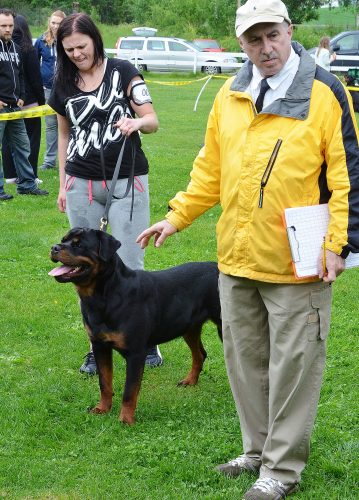

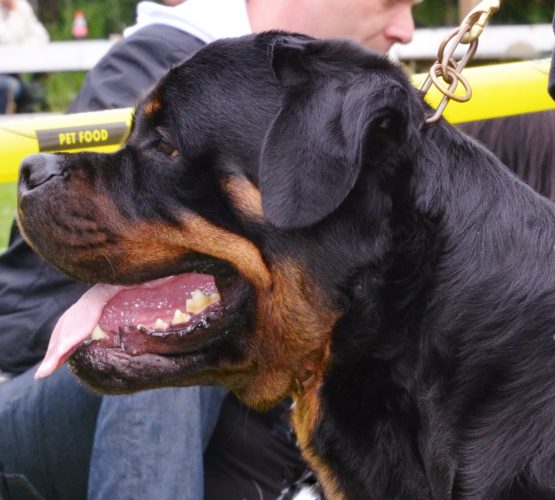
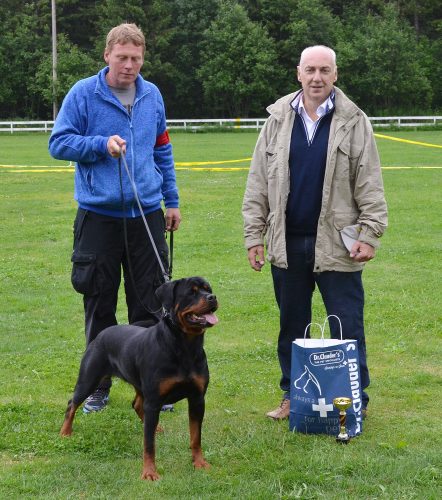
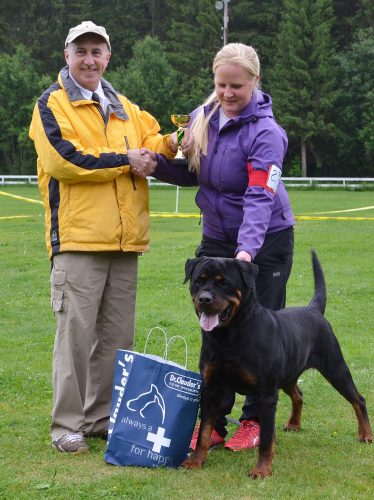


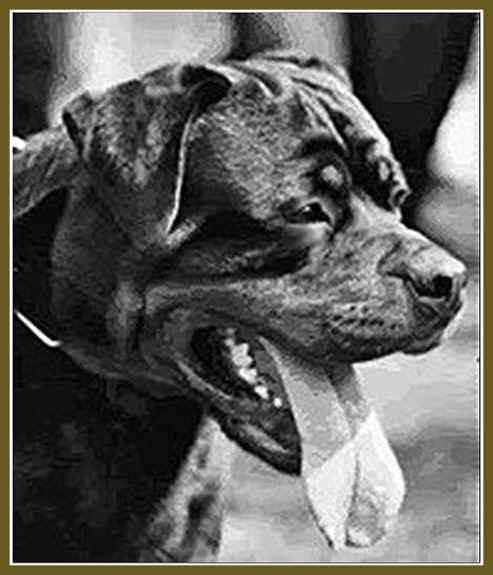
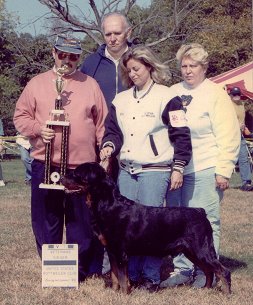

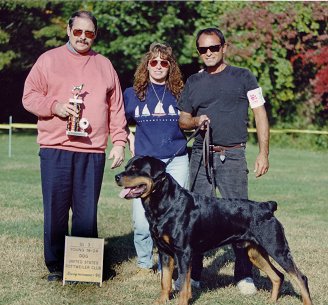
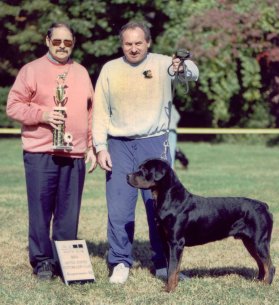
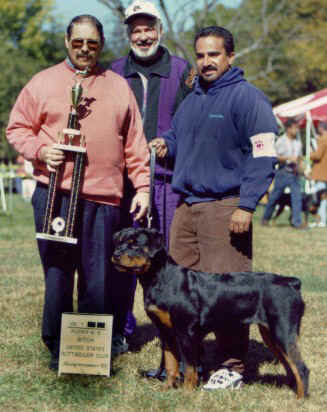
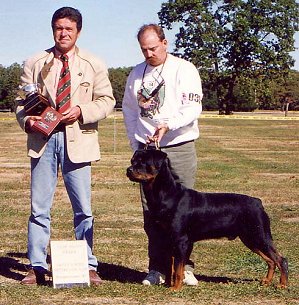


)